USAID DEC
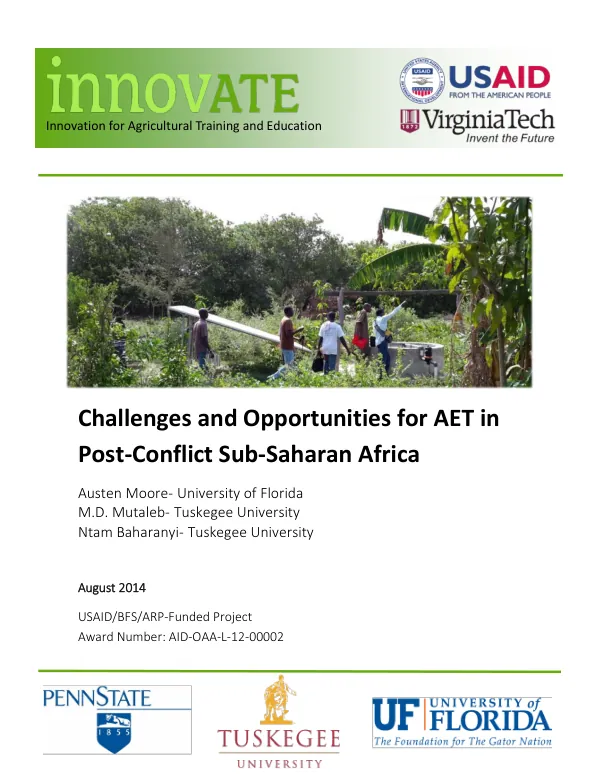
Innovation for Agricultural Training and Education: Challenges and Opportunities for AET in Post-Conflict Sub-Saharan Africa
Sign inFLORIDA INTERNATIONAL UNIVERSITY
Innovation for Agricultural Training and Education: Challenges and Opportunities for AET in Post-Conflict Sub-Saharan Africa
Agricultural development is a critical component of post-conflict rehabilitation in Sub-Saharan Africa.
2014 · 31 pages
Sign in to readA free account is required to download.
Abstract
The region's agricultural sector is central to poverty reduction, peacebuilding, and overall development. However, the sector faces significant challenges, including the need to contribute to peacebuilding and reintegration of youth in civilian society, curriculum limitations, and poor institutional capacity. In post-conflict environments, agricultural education and training (AET) systems must be adapted to address the unique needs of the region. AET systems contribute to the development of Sub-Saharan Africa and other regions, with tangible impacts in agriculture and other sectors at both national and local levels. Effective AET is a fundamental requirement for poverty reduction in the region, and its impacts are closely related to food security and hunger alleviation. The agricultural sector in Sub-Saharan Africa is heavily affected by conflict, with violent conflict leading to an average annual reduction of 12.3% in the sector's productivity. Smallholders suffer the most from disruption to agriculture during violent internal conflicts, and conflict also impacts food supplies and creates and/or exacerbates hunger. Post-conflict development requires multi-faceted strategies and attention to virtually all sectors to address the underlying conditions that create and are exacerbated by conflict. Agricultural education and training systems in post-conflict Sub-Saharan Africa face several challenges, including the need for institutional capacity building, improved collaboration and partnerships between AET providers, and enhanced linkages within agricultural sectors. Private AET providers have many benefits for governments, including lessening the financial burden on governments in post-conflict and least-developed countries, improving the coverage of and access to quality AET, and being more flexible to the needs of labor markets. Curriculum reform is also essential in post-conflict countries, with participatory curriculum development approaches and decentralization being key to successful reform. Teaching and learning in AET should also be more participatory, with greater participation in teaching helping to tailor instruction to the needs of learners and teaching students the participatory skills they will use in future interactions with agricultural stakeholders. Alternative and transitional education models, such as the Flexible Approach to Education (FAE) model, can be used in remote regions affected by conflict and without government-run schools. This model uses a flexible demand-driven curriculum, local community members as teachers, and operates within communally-owned land or buildings. Building upon successes of other systems in the region is also an important means of improving AET systems in post-conflict Sub-Saharan Africa, with lessons learned from successful AET schools and systems being beneficial to other AET systems and institutions in the region. Capacity building is required of all stakeholders within post-conflict AET systems in Sub-Saharan Africa, with many international agencies working in post-conflict countries including the improvement of governance and the development of governmental capacity in their mandates. This creates a unique opportunity to build the capacity of Sub-Saharan African AET systems, as expertise and funding from NGOs and multilateral donors is already available. Employment and workforce development are also critical components of AET systems in post-conflict Sub-Saharan Africa, with the sector employing about 60% of the workforce and being the largest source of livelihood in the region. Not only are the poor and hungry concentrated in agriculture, but nations dependent on agriculture house the majority of the world's poor and hungry.
Related documents