USAID DEC
Institutional Roles and Relationships Governing the Quality of Health Care: Country Experiences, Challenges, and Lessons Learned
Sign inABT ASSOCIATES
Institutional Roles and Relationships Governing the Quality of Health Care: Country Experiences, Challenges, and Lessons Learned
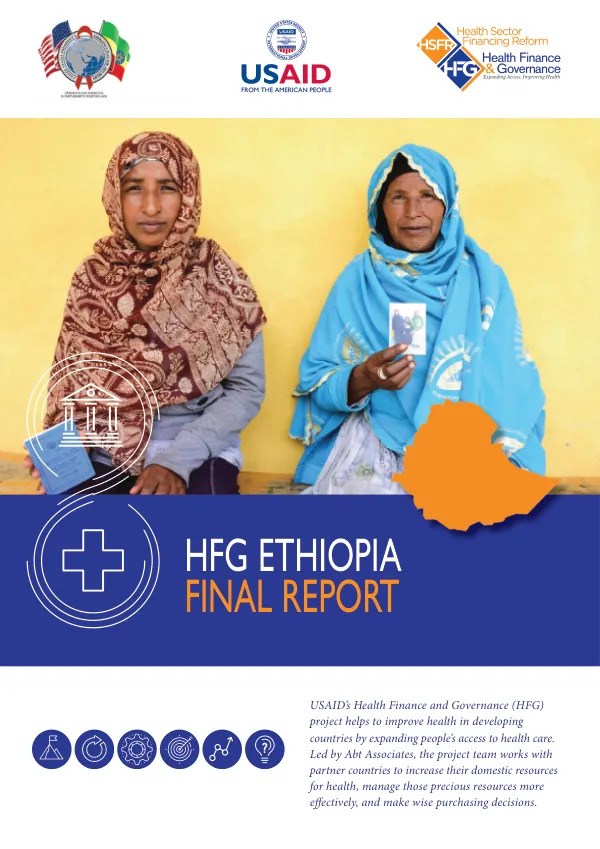
The Health Finance and Governance (HFG) Project, led by Abt Associates, aims to improve health in developing countries by expanding people's access to health care.
2016 · 60 pages
Sign in to readA free account is required to download.
Abstract
The five-year, $209 million global project is designed to increase the use of both primary and priority health services, including HIV/AIDS, tuberculosis, malaria, and reproductive health services. The project supports countries as they navigate economic transitions needed to achieve universal health care. The HFG project has several partners, including Avenir Health, Broad Branch Associates, Development Alternatives Inc., Johns Hopkins Bloomberg School of Public Health, Results for Development Institute (R4D), RTI International, and Training Resources Group, Inc. (TRG). The project's methodology involves a literature review, semi-structured interviews, and peer consultation to identify best practices in health system governance. The project's research findings highlight the importance of good health system governance in ensuring quality health services. The authors identify eight key principles, or "stones," for governing quality, including structural stones such as governing quality with strategies, policies, and other mechanisms, and process stones such as measuring and using data for quality improvement. The research also emphasizes the need for institutionalizing non-state involvement in pursuit of person-centered quality care, garnering political will to pursue quality, and addressing the knowledge gap of quality care at various levels. Additionally, the project highlights the importance of linking finance to quality and developing a quality improvement culture. Country experiences, challenges, and lessons learned are also presented in the report. The research findings are based on a literature review of existing research on health system governance, as well as semi-structured interviews with experts in the field. The report provides a comprehensive overview of the key principles and strategies for governing quality in health systems. The USAID Applying Science to Strengthen and Improve Systems (ASSIST) Project is a five-year cooperative agreement of the Office of Health Systems of the USAID Global Health Bureau designed to improve health and social services in USAID-assisted countries, strengthen their health systems, and advance the frontier of improvement science. The ASSIST project is a key partner in the HFG project, providing technical assistance and support to countries to improve their health systems. The report's methodology involves a literature review, semi-structured interviews, and peer consultation to identify best practices in health system governance. The research findings highlight the importance of good health system governance in ensuring quality health services and provide a comprehensive overview of the key principles and strategies for governing quality in health systems. The report concludes by emphasizing the need for continued support and investment in health system governance to ensure that countries can provide high-quality health services to their citizens. The report provides a valuable resource for policymakers, practitioners, and researchers working to improve health systems and ensure that people have access to quality health care.