COUNTER PART INTERNATIONAL
Integrated Marine Ecosystem Management in Northern Hispaniola Year 1 Annual Report
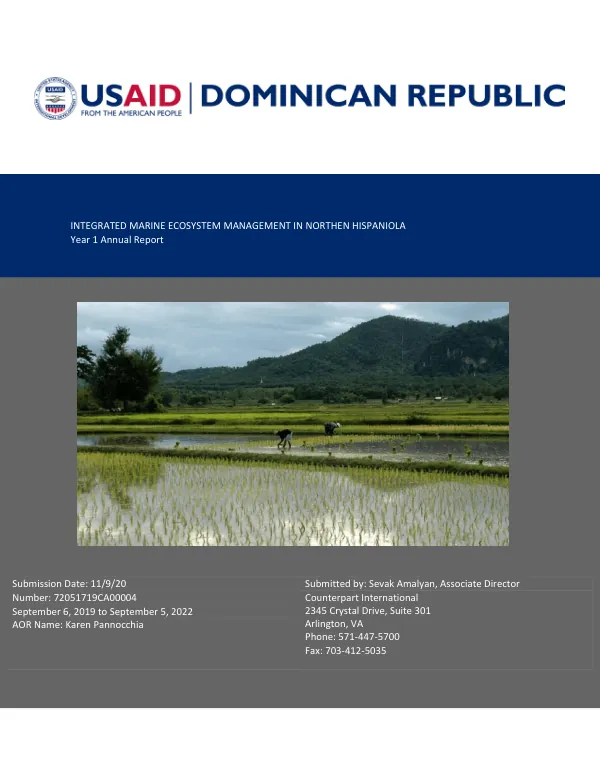
The Integrated Marine Ecosystem Management in Northern Hispaniola project preserves and promotes the livelihoods of farmers and fishers in Haiti and the Dominican Republic by improving ecosystem management across Marine Protected Areas and promoting sustainable practices in farming and fishing throughout Northern Hispaniola.
2020 · 29 pages
Sign in to readA free account is required to download.
Abstract
The project's main objective is to address the issues affecting the fish value chain and the management of Marine Protected Areas. The project established partnerships with two leading local organizations, AgroFronteras in the Dominican Republic and FoProBiM in Haiti, to implement activities across each of the project's program areas. The project identified and engaged with key stakeholders in the marine and sustainable rice value chains, and created governance councils in the four Marine Protected Areas. These councils are the key vector for addressing the issues affecting the fish value chain. The project conducted workshops with stakeholders to identify issues affecting the fish and sustainable rice value chains, and developed a program to build capacity for the governance councils. IMEM also began developing curricula to integrate teaching of natural resource management and ecosystem management in schools. The project identified the key principles for the curricula and developed modules for use in public schools in the Dominican Republic and Haiti. Throughout the first year of programming, the project successfully implemented a variety of activities across each of its program areas, achieving significant progress toward its objectives. The project established partnerships to support USAID's COVID-19 relief programming, and leveraged its local partners and their network to support the delivery of monthly food rations to 700 families. The project also demonstrated the greater profitability of sustainable rice compared to conventional rice, and the potential market success of sustainable rice is a powerful incentive for continued efforts in its favor. IMEM's work on a financing initiative for sustainable rice farmers connected rice farmers associations with financial institutions, and secured $200,000 in loans for 52 farmers to produce sustainably produced rice. The project's implementation of the Marine Monitoring and Enforcement Program across three Marine Protected Areas resulted in improved data collection processes and tools for CODOPESCA. The project also created environmental education modules for public schools in the Dominican Republic and Haiti, and developed a program to build capacity for the governance councils. The project's achievements in the first year demonstrate its ability to address the complex challenges facing the marine and sustainable rice value chains in Northern Hispaniola. The project's focus on building capacity for governance councils, improving data collection processes, and promoting sustainable practices in farming and fishing will continue to be essential in achieving its objectives. The project's work on a financing initiative for sustainable rice farmers has demonstrated the potential for sustainable rice production to succeed in the region. The project's certification as a Sustainable Rice Platform (SRP) connects it to sustainable rice projects worldwide, and will facilitate the sharing of best practices in sustainable rice production. The project's achievements in the first year have laid the foundation for continued progress toward its objectives. The project's focus on building capacity for governance councils, improving data collection processes, and promoting sustainable practices in farming and fishing will continue to be essential in achieving its objectives.