USAID DEC
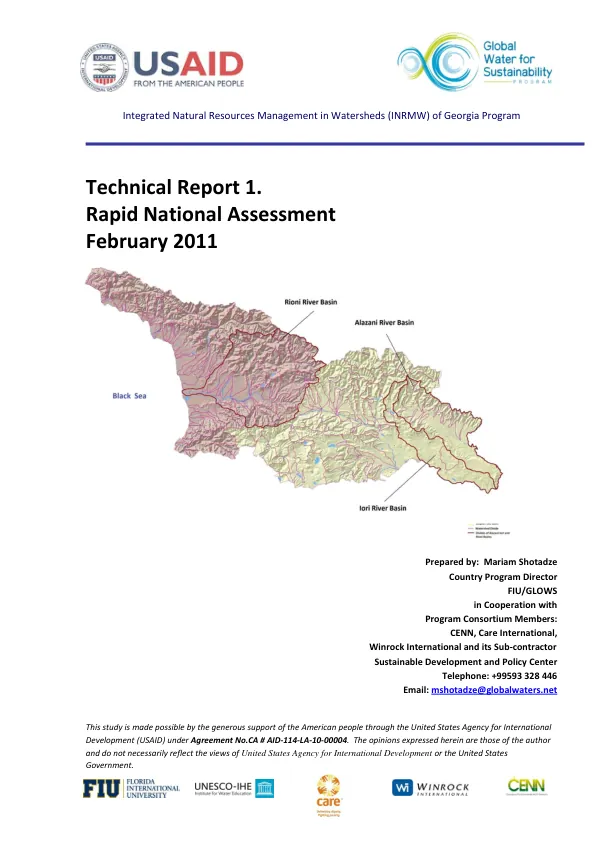
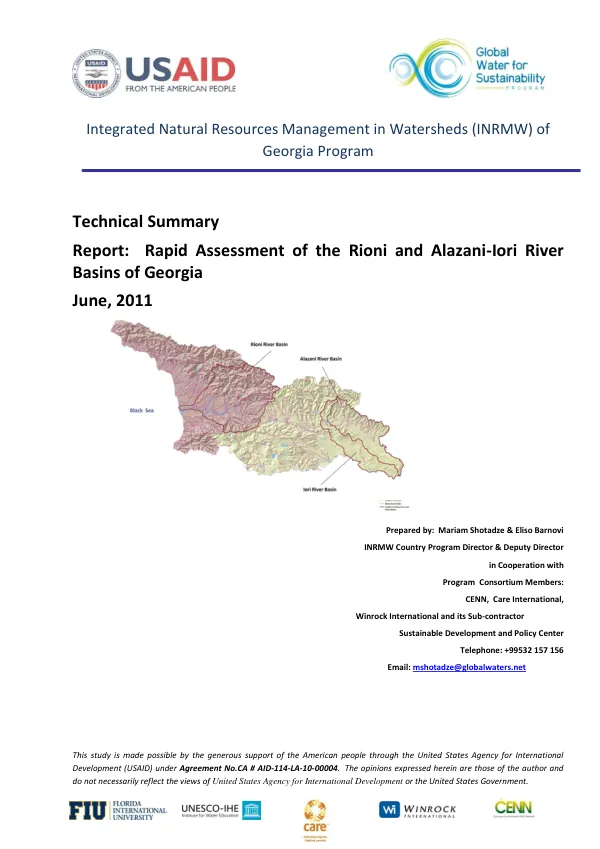
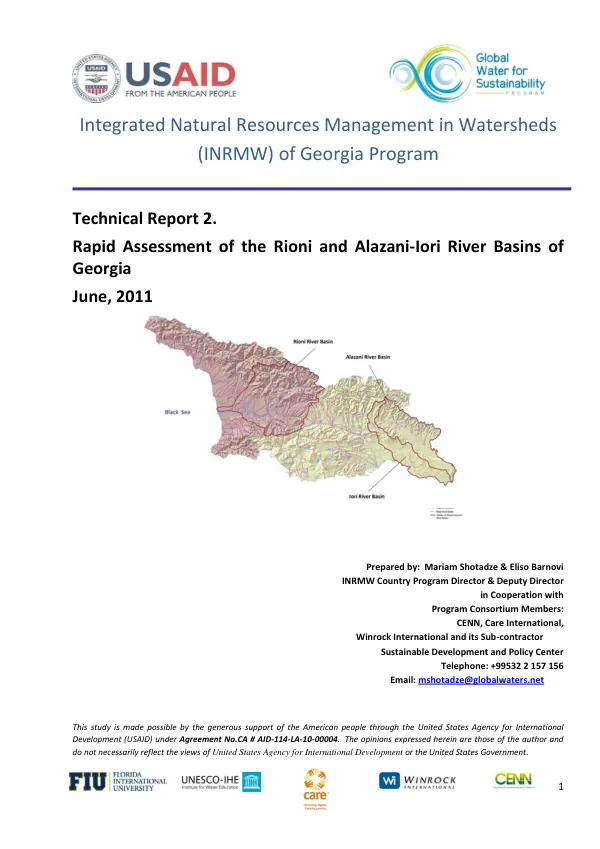
Integrated Natural Resources Management in Watersheds (INRMW) of Georgia Program: Rapid Assessment of the Rioni and Alazani-Iori River Basins of Georgia
Sign inCARE
Integrated Natural Resources Management in Watersheds (INRMW) of Georgia Program: Rapid Assessment of the Rioni and Alazani-Iori River Basins of Georgia
Integrated Natural Resources Management in Watersheds (INRMW) of Georgia Program Technical Report 2, Rapid Assessment of the Rioni and Alazani-Iori River Basins of Georgia, June 2011, was prepared by Mariam Shotadze and Eliso Barnovi, INRMW Country Program Director and Deputy Director, in cooperation with Program Consortium Members, CENN, Care International, Winrock International, and its Sub-contractor, Sustainable Development and Policy Center.
2011 · 274 pages
Sign in to readA free account is required to download.
Abstract
The Rioni and Alazani-Iori River Basins of Georgia are characterized by diverse physical-geographic and environmental conditions. The Rioni Basin is a mountainous region with a climate influenced by the Black Sea, while the Alazani-Iori Basin is a semi-arid region with a climate influenced by the Caspian Sea. The basins have unique geo-morphological, geological, and landscape features, including forests, land resources, mineral resources, energy resources, and hydrology. The socio-economic context of the basins is also diverse, with a range of demographic, economic, cultural, and infrastructure characteristics. The population of the basins is predominantly rural, with a high percentage of agricultural workers. The economy is primarily based on agriculture, with a significant portion of the population engaged in subsistence farming. The culture of the region is influenced by its history and geography, with a strong emphasis on traditional practices and customs. The institutional context of the basins is complex, with multiple levels of government and administrative structures. The regional governments, municipal authorities, and local territorial units of municipalities play important roles in managing natural resources and implementing policies. However, there are challenges related to coordination, communication, and resource allocation among these institutions. The rapid assessment identified several pressures and impacts on natural resources in the Rioni and Alazani-Iori River Basins. Water resources are under pressure due to climate change, population growth, and agricultural activities, leading to decreased water quality and quantity. Land resources are also under pressure due to deforestation, soil erosion, and land degradation, resulting in loss of biodiversity and ecosystem functions. The utilization of local energy resources is limited, and there are linkages between resource uses and ecosystem functions that need to be addressed. The conclusions and recommendations of the rapid assessment highlight the need for integrated natural resources management in the Rioni and Alazani-Iori River Basins. The report recommends the development of a comprehensive management plan that takes into account the physical-geographic, environmental, and socio-economic characteristics of the basins. It also emphasizes the importance of strengthening institutional capacity, improving coordination and communication among stakeholders, and promoting sustainable practices and technologies. The report provides a detailed analysis of the Rioni and Alazani-Iori River Basins, highlighting the challenges and opportunities for integrated natural resources management. It serves as a valuable resource for policymakers, practitioners, and stakeholders working to protect and conserve the natural resources of the region.