ACTION AGAINST HUNGER
Integrated Nutrition and Retrospective Mortality Survey
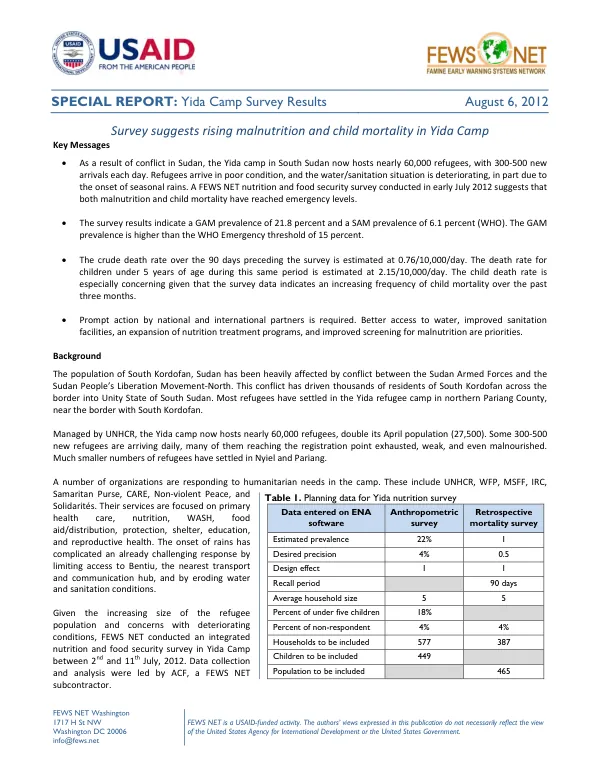
The Integrated Nutrition and Retrospective Mortality Survey was conducted in Yida Refugee Camp, Unity State, South Sudan, as part of the Famine Early Warning Systems Network (FEWS NET) III activity.
2012 · 50 pages
Sign in to readA free account is required to download.
Abstract
The survey aimed to assess the nutritional status of the refugee population and retrospectively measure mortality rates. The survey was conducted by Action Against Hunger (ACF), a FEWS NET implementation team member, with funding provided by the United States Agency for International Development (USAID). The survey targeted the general population of Yida Refugee Camp, with a focus on children under the age of 5. The survey team collected data on anthropometric measurements, including weight-for-height z-scores and mid-upper arm circumference (MUAC), as well as retrospective mortality rates. The team also collected contextual information, such as the time of arrival in the camp, state and county of origin, and travel period and reasons for leaving the place of origin. The survey results showed a high prevalence of acute malnutrition among children under 5, with 34.6% of the sample population experiencing severe acute malnutrition. The prevalence of acute malnutrition was highest among children aged 6-23 months, with 41.4% experiencing severe acute malnutrition. The survey also found that the prevalence of acute malnutrition was significantly higher among children who arrived in the camp during the dry season, with 44.1% experiencing severe acute malnutrition. The retrospective mortality survey revealed a high mortality rate among children under 5, with a mortality rate of 2.3 deaths per 10,000 population per day. The mortality rate was highest among children aged 6-11 months, with a mortality rate of 3.5 deaths per 10,000 population per day. The survey also found that the mortality rate was significantly higher among children who arrived in the camp during the dry season, with a mortality rate of 2.9 deaths per 10,000 population per day. The survey also collected data on food security and livelihoods, including the Food Consumption Score (FCS) and infant and young child care practices. The results showed that the FCS was low among the survey population, with 71.4% of the sample population experiencing a low FCS. The survey also found that the prevalence of timely initiation of breastfeeding was low, with 44.1% of the sample population experiencing delayed initiation of breastfeeding. The survey results highlight the need for urgent action to address the nutritional and health needs of the refugee population in Yida Refugee Camp. The findings suggest that the camp's population is experiencing high levels of acute malnutrition and mortality, particularly among children under 5. The survey also highlights the need for improved food security and livelihoods, as well as enhanced infant and young child care practices, to address the nutritional needs of the refugee population.
Related documents