USAID. BUR. FOR LATIN AMERICA AND THE CARIBBEAN. REGIONAL HOUSING AND URBAN DEVELOPMENT OFC.
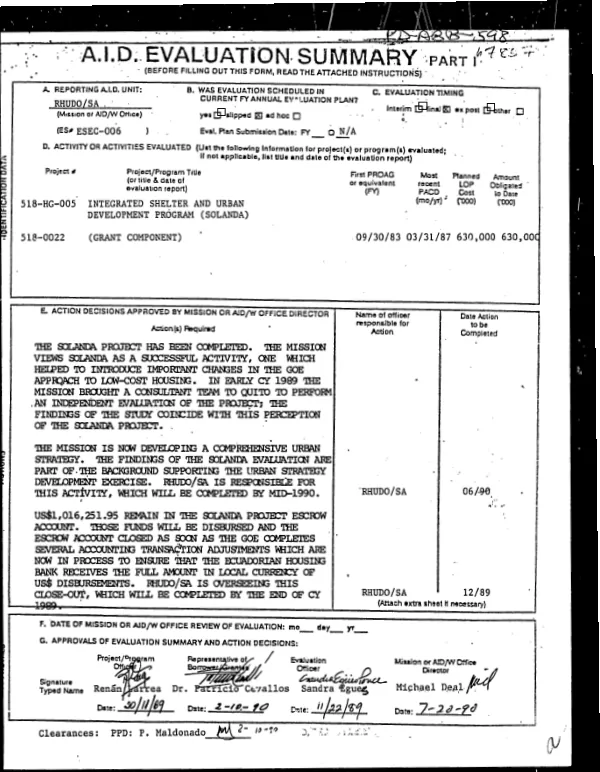
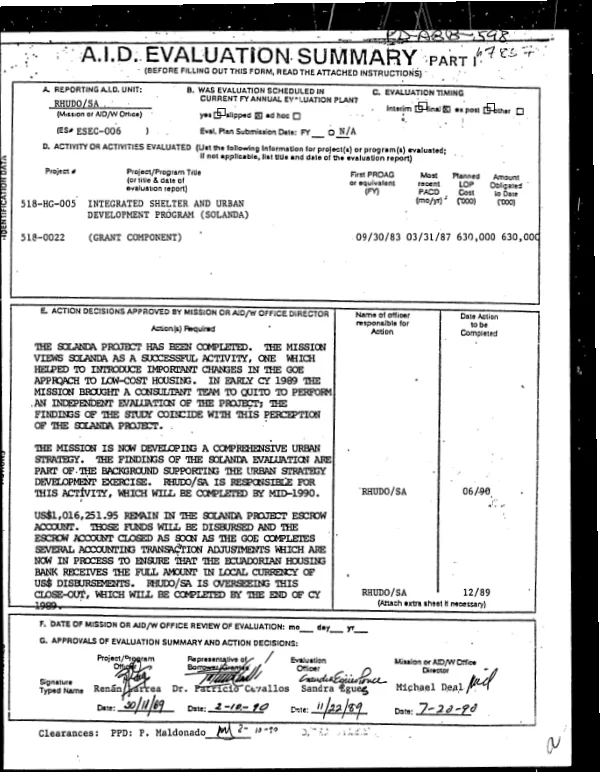
Integrated shelter and urban development program (Solanda) -- grant component
Summarizes final evaluation (XD-ABB-598-A) of a project to construct a model public housing project in Quito, Ecuador.
1990
Sign in to readA free account is required to download.
Abstract
The evaluation covered the period 9/83-3/87. The project was very successful in introducing changes in the Government of Ecuador"s (GOE) approach to low-cost housing for urban families, and a large majority of units under production are now destined for low-income families. Lower standards for unit design and infrastructure were accepted by the municipality of Quito, which reduced housing costs. As a result, a total of 5,746 units were constructed, exceeding the original target by 28%. All of the units have basic water and sewer services and sanitary fixtures. In order to reach lower income families, the GOE adopted a graduated payment plan, introduced signature loans for home improvements, brought interest rates closer to market rates, allowed for application processing and preliminary underwriting by nonprofit organizations, and instituted a computerized process for selecting beneficiaries, nearly all of whom were below the median income level. In addition, the use of home improvement loans to support housing unit development and consolidation by individual families was pioneered in this project. A survey indicated that 62% of families have already begun or completed expansion of their units and nearly 70% have received home improvement loans. On the negative side, the project, which was publicly sponsored, achieved a low level of community development in comparison to an informal settlement called Lucha de los Pobres. The Lucha cooperative placed community development first and lobbied successfully for government provision of physical and social infrastructure, whereas the project, which considered community development a post-construction activity, constructed only a small portion of infrastructure, and activities such as job creation and training and small industry credit were planned but never carried out. As a result, many project families did not receive what they wanted. The project teaches three lessons. (1) Problems should be resolved at the lowest level, which for housing would normally be at the community or project level, while in the case of water and other services, it might be the municipal or provincial level. (2) An improved appreciation of families own abilities to design and construct their own houses could have accelerated the process and saved waste when original units were modified after families moved in. (3) Inadequate coordination among the many organizations involved in the project caused needless delays.
Related documents