MINISTRY OF HEALTH
Integrated Systems Strengthening for CHW Programming
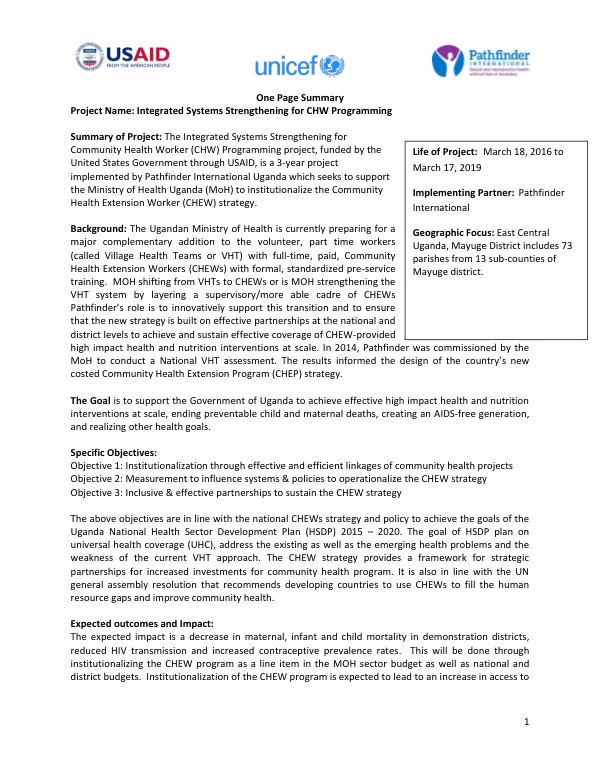
The Integrated Systems Strengthening for Community Health Worker (CHW) Programming project is a 3-year initiative implemented by Pathfinder International Uganda, funded by the United States Government through USAID.
2016 · 9 pages
Sign in to readA free account is required to download.
Abstract
The project aims to support the Ministry of Health Uganda (MoH) in institutionalizing the Community Health Extension Worker (CHEW) strategy. The CHEW strategy involves the introduction of full-time, paid, and formally trained community health workers to complement the existing Village Health Teams (VHTs). The project's background is rooted in the Ugandan Ministry of Health's preparation to transition from VHTs to CHEWs, with a focus on formal, standardized pre-service training. Pathfinder International was commissioned by the MoH to conduct a National VHT assessment in 2014, which informed the design of the country's new costed Community Health Extension Program (CHEP) strategy. The project's goal is to support the Government of Uganda in achieving effective high-impact health and nutrition interventions at scale, ending preventable child and maternal deaths, and creating an AIDS-free generation. The project has three specific objectives: institutionalization through effective and efficient linkages of community health projects, measurement to influence systems and policies to operationalize the CHEW strategy, and inclusive and effective partnerships to sustain the CHEW strategy. These objectives align with the national CHEWs strategy and policy to achieve the goals of the Uganda National Health Sector Development Plan (HSDP) 2015-2020, which focuses on universal health coverage (UHC) and addressing existing and emerging health problems. The expected outcomes and impact of the project include a decrease in maternal, infant, and child mortality in demonstration districts, reduced HIV transmission, and increased contraceptive prevalence rates. The project aims to institutionalize the CHEW program as a line item in the MoH sector budget and national and district budgets, leading to increased access to high-impact health and nutrition interventions provided by CHEWs in demonstration districts. In the first year of the project, Pathfinder International has made notable achievements in drawing attention and support from the Ugandan Government to implement a revised community health worker strategy. The project has coordinated government and other stakeholders to rally support and manage needs, provided technical input with health development partners and the Ministry of Health to develop training materials, and worked with the Ministry of Health to create a TOR and constitute a National CHEW Coordination Committee (NCCC). The NCCC has met seven times during the reporting period to deliberate on policy and strategic direction for the CHEWs program. Pathfinder has also led and facilitated intergovernmental consultations with Ministries of Public Service and Finance, focusing on reviewing the CHEW policy and strategy. The results of the consultation have highlighted areas that need improvement or clarity within the CHEW policy. In addition, Pathfinder has developed draft CHEW training materials, including the CHEW curriculum, trainer's manual, job aides, students' guide, and standard operating procedures (SOPs). The materials have undergone a meticulous consultative process with key stakeholders, including the Ministry of Education. Pathfinder is currently negotiating with WHO and UNICEF for budget for printing the materials, which will be done in year 2. The project has also worked with the NCCC to develop accreditation guidelines that will facilitate the selection and accreditation of training institutions for the CHEWs. Pathfinder has worked with the USAID Mission in Uganda to mobilize financial resources from IntraHealth for accreditation of CHEWs' training sites. Training of CHEWs is projected to commence as soon as the revisions in the strategy are approved by MoH top management, with an expected target of starting with at least 10% of the 15,000 CHEWs to be trained. The project has also conducted a study to assess Mayuge district programmatic readiness to implement the CHEW strategy. The study found that there is a need to strengthen the whole community health system at the district level to enable CHEW functionality. The study targeted the Mayuge District Health Management Team and used a FGD approach for data collection, with findings indicating a need to strengthen community-level service delivery, health workforce, health information systems, medical equipment and vaccines, health financing, governance and supervision, and general awareness of the CHEW program.