KPMG
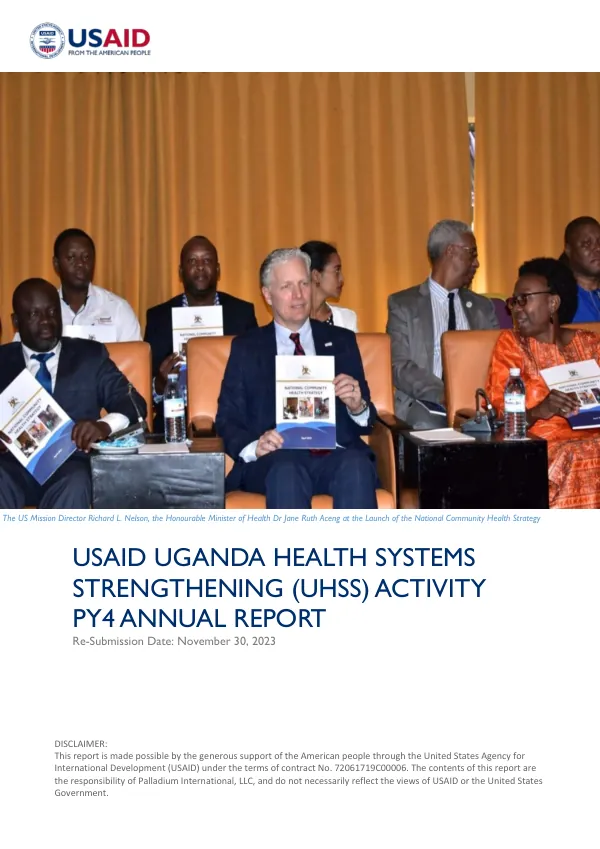
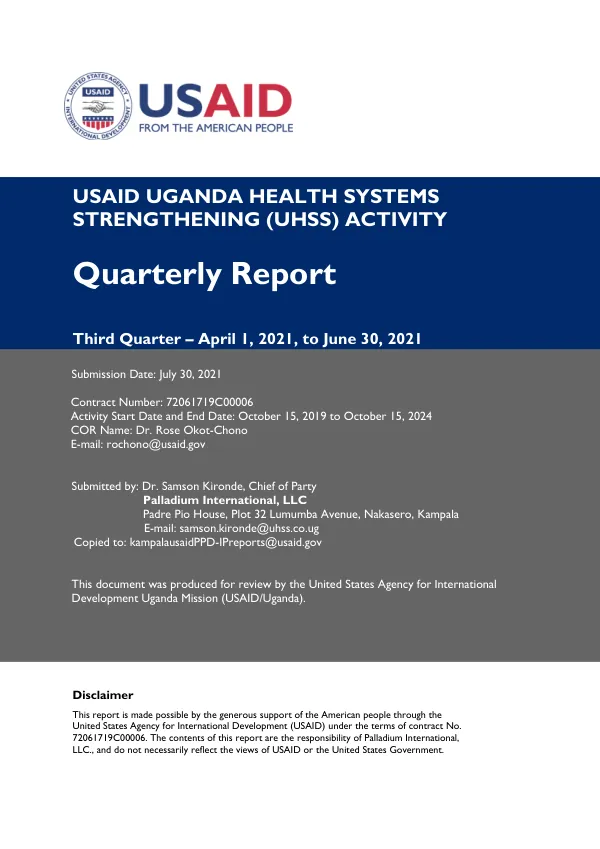
USAID Uganda Health Systems Strengthening (UHSS) Activity Quarterly Report
The USAID Uganda Health Systems Strengthening (UHSS) Activity is a five-year project aimed at improving the health systems in Uganda.
2021 · 53 pages
Sign in to readA free account is required to download.
Abstract
The project focuses on four main results: Improved Governance Leadership and Accountability (GLA), Increased Availability and Improved Management of Key Health Resources, Strengthened Community Systems for Quality Health Services, and Enhanced Health Financing. The project is implemented by Palladium International, LLC, in partnership with several sub-awardees, including BRAC Uganda, Civil Society Advocacy Group (CSAG), Infectious Disease Institute (IDI), KPMG, Panagroup, and Makerere University School of Public Health. The project is supported by the USAID Uganda Mission and has a total budget of $72061719C00006. The project operates in 77 districts in five regions of Uganda, with a focus on improving health services, increasing access to healthcare, and enhancing the capacity of health systems. The project also works with various stakeholders, including the Ministry of Health, Ministry of Local Government, Ministry of Finance, Planning and Economic Development, and District Local Governments. The project has made significant progress in the first two years, with notable achievements including the establishment of a Community Health Extension Workers (CHEWs) program, the implementation of a Health Financing Harmonization and Harmonization Plan (HFHTP), and the development of a District Costed Strategic Plan (DCSP). The project has also made progress in improving health services, with a 27% increase in the number of community health workers and a 25% increase in the number of health facilities with functional health management information systems. Additionally, the project has supported the development of a National Health Insurance Scheme (NHIS) and has worked with the Ministry of Health to develop a National Health Policy III (NHP III). The project has also made significant progress in strengthening community systems, with a 30% increase in the number of community health workers and a 25% increase in the number of health facilities with functional health management information systems. The project has also supported the development of a Community Health Management Information System (CHMIS) and has worked with the Ministry of Health to develop a National Health Strategy (NHS). The project has also made progress in improving health financing, with a 25% increase in the number of health facilities with functional health management information systems and a 20% increase in the number of community health workers. The project has also supported the development of a Health Financing Harmonization and Harmonization Plan (HFHTP) and has worked with the Ministry of Health to develop a National Health Insurance Scheme (NHIS). The project has also made significant progress in improving health outcomes, with a 25% increase in the number of community health workers and a 20% increase in the number of health facilities with functional health management information systems. The project has also supported the development of a National Health Strategy (NHS) and has worked with the Ministry of Health to develop a National Health Policy III (NHP III). The