RTI INTERNATIONAL
Interfaith Network for Maternal and Newborn Care and Advocacy
The Interfaith Network, a collaboration between Muhammadiyah and other faith-based organizations, aims to improve maternal and newborn care and advocacy in Indonesia.
2015 · 6 pages
Sign in to readA free account is required to download.
Abstract
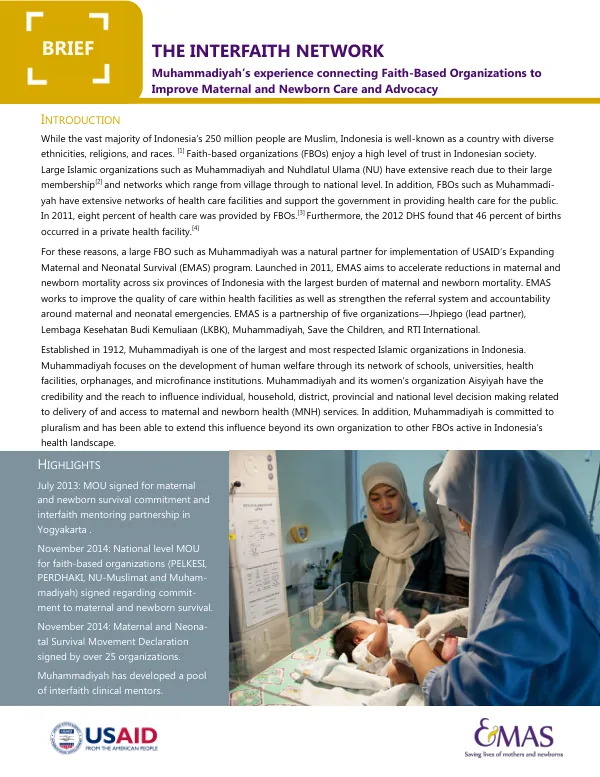
Established in 1912, Muhammadiyah is one of the largest and most respected Islamic organizations in Indonesia, with a network of schools, universities, health facilities, orphanages, and microfinance institutions. The organization has a strong commitment to pluralism and has been able to extend its influence beyond its own organization to other faith-based organizations active in Indonesia's health landscape. Muhammadiyah's experience in connecting faith-based organizations to improve maternal and newborn care and advocacy began in 2011, when it partnered with USAID's Expanding Maternal and Neonatal Survival (EMAS) program. The EMAS program aims to accelerate reductions in maternal and newborn mortality across six provinces of Indonesia with the largest burden of maternal and newborn mortality. Muhammadiyah works across the three objectives of EMAS: improved quality of emergency maternal and newborn health services, increased efficiency and effectiveness of referral systems, and strengthened accountability within government, the community, and the health system for supportive policies and resource management. Muhammadiyah has developed a pool of interfaith clinical mentors who have mentored influential Muhammadiyah hospitals in other areas to improve maternal and newborn emergency care. These clinical mentors have also expanded mentoring to other faith-based organizations and facilities. Additionally, Muhammadiyah has led the development of Civic Forums, which link government, facilities, and civil society; expand public participation in maternal and newborn health; and serve as a monitoring body for the quality of maternal and newborn health services. Civic Forums have been established at sub-district/village and district levels to increase action and advocacy on relevant issues. Muhammadiyah has also engaged other faith-based organizations in maternal and newborn health through its strong networks and credibility. For example, in 1970, Muhammadiyah was one of the founders of an interfaith forum on public health called the Forum Komunikasi Pengembangan Kesehatan Masyarakat Indonesia (FKPKMI). The FKPKMI comprises Muslimat NU, Persatuan Dharma Karya Kesehatan Indonesia (PERDHAKI), and Persekutuan Pelayanan Kristen Untuk Kesehatan di Indonesia (PELKESI). Muhammadiyah used its strong networks and credibility to pave the way for interfaith facilities to utilize mentoring to improve quality of maternal and newborn emergency care. On July 31, 2013, a cooperation agreement (MOU) was signed between Yayasan Kristen Untuk Kesehatan Umum (YAKKUM), Badan Pengus Harian Rumah Sakit Pembina Kesehatan Umum Yogyakarta (Management Board RS PKU Muhammadiyah Yogyakarta), and Yayasan Panti Raphi (Panti Raphi Foundation), a Catholic Hospital in Yogyakarta. This MOU formalized the interfaith organizations' commitment to prioritize maternal and newborn survival, as well as the partnership between the faith-based hospitals to strengthen the quality of health services through mentoring and increase advocacy. The MOU was signed by the organizations' provincial representatives and owners of the faith-based hospitals, and covered four hospitals in Yogyakarta. The parties jointly declared that the high rate of maternal and newborn mortality is a universal human phenomenon that needs to be addressed because it is contrary to the values of humanity. They agreed to enter into a partnership with the following conditions: strengthening maternal and neonatal health services, advocacy policy, and community support mechanism. The parties agreed to jointly develop synergies and quality in providing health services for maternal and newborn babies, conduct public policy advocacy at various levels, and develop public support mechanisms for society endorsement in an effort to sustainably develop service activities and public health services.