USAID DEC
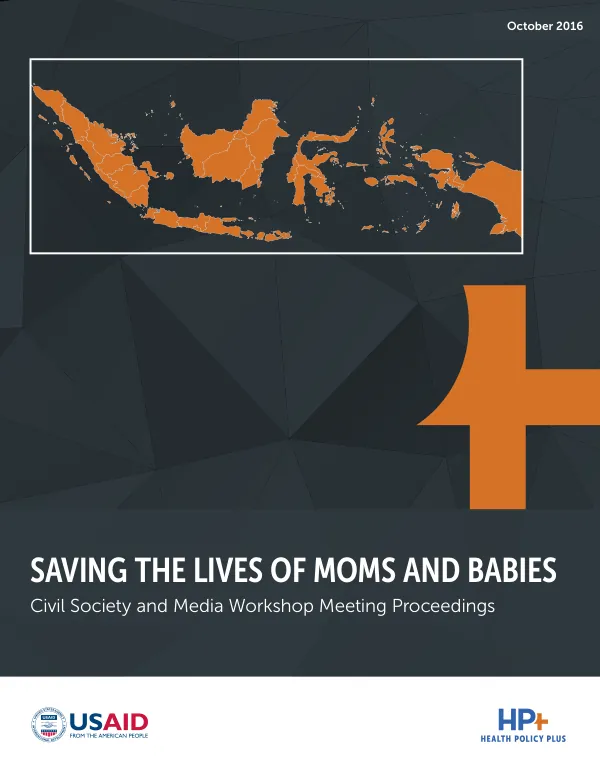
Saving the Lives of Moms and Babies: Civil Society and Media Workshop Meeting Proceedings
Sign inPALLADIUM INTERNATIONAL, LLC
Saving the Lives of Moms and Babies: Civil Society and Media Workshop Meeting Proceedings
Maternal and Newborn Health in Indonesia has remained stagnant over the past two decades, with the country's position being better than Cambodia and Laos but worse than the remainder of Association of Southeast Asian Nations (ASEAN) members.
2016 · 14 pages
Sign in to readA free account is required to download.
Abstract
If the issue is left unaddressed, Indonesia may become the country with the highest maternal mortality rate. The majority of maternal deaths in Indonesia occur in five provinces: West Java, Central Java, East Java, Banten, and North Sumatra. These provinces should be prioritized to maximize impact. Despite increases in facility deliveries in recent years, maternal deaths remain high, raising concerns about the quality of care. The continuum of care framework could represent a tool to identify bottlenecks in the system that contribute to maternal and newborn deaths. Accurate data is necessary to assess these root causes. Civil society and the media play a significant role in elevating Maternal and Newborn Health as a critical issue and driving solutions. The Health Policy Plus project conducted an assessment of civil society and media engagement in Indonesia, involving interviews with 193 civil society organizations, academic, and media firms. The assessment found that civil society, media, and citizens have not internalized Maternal and Newborn Health as a human rights issue. There is insufficient information and data defining the problem, and few partnerships and collaborations among key actors aim to improve Maternal and Newborn Health. Incentives are lacking to drive active and sustained engagement in Maternal and Newborn Health. To address this, a social movement around Maternal and Newborn Health is necessary. The first step in igniting this movement is the internalization of the issue by all stakeholders. Proposed actions include generating and packaging data in a form that can be easily digested, and developing a consistent and accepted framing of the issue, including an aligned communication strategy and slogans. Alignment of civil society, government, the media, researchers, and the private sector is required to elevate the issue. Proposed actions include establishing a national network of civil society organizations, media outlets, and academic partners working on Maternal and Newborn Health, and coordinating advocacy efforts that engage various government leaders in dialogue. Communication and coordination among organizations is critical for an effective advocacy campaign, and engaging key decisionmakers and healthcare providers is essential. A maternal and newborn health movement will require financial resources for all actors to engage and increase policy advocacy work around the issue. The Health Policy Plus project held a workshop for civil society and the media in September 2016 to validate the assessment findings and define the type of support each actor will need to offer within the context of a maternal and newborn health movement. The workshop proceedings highlighted the importance of partnerships among civil society, media, and the private sector to address maternal and newborn mortality in Indonesia. The Health Office Director of USAID/Indonesia emphasized the importance of maternal and newborn health to the agency and the need for new and strong partnerships to collectively address this issue. He noted the critical role of civil society, media organizations, and academic institutions in monitoring performance and service quality, especially as the national health insurance scheme, JKN, opens doors to private sector engagement in health. The director urged participants to engage and brainstorm new ways for civil society, media, and academic institutions to contribute to maternal and newborn health, and looked forward to discussing the nature of USAID support to the process. The workshop proceedings also highlighted the need to make a case for maternal and newborn health in Indonesia. The presentation defined the issue and made the case to elevate its priority in the country. Key takeaways from the presentation included the following: maternal and newborn deaths in Indonesia have remained stagnant over the past two decades; among ASEAN members, Indonesia's position is better than Cambodia and Laos but worse than the remainder of members; half of Indonesia's maternal deaths occur in only five provinces; and despite increases in facility deliveries, maternal deaths remain high, raising concerns about the quality of care. The workshop proceedings also emphasized the importance of partnerships among civil society, media, and the private sector to address maternal and newborn mortality in Indonesia. The Health Policy Plus project held a workshop for civil society and the media in September 2016 to validate the assessment findings and define the type of support each actor will need to offer within the context of a maternal and newborn health movement. The workshop proceedings highlighted the need to make a case for maternal and newborn health in Indonesia and the importance of partnerships among civil society, media, and the private sector to address this issue.