USAID DEC
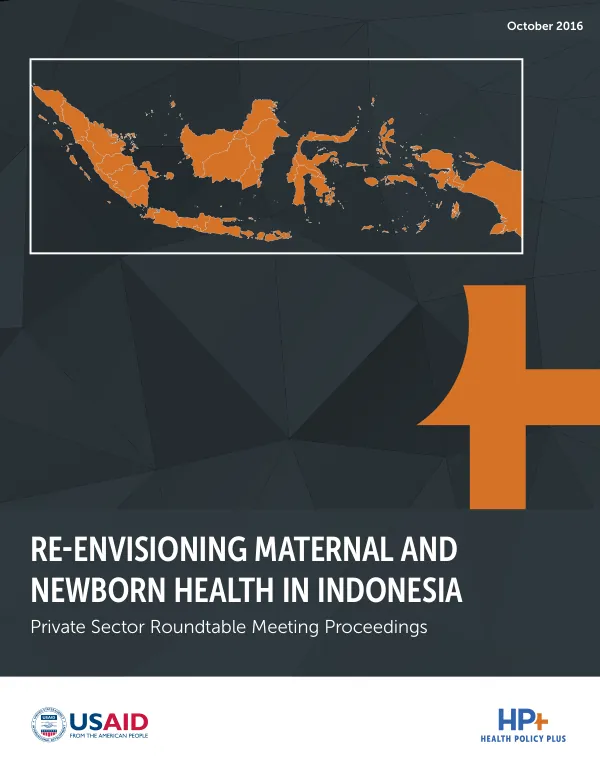
Re-envisioning Maternal and Newborn Health in Indonesia: Private Sector Roundtable Meeting Proceedings
Sign inAVENIR HEALTH
Re-envisioning Maternal and Newborn Health in Indonesia: Private Sector Roundtable Meeting Proceedings
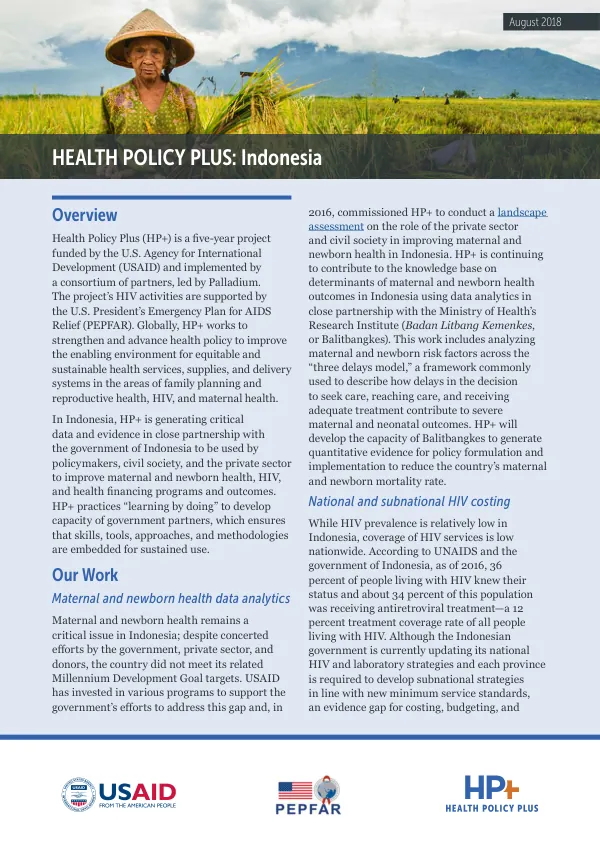
The private sector's role in addressing maternal and newborn health (MNH) challenges in Indonesia was a key focus of a roundtable discussion hosted by the Health Policy Plus project (HP+) in Jakarta in September 2016.
2016 · 14 pages
Sign in to readA free account is required to download.
Abstract
The discussion aimed to foster dialogue between private sector and government representatives on how private solutions can address MNH challenges in Indonesia. Indonesia experiences a high number of maternal and newborn deaths, with almost 15,000 maternal deaths and 90,000 newborn deaths occurring annually. The country failed to meet its Millennium Development Goals on these two indicators and is struggling to catch up to its regional peers. The government's national health insurance scheme (JKN) aims to enroll all citizens by 2019, creating a powerful incentive for private sector engagement. HP+ presented key findings from a private sector landscape assessment, highlighting market-based opportunities to address MNH in Indonesia. The private sector is becoming increasingly relevant to service delivery, with healthcare utilization shifting toward private sector clinics, particularly in the context of assisted deliveries and maternal and child health services. JKN has led to a large increase in the number of private hospitals and clinics, and the private healthcare market is expected to triple in size from US$7 billion in 2014 to US$21 billion in 2019. The HP+ study team identified five key private sector opportunities to address MNH: scaling up successful private health facilities, developing transportation solutions to improve referral, developing technology solutions for improving service delivery, improving private midwifery training institutes, and tailoring financial products for maternal and newborn health. Roundtable participants agreed that the private sector can play an important role in reducing maternal and newborn mortality in Indonesia. Government representatives recognized the need to engage the private sector to improve health outcomes, particularly in remote areas where private midwives play a critical role. Private businesses operating in remote areas expressed a desire to ensure employee access to high-quality healthcare, while private companies not involved in healthcare but operating in remote areas face difficulties in accessing healthcare for their workers and neighboring communities. Private sector engagement goes beyond corporate social responsibility, and participants agreed on the need to change the perception that the private sector cannot recover costs by working in the healthcare business. Profit drives private sector interests, but private sector players are not necessarily only interested in profit maximization. Regulatory barriers to private sector engagement with MNH were also discussed, with healthcare being a very attractive market for investment despite inconsistent regulation. Private investors face challenges in engaging with the healthcare sector due to regulatory inconsistencies, which make it difficult to recover costs. The shares for hospital groups on the Jakarta stock market are trading at approximately triple the value of the average stock, indicating the potential for investment in the healthcare sector. The roundtable discussion highlighted the need for USAID to catalyze the private financial sector and private businesses to improve MNH outcomes while achieving financial returns. The discussion outcomes emphasized the importance of private sector engagement in addressing MNH challenges in Indonesia and the need to change the perception that the private sector cannot recover costs by working in the healthcare business.