U.S. DEPARTMENT OF STATE/OES
International Criminal Investigative Training Assistance Program (ICITAP)
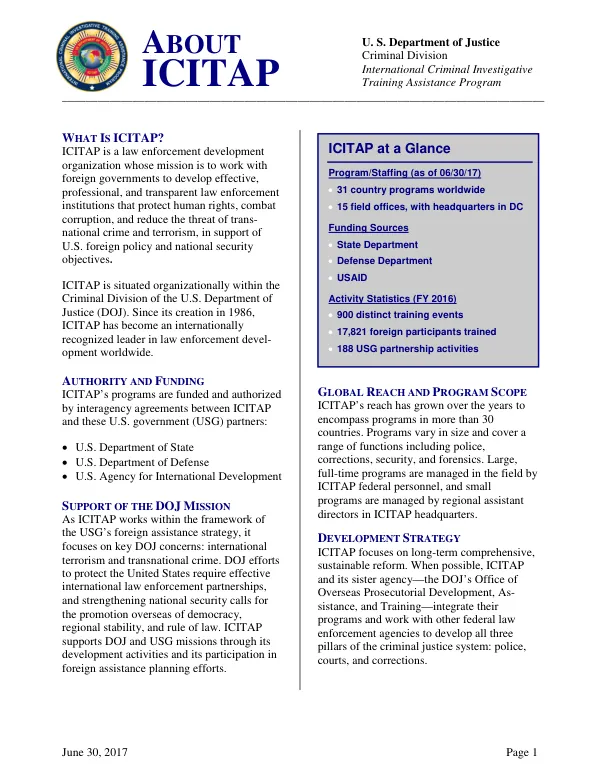
International Criminal Investigative Training Assistance Program (ICITAP) is a law enforcement development organization that works with foreign governments to develop effective, professional, and transparent law enforcement capacity.
2009 · 2 pages
Sign in to readA free account is required to download.
Abstract
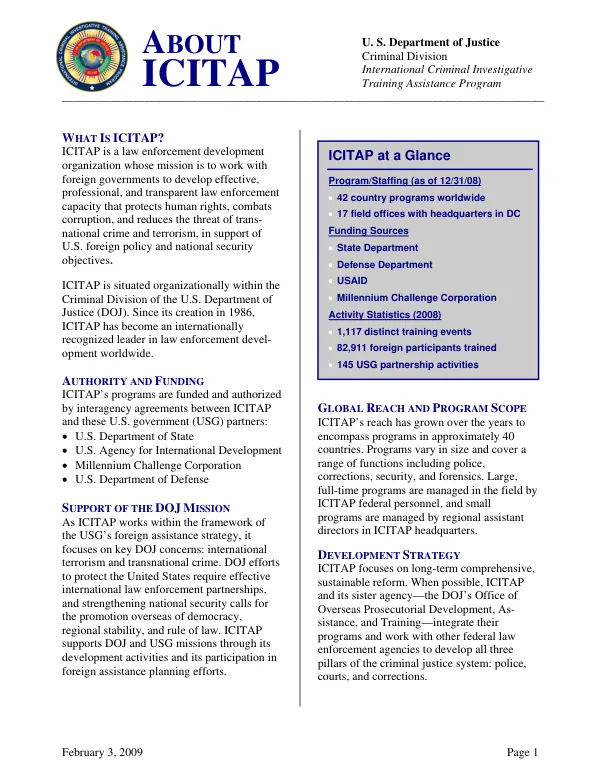
ICITAP's mission is to protect human rights, combat corruption, and reduce the threat of transnational crime and terrorism, in support of U.S. foreign policy and national security objectives. ICITAP is organized within the Criminal Division of the U.S. Department of Justice (DOJ) and has become an internationally recognized leader in law enforcement development since its establishment in 1986. The organization's programs are funded by interagency agreements with U.S. government partners, including the U.S. Department of State, the U.S. Agency for International Development (USAID), the Millennium Challenge Corporation, and the U.S. Department of Defense. ICITAP's activities focus on key DOJ concerns, including international terrorism and transnational crime. The organization supports DOJ and U.S. government missions through its activities and participation in foreign assistance planning efforts. ICITAP's global reach has grown to encompass programs in approximately 40 countries, with a range of functions including police, corrections, security, and forensics. ICITAP's development strategy focuses on long-term, comprehensive, and sustainable reform. The organization integrates its activities with its sister agency, the Office of Overseas Prosecutorial Development, Assistance, and Assistance, and works with other federal law enforcement agencies to develop all three pillars of the criminal justice system: police, courts, and corrections. ICITAP's areas of expertise include organizational development, transnational crime, criminal investigations, public integrity and ant-corruption, special and tactical skills, forensics, basic services, academy and development, community policing, corrections, and corrections. The organization delivers its programs through various methods, including pre-program assessments, program plans and reviews, program management, training curricula development, platform and on-the-job training, seminars and workshops, internships abroad, and equipment donations and technology acquisition and implementation. ICITAP's activities have grown to encompass three principal types of assistance projects: enhancing the capabilities of existing law enforcement forces in emerging democracies and developing countries, assisting key allies on the frontlines of the war on terrorism, and developing law enforcement institutions in the context of post-conflict reconstruction or international peacekeeping operations. The organization has participated in the majority of U.S. and international peacekeeping operations, including operations in Bosnia and Herzegovina, East Timor, El Salvador, Haiti, Iraq, Kosovo, and Kosovo. ICITAP's federal staff brings a range of law enforcement experience to the organization's work, with more than half of the staff having worked in U.S. federal, state, and local law enforcement agencies for an average of 20-plus years. The organization enlists the professional support of numerous federal, state, and local law enforcement experts, including the Federal Bureau of Investigation, the Drug Enforcement Administration, the Bureau of Alcohol, Tobacco, Firearms and Explosives, the U.S. Marshals Service, the Internal Revenue Service, and the Department of Homeland Security. ICITAP maintains control over the development, management, and review of its programs.