USAID
Introduction to Process Tracing: Module 1 of 3
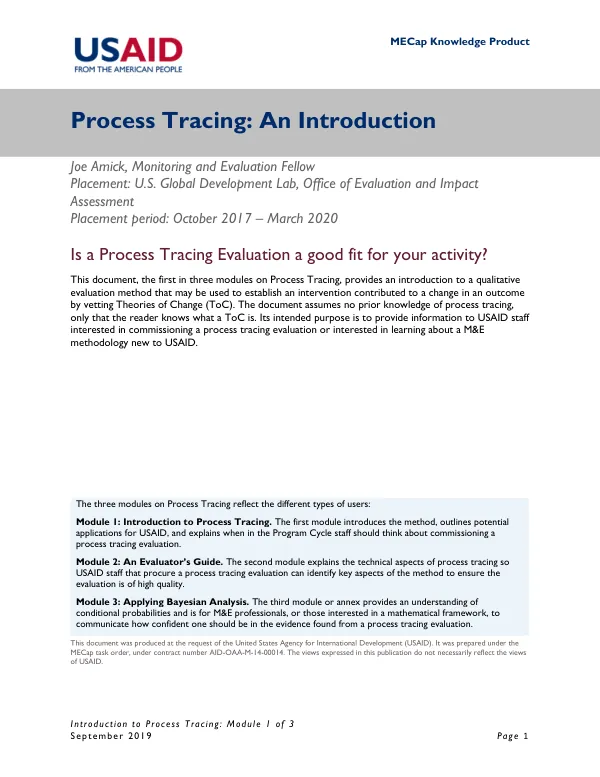
Process tracing is a qualitative research and evaluation method used to verify the presence of causal mechanisms by examining how a causal process plays out from an intervention to an observed outcome.
2019 · 25 pages
Sign in to readA free account is required to download.
Abstract
This method provides a transparent way to establish that an intervention led to a development outcome by vetting a program's Theory of Change (ToC). Process tracing is different from other qualitative methods because it considers how other factors within the local system may impact development outcomes, aligning with local systems approaches to Monitoring and Evaluation (M&E). Process tracing evaluations require that the development outcome has been achieved or will have had sufficient time to be achieved during the evaluation. The method fits within the broader category of contribution analysis, which establishes a causal link between an intervention and an outcome but does not specify the magnitude of the intervention's contribution toward that outcome. Process tracing evaluations lead to three broad categories of findings: validating the ToC and showing an intervention contributed to an outcome, showing a ToC to be incorrect and identifying where the causal chain breaks down, and identifying factors that increase or decrease the effectiveness of an intervention. A process tracing evaluation begins with a series of meetings between the Activity or Country Office Responsible (AOR/COR), technical teams, or partners who were involved in writing the ToC. These meetings break down the program's ToC into distinct causal steps, specify the temporal sequence of each causal step, and identify the real-world evidence that should exist if each causal step occurred. The evaluator then identifies factors, or plausible alternative explanations, for what could have caused each step in the causal process to occur absent the intervention. The design must also look for information that confirms other explanations for the outcome. For example, an intervention aimed at raising farmer incomes may provide information to farmers on how to change certain practices that improve the quality of the harvest, netting them higher prices. At the same time, buyers of those same crops may be providing the same information to farmers because they also want improved quality. The evaluator would want to find out whether this information was being passed down from buyers and whether farmers in areas outside the target area, but covered by similar buying networks, also know this information. A basic process tracing design includes three causal steps from intervention to intermediate outcome 1, then from intermediate outcome 1 to intermediate outcome 2, and finally from intermediate outcomes 2 to the final outcome. This evaluation design also includes alternative explanations for each step in the process, increasing the rigor of the design. With this set-up, it is possible for the final outcome to change, even if one step in the process does not occur as expected.
Related documents