USAID DEC
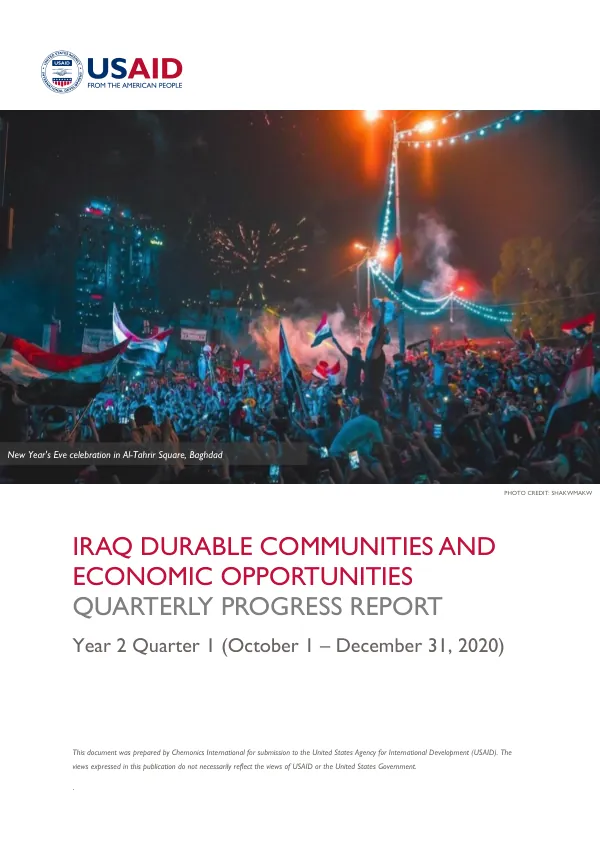
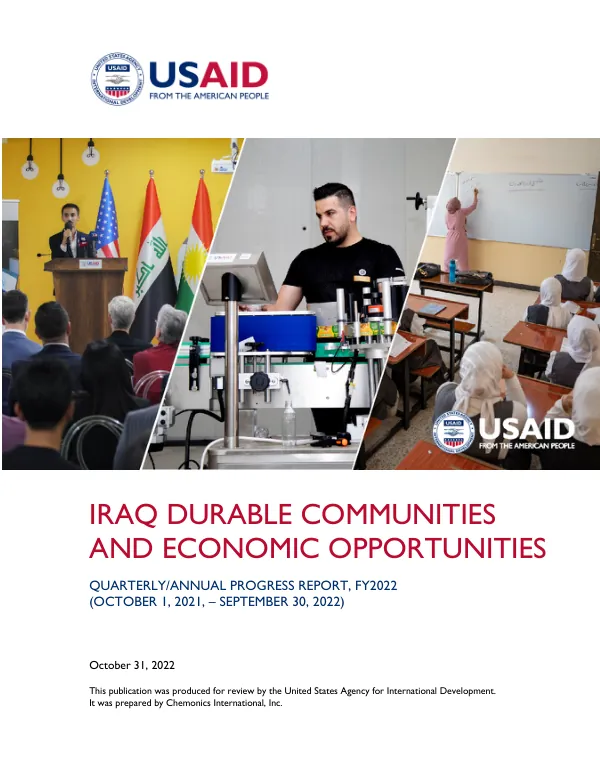
Iraq Durable Communities and Economic Opportunities QUARTERLY/ANNUAL PROGRESS REPORT FY2022
Sign inCHEMONICS
Iraq Durable Communities and Economic Opportunities QUARTERLY/ANNUAL PROGRESS REPORT FY2022
The Durable Communities and Economic Opportunities (DCEO/Tahfeez) project aims to cultivate community cohesion and strengthen private sector competitiveness in Iraq.
2022 · 119 pages
Sign in to readA free account is required to download.
Abstract
The project delivers assistance through two workstreams: Economic Opportunities and Durable Communities. The Economic Opportunities Workstream increased private sector competitiveness, directly delivering firm-level assistance to improve the competitiveness of Iraqi MSMEs. In FY'22, the project delivered services to 238 client firms and individuals across six governorates. The project facilitated $41 million in investments for Iraqi businesses, exceeding the FY22 target of $4 million and the life of activity target of $25 million. These investments have far-reaching effects, as they are reinvested in local communities through job creation and spending. The project also created 1,696 jobs in the fiscal year, exceeding the FY22 target of 500. Firms supported by the project generated $25 million in sales, representing a 54% increase over baseline sales figures. The Durable Communities workstream improved community cohesion and resilience by implementing participatory community problem-solving dialogues, rapid and durable solutions to resolve conflict, empowering community leaders, and delivering tailored assistance to vulnerable groups to (re-) establish and sustain livelihoods. In FY'22, the project worked in partnership with 10 CSOs and through its community-teams to achieve the following: * Implemented 78 activities across six governorates * Conducted 1,200 community meetings and community meetings * Empowered 1,200 community leaders * Provided assistance to 1,200 vulnerable individuals * Established 10 community-led solutions The project convened two important Access to Finance events, bringing together key stakeholders, identifying financial barriers, opening dialogue for solutions, and spurring new USAID programming to unlock finance for Iraqi SMEs. The project also worked with women entrepreneurs and business-owners, who made up 23% of participants. The DCEO/Tahfeez project has made significant progress in addressing underlying drivers of conflict, increasing community leadership, improving private sector networks, and advancing micro-, small-, and medium-sized enterprise (MSME) competitiveness. The project has also demonstrated a commitment to the do no harm principle, tailoring assistance to innocent Iraqis who have suffered harm as a result of coalition, security forces, or terrorist activities. The project's success is evident in its ability to facilitate investments, create jobs, and generate sales, while also improving community cohesion and resilience. The project's work has far-reaching effects, as it is reinvested in local communities through job creation and spending. The project's commitment to the do no harm principle and its focus on vulnerable communities demonstrate its dedication to addressing the underlying drivers of conflict in Iraq. The DCEO/Tahfeez project has made significant progress in its first year, and its success is a testament to the dedication and hard work of its team. The project's work has the potential to make a lasting impact on the lives of Iraqis, and its commitment to the do no harm principle and its focus on vulnerable communities demonstrate its dedication to addressing the underlying drivers of conflict in Iraq. The project's success is also evident in its ability to convene key stakeholders, identify financial barriers, and spur new USAID programming to unlock finance for Iraqi SMEs. The project's work with women entrepreneurs and business-owners has also been notable, with 23% of participants being women. The DCEO/Tahfeez project has made significant progress in its first year, and its success is a testament to the dedication and hard work of its team. The project's work has the potential to