INTERNATIONAL MONETARY FUND
Iraq Governance and Performance Accountability Project Final Report
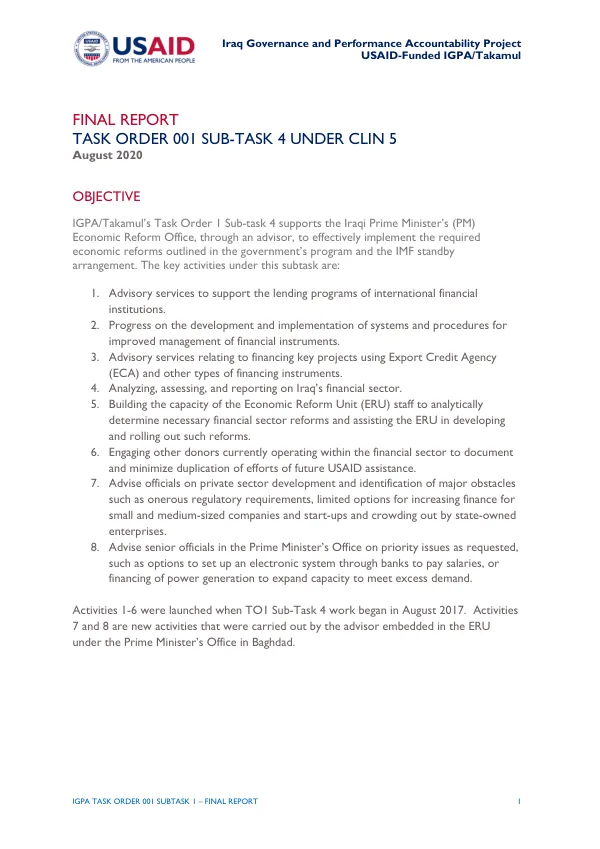
Iraq's Economic Reform Office, supported by the IGPA/Takamul project, aimed to implement economic reforms outlined in the government's program and the IMF standby arrangement.
2020 · 5 pages
Sign in to readA free account is required to download.
Abstract
The key activities under this subtask included advisory services to support international financial institutions, development and implementation of financial management systems, and analysis of Iraq's financial sector. Advisory services to support the IMF lending program were hindered by the lack of continuity in the Iraqi team leading IMF negotiations, resulting in few requirements being implemented by the Iraqi Government. To address this issue, it is recommended that a team/unit be established within the Ministry of Finance to consolidate information and lead discussions with the IMF. The development and implementation of financial management systems were also impacted by the limited capacity of the Budget Department at the Ministry of Finance. The department's outdated and inefficient management structure and systems hindered the availability of budget execution data. To improve this situation, it is suggested that the capacity of the Budget Department be built to carry out budget processes and procedures more efficiently. The IGPA/Takamul advisor worked closely with the Prime Minister's Finance advisor to support proposals and reports on state-owned banks, small to medium enterprise financing initiatives, and financial sector topics. However, managing various government stakeholders proved to be a challenge due to their limited understanding of modern technologies and governance systems. To address this issue, it is recommended that the Government of Iraq make changes to senior management in state-owned financial institutions, bringing in technocrats with international work experience. The ERU team's capacity was also a focus area, with the IGPA/Takamul advisor working to develop their analytical skills in reviewing government reports and other core tasks. The new ERU office, located in Zaqura Palace, provided a more suitable working environment for the team. The IGPA/Takamul project also engaged with other donors operating within the financial sector to document and minimize the duplication of efforts of future USAID assistance. Regular updates were provided on meetings with donors and embassies to identify opportunities for additional support to the ERU and the financial sector. However, the October 2019 protests and subsequent political and security challenges prevented substantial follow-up and coordination with donors. The project's activities were hindered by the October 2019 protests and subsequent political and security challenges, which delayed the Council of Representatives' approval of the 2020 budget. The systems used by the Ministry of Finance's Public Debt Department were also inefficient and outdated, requiring reform and modernization to efficiently manage the government's debt obligations and lower borrowing costs. The IGPA/Takamul advisor assisted the Ministry of Finance in their discussions with international investment banks that will facilitate loans for key projects. The advisor also prepared documentation for an ECA-backed facility for the Ministries and worked with the relevant PM advisors to prioritize these projects in order of importance. The project's activities were focused on supporting the Iraqi Government's economic reform efforts, with a focus on improving financial management systems, building the capacity of the ERU team, and engaging with other donors to avoid duplication of work. The project's recommendations aimed to address the challenges faced by the Iraqi Government in implementing economic reforms and improving the financial sector.