USAID DEC
Iraq Governance & Performance Accountability Project (IGPA/Takamul) FY2022 Quarter-3 Report
Sign inDAI GLOBAL, LLC
Iraq Governance & Performance Accountability Project (IGPA/Takamul) FY2022 Quarter-3 Report
Iraq Governance and Performance Accountability Project (IGPA/Takamul) began in 2018 with funding from USAID's Iraq office.
2022 · 139 pages
Sign in to readA free account is required to download.
Abstract
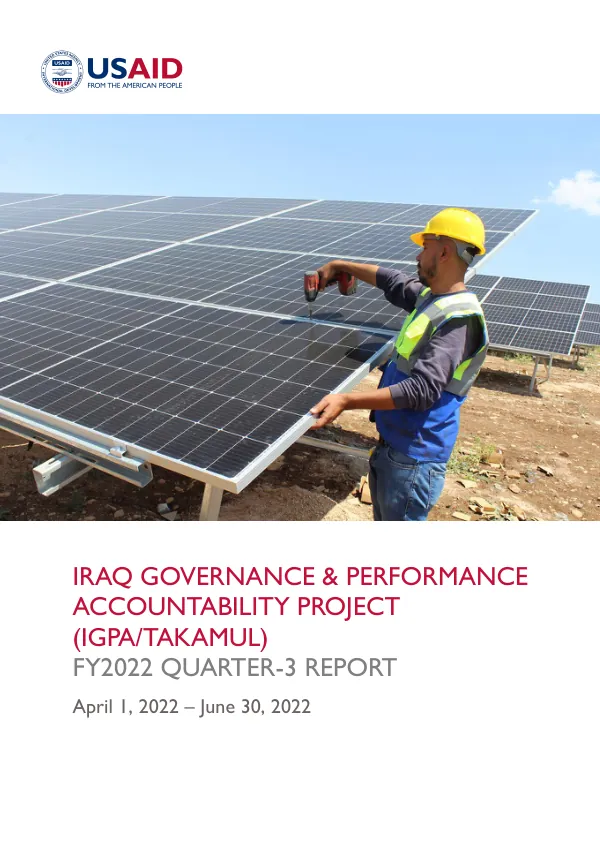
The project aims to enhance the service delivery capacity of the Government of Iraq, improve public financial management, strengthen monitoring and oversight, and support Iraqi Change Agents. The project has four main objectives: Objective 1, Enhance the service delivery capacity of the Government of Iraq; Objective 2, Improve the public financial management of the national government and governorates; Objective 3, Strengthen monitoring and oversight of service delivery and public expenditure; and Objective 4, Support Iraqi Change Agents. Mainstreaming Gender Equity and Inclusion is also a key component of the project. At the federal level, the project has made significant progress in various ministries, including the Ministry of Electricity, Ministry of Construction, Housing, Municipalities, and Public Works (MOCHMPW), Ministry of Water Resources, Ministry of Oil, and the National Investment Commission. The project has also made progress in the provinces, with a focus on improving service delivery and public financial management. One notable success story is the establishment of the first-ever solar farm in Iraq, which was made possible through USAID IGPA procurement assistance. The two-acre solar farm has a 2-megawatt capacity and is expected to start generating solar energy in September 2022. The project has also made progress in monitoring, evaluation, and learning, with the establishment of an IGPA/Takamul MEL system. The system includes monitoring, evaluation, and measuring the effectiveness of technical assistance and capacity building initiatives. The project is also monitoring the political economy and governance context of Iraq, including the political dynamics and government formation, the 2022 federal budget, and the U.S.-Iran conflict in Iraq. The project has identified several key challenges, including the political deadlock that has dominated Iraq for the past seven months. The project has also made progress in training and capacity building, with over 2,500 individuals trained in various areas, including program budgeting and performance, problem-solving, and behavior change communication and outreach. The project has also conducted several workshops and training sessions, including a workshop on waste-to-energy model and a workshop on establishing service delivery units at Mayor's Offices. The project has also made progress in implementing its activities, with a focus on improving service delivery and public financial management. The project has established several service delivery units in four provinces and has made progress in implementing its activities in the provinces. Overall, the project has made significant progress in its objectives and has identified several key challenges that need to be addressed. The project continues to work towards its objectives and is committed to improving service delivery and public financial management in Iraq. The project has also made progress in its quarterly financial information, with a total expenditure of $X million in the third quarter of FY22. The project has also made progress in its subcontractors overview, with several subcontractors working on various activities. The project has also made progress in its media coverage, with several articles and publications highlighting the project's activities and achievements. The project continues to work towards its objectives and is committed to improving service delivery and public financial management in Iraq. The project's mechanisms that underlie good governance are woven into several key legislative pieces, including national procurement, public-private partnership, and the implementing guidelines of the Public Financial Management (PFM). These bills remain pending due to the ongoing political deadlock in Iraq. The project continues to work towards its objectives and is committed to improving service delivery and public financial management in Iraq. The project's progress and achievements are reflected in its quarterly reports and annual reports, which provide a detailed overview of the project's activities and achievements.
Related documents