DAI
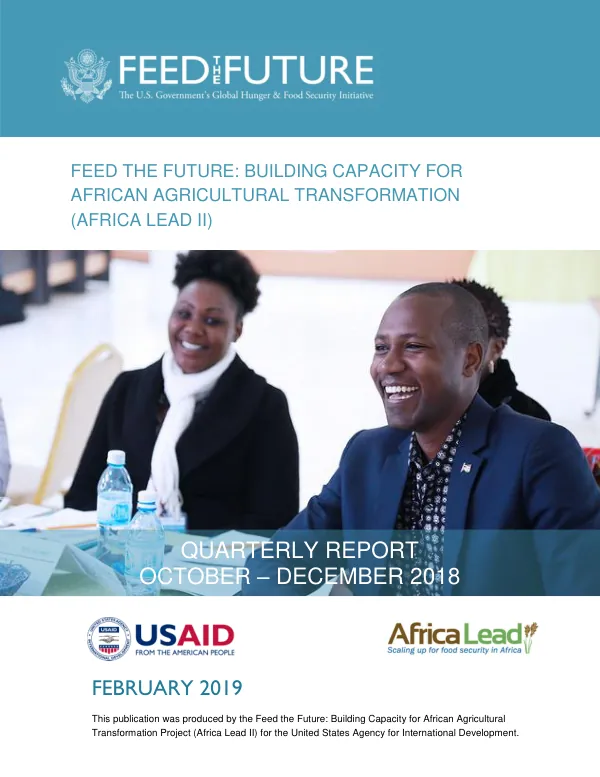
Africa Lead FY 2019 Quarter 1 Report
Africa Lead — Feed the Future's Building Capacity for African Agricultural Transformation Program — supports the advancement of agricultural transformation in Africa that aligns with the African Union Comprehensive Africa Agriculture Development Programme (CAADP).
2019 · 62 pages
Sign in to readA free account is required to download.
Abstract
The program has traditionally contributed to the FTF goals of reduced hunger and poverty by building the capacity of champions — i.e., men and women leaders in agriculture — and the institutions in which they operate to develop, lead, and manage the policies, structures, and processes needed for transformation. The Bureau for Food Security (BFS) at the U.S. Agency for International Development (USAID) has established three priority areas of agriculture policy change: (1) changes in policies themselves; (2) changes in systems to formulate and implement policy changes; and (3) laying the foundations for the next generation of policy change. Africa Lead continues to evolve in the services provided to support new, emerging challenges in food security. During FY2019, this effort includes strategic facilitation to improve government agency planning, providing backbone support to CAADP activities, and strengthening the planning and dialogue processes for national agricultural investment plans (NAIPs). In Senegal, Africa Lead provided capacity building support to the "Cellule de Lutte contre la Malnutrition" (CLM) — the government entity charged with implementing the government's multi-sectorial plan to improve nutrition in Senegal. During the quarter, Africa Lead delivered two training programs on negotiation and delegation for the executive staff. The trainings provided CLM senior management staff with techniques to negotiate effectively and helped them to develop skills, such as delegation, to be more effective and efficient when it comes to managing their program and working as a team. The workshop used the experiential learning approach to present new concepts and give participants the opportunity to apply them, using role-playing and small-group work. As a result, participants acquired knowledge on modern theories of negotiation and the use of negotiation competences in various contexts. They also learned about the importance of effective communication and collaboration in achieving program goals. Africa Lead activities promote and sustain a culture of learning and continue to build a process by which evidence can play a greater role in determining policy directions and programs in agriculture. By design, Africa Lead activities are demand-driven, and the project serves as a flexible mechanism to support various USAID initiatives at the mission and continental level. Africa Lead is truly greater than the sum of its parts; to appreciate its full impact, individual activities must be viewed within the context of the continent-wide goals that drive them. The program's major accomplishments and outputs from October through December 2018, which is Quarter 1 of Africa Lead's sixth year of implementation, are highlighted in this report. It focuses on the support, facilitation, and training that Africa Lead provides partners to improve institutional capacity and broader systems and institutional architecture to manage agricultural transformation as well as to promote the effective, inclusive participation of non-state actors (NSAs) in policy processes. Africa Lead's activities in Quarter 1 (FY19 Q1) are summarized in the following areas: Developing Organizations and Leaders, CAADP Backbone Support, Inclusive Policy Dialogue, National Agriculture Investment Planning, Knowledge Sharing and Communication for Development Partners, and Management and Operations. Section 9 includes mission-level dashboards, which provide a snapshot view of FY19 Q1 activities and key data points for each of the project's buy-ins. In addition to the capacity building support provided to CLM, Africa Lead also facilitated a policy brief write shop for the Agriculture Council of Kenya, highlighted at the USAID Bureau for Food Security Senegal Roundtable, and facilitated a national youth forum and C4C training to catalyze opportunities for Kenyan youth in agriculture and agribusiness. These activities demonstrate the program's commitment to building the capacity of champions and institutions to drive agricultural transformation in Africa.