MANAGEMENT SYSTEMS INTERNATIONAL
Issue Brief: Achieving Multiple Outcomes From Community Forest Management
Community forest management (CFM) is an approach to forest management and use that prioritizes the local population's role.
2021 · 70 pages
Sign in to readA free account is required to download.
Abstract
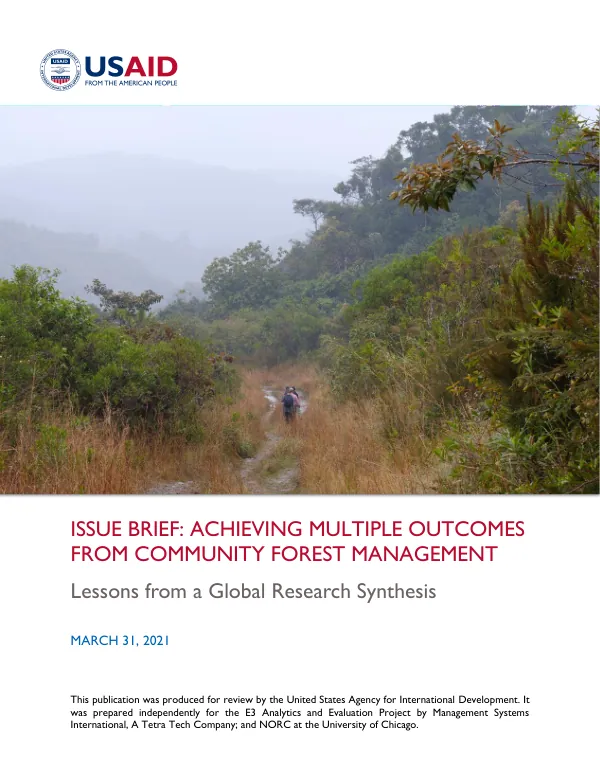
Over the past decade, the United States Agency for International Development (USAID) has funded CFM activities around the globe to empower local communities, improve livelihoods, and protect the environment. CFM involves devolved management and use rights, which has changed the focus of government- and donor-led programming in USAID partner countries over the past 40 years. Research has highlighted several general drivers of CFM success, including property rights and community use of the forest. However, there are still many questions about the specific impacts and drivers of observed change. In addition to forest outcomes, related governance and livelihoods outcomes, including equity outcomes, for communities involved in CFM, are still open questions in the literature. While individual studies may address conservation or socioeconomic impacts, there has been limited analysis of the tradeoffs between different outcomes. A recent global synthesis of 697 cases in the CFM literature, conducted by Hajjar et al. (2020), provides valuable insights into the effectiveness of CFM. The study found that environmental and income benefits often appear to be achieved together, with most cases reporting positive change in both dimensions. However, income distribution within communities can be problematic, with about half of the cases examined reporting that benefit sharing had become less equitable or mostly inequitable following CFM. Declining forest resource rights and distributional asymmetries within communities are also common. While information on forest resources rights was less commonly reported, most cases reported a decrease in forest resource rights for all or some community members. In some cases, those losing access rights were compensated with other livelihood benefits, while in other cases, those who had their resource access rights curtailed were less likely to benefit from alternative livelihood strategies or new, formal forest-based community businesses. The cases examined by Hajjar et al. reflect a heavy reporting bias in the literature toward cases from South Asia, with about a third of the cases being of joint forest management, a type of CFM policy prevalent in India. There is an apparent under-representation in the literature of CFM in Latin America and East and Southeast Asia. However, the outcome patterns hold even when India and Nepal are excluded. The key messages highlighted by this brief for improved effectiveness of USAID's CFM programming include the importance of considering the nature of community de facto and de jure rights prior to CFM interventions, and the changes to them as a result of a given intervention, in achieving CFM's diverse goals. CFM interventions should also consider who in local communities benefits from collective rights, who is left out of the creation of new community-based institutions, and who is negatively affected by changes to individual rights under CFM. Many contextual factors can influence the likelihood for a CFM intervention to achieve its stated goals. CFM program designers should take into consideration several context factors when thinking about where interventions might be located, the nature of programming provided, and expectations for outcomes. These factors include the type of CFM, time since policy change, type of forest, degree to which a community adheres to forest rules, nature of community de facto and de jure rights to forests, population size of management community, and migration. The findings of Hajjar et al. have important implications for USAID's CFM programming. By considering the nature of community de facto and de jure rights, and the changes to them as a result of a given intervention, CFM program designers can better achieve CFM's diverse goals. Additionally, by taking into account several context factors, CFM program designers can increase the likelihood of a CFM intervention achieving its stated goals.
Related documents