USAID
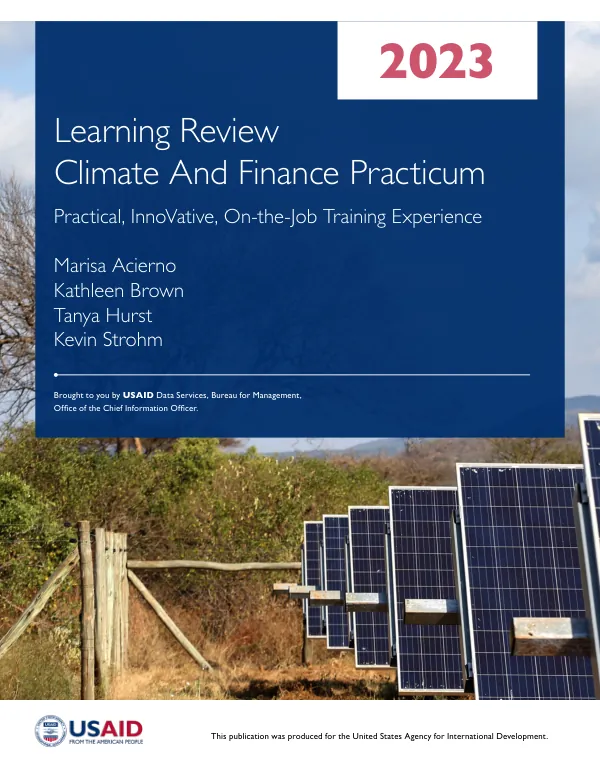
Learning Review Climate and Finance Practicum
The Climate and Finance Practicum (CFP) is a practical, innovative, on-the-job training experience designed to equip USAID Foreign Service Officers with the skills and knowledge necessary to address climate change and mobilize climate finance.
2023 · 191 pages
Sign in to readA free account is required to download.
Abstract
The CFP is a collaborative effort between USAID's Bureau for Management, Office of the Chief Information Officer, and USAID Data Services. The CFP is grounded in the principles of Collaborating, Learning, and Adapting (CLA), which emphasizes the importance of building relationships, sharing knowledge, and adapting to changing circumstances. The program is designed to be flexible and adaptable, allowing participants to apply their learning to real-world challenges. The CFP consists of a series of modules, each focusing on a specific aspect of climate finance and adaptation. Participants engage in action learning projects, which involve applying theoretical knowledge to practical problems. The program also includes a competency framework, which outlines the skills and knowledge required to effectively address climate change and mobilize climate finance. One of the key components of the CFP is the development of a theory of change, which outlines the desired outcomes and impact of the program. The theory of change is based on a comprehensive review of the literature on climate finance and adaptation, as well as input from stakeholders and experts in the field. The CFP has been implemented in several countries, including Madagascar, Liberia, Rwanda, Mozambique, Southern Africa, and Tanzania. Each country-specific project has its own unique context and challenges, but all share a common goal of addressing climate change and mobilizing climate finance. The CFP has been evaluated using a range of methods, including surveys, focus group discussions, and key informant interviews. The evaluation has shown that participants have gained a range of skills and knowledge, including the ability to integrate USAID's Climate Strategy objectives into their mission's strategy and program design, and to mobilize resources for climate action. The CFP has also been found to have a positive impact on participants' ability to develop and manage relationships with public and private sector contacts and other climate stakeholders. Additionally, participants have reported an increased ability to convert opportunities to mobilize resources for climate action into strategic programmatic approaches. The CFP has been designed to be a flexible and adaptable program, allowing participants to apply their learning to real-world challenges. The program has been found to be effective in equipping participants with the skills and knowledge necessary to address climate change and mobilize climate finance.