SEARCH FOR COMMON GROUND
Ivoirian Youth Take the First Steps Toward Reconciliation
Côte d'Ivoire's post-election violence in 2010 had a profound impact on low-income neighborhoods in Abidjan, particularly Abobo and Youssougan.
2011 · 1 pages
Sign in to readA free account is required to download.
Abstract
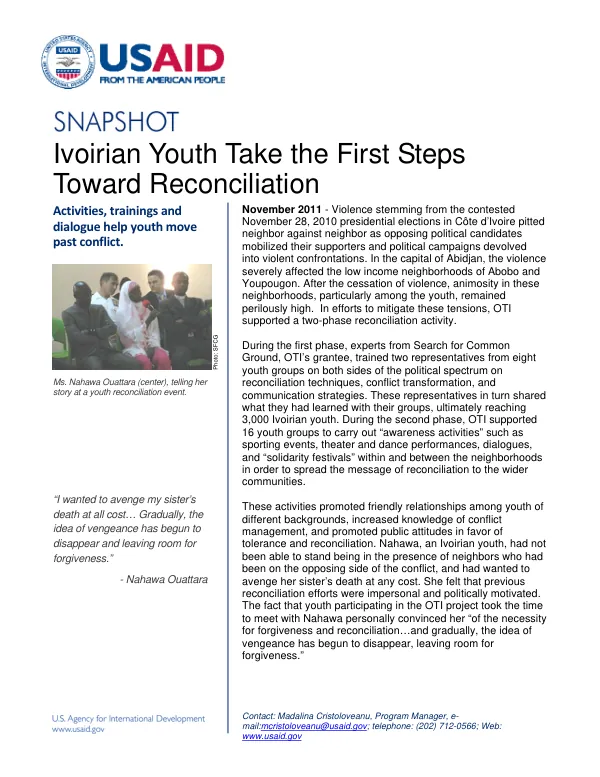
The conflict resulted in severe consequences, including the mobilization of opposing political candidates and their supporters, which led to violent confrontations. The violence was most pronounced in the capital city, Abidjan, where it severely affected the daily lives of residents. Experts from Search for Common Ground, a grantee of the Office of Transition Initiatives (OTI), played a crucial role in mitigating tensions between youth from opposing sides of the conflict. The organization trained two representatives from eight youth groups on both sides of the conflict spectrum on reconciliation, conflict transformation, and communication strategies. These trained representatives then shared their knowledge with their respective groups, reaching a total of 3,000 Ivoirian youth. The second phase of the OTI project focused on promoting reconciliation through various activities, including sporting events, theater and dance performances, dialogues, and solidarity festivals. These events aimed to foster friendly relationships among youth from different backgrounds, increase knowledge of conflict management, and promote public attitudes in favor of tolerance and reconciliation. The initiative was successful in promoting a culture of forgiveness and reconciliation among the youth. Nahawa, an Ivoirian youth, was one of the individuals who benefited from the OTI project. She had previously been unable to stand in the presence of neighbors who were on the opposing side of the conflict, and had even wanted to avenge her sister's death. However, after participating in the OTI project, Nahawa began to see the importance of forgiveness and reconciliation. She credited the project's personal approach and the willingness of youth to meet with her as key factors in her transformation. The OTI project's success in promoting reconciliation among Ivoirian youth has been evident in the testimonies of individuals like Nahawa. The project's focus on community-based activities and personal interactions has helped to create a culture of forgiveness and reconciliation, which is essential for healing and rebuilding communities affected by conflict. The project's impact has been significant, and its success serves as a model for future initiatives aimed at promoting reconciliation and promoting peace in post-conflict communities.