USAID
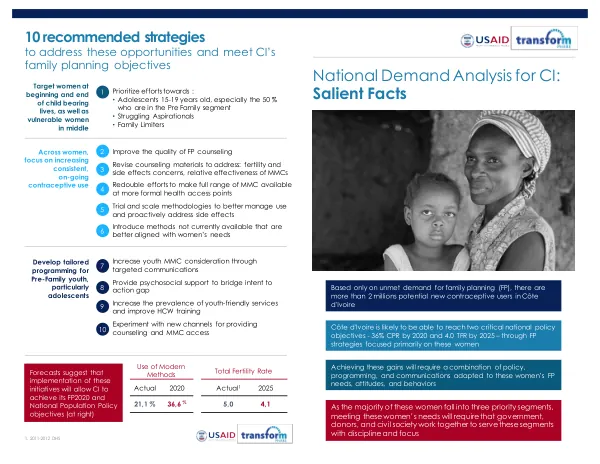
National Demand Analysis for CI: Salient Facts
Côte d'Ivoire has a significant unmet demand for family planning (FP), with more than 2 million potential new contraceptive users.
2020 · 2 pages
Sign in to readA free account is required to download.
Abstract
Meeting this demand is crucial for achieving the country's national policy objectives, including a 36% Contraceptive Prevalence Rate (CPR) by 2020 and a Total Fertility Rate (TFR) of 4.0 by 2025. These objectives can be achieved through FP strategies focused on women who are likely to benefit from FP services. The majority of these women fall into three priority segments: Pre-Family youth, Struggling Aspirationals, and Family Limiters. These segments account for a significant proportion of the unmet demand for FP services. To address these opportunities and meet Côte d'Ivoire's family planning objectives, a combination of policy, programming, and communications adapted to these women's FP needs, attitudes, and behaviors is required. A national demand analysis for Côte d'Ivoire has identified 10 recommended strategies to address the unmet demand for FP services. These strategies include improving the quality of FP counseling, revising counseling materials to address fertility and side effects concerns, and introducing methods not currently available that are better aligned with women's needs. Additionally, efforts should be made to increase youth MMC consideration through targeted communications, provide psychosocial support to bridge the intent to action gap, and increase the prevalence of youth-friendly services and improve healthcare worker training. The relationship between unmet demand, health transition stage (HTSP)-related risk, and contraceptive use is complex. Women who are at risk of non-HTSP pregnancies, based on Camber survey data, are categorized into three priority target segments. These segments include women who are less than 18 years old, more than 35 years old, and/or exceeding the average number of children for their age group by 1 standard deviation or more. These women may or may not be aware that they are at risk. The data suggests that 33% of Côte d'Ivoire's female population aged 15-49 has unmet FP demand, and more than half (18% of the total) has high unaddressed risk. This group is a priority for interventions, as they are both ready to change their behavior and are at material health risk if their behavior does not change. The priority segments identified are Pre-Family, Struggling Aspirationals, and Family Limiters, which account for a significant proportion of the unmet demand for FP services. The quotes from women in Côte d'Ivoire highlight the complex social and cultural factors that influence FP decision-making. Women's attitudes towards FP are shaped by their social and economic context, and FP services must be tailored to meet their needs and address their concerns. By addressing the unmet demand for FP services and providing women with access to a range of contraceptive methods, Côte d'Ivoire can achieve its FP2020 and National Population Policy objectives.