ADVENTIST DEVELOPMENT AND RELIEF AGENCY INTERNATIONAL
January 2011 Newsletter
The Office of U.S.
2011 · 2 pages
Sign in to readA free account is required to download.
Abstract
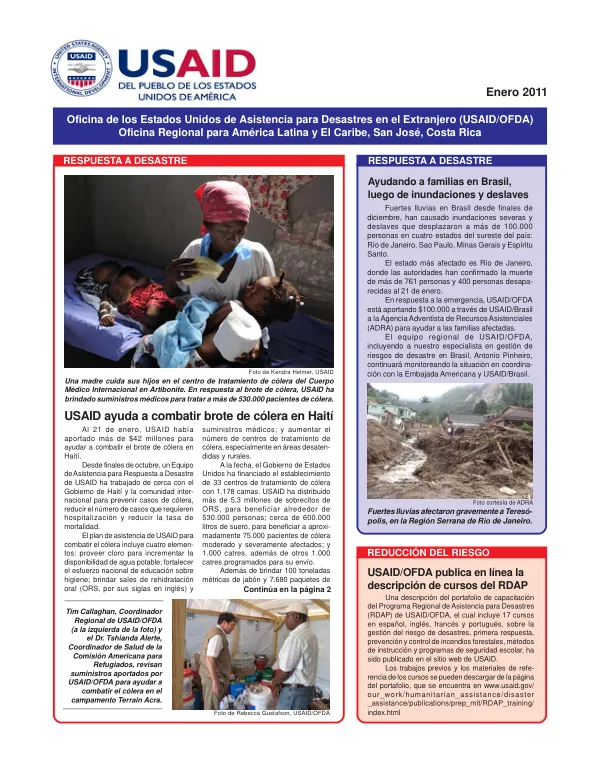
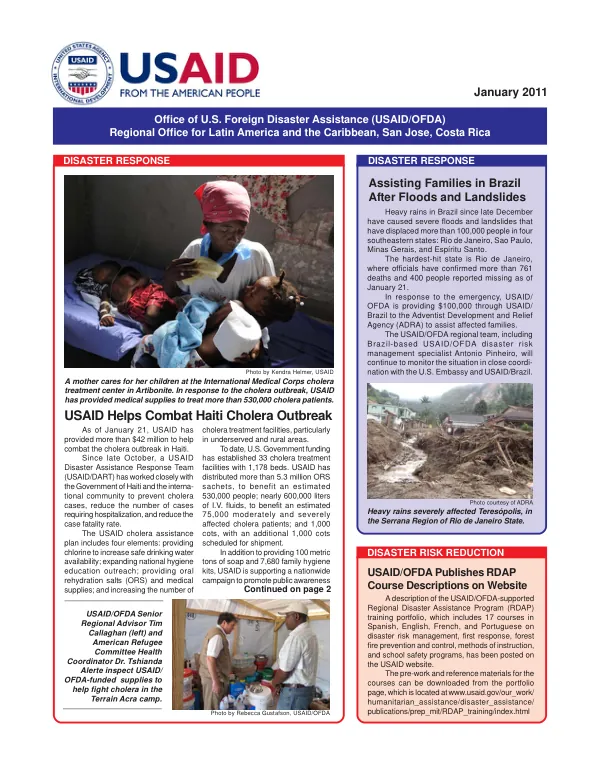
Foreign Disaster Assistance (USAID/OFDA) Regional Office for Latin America and the Caribbean, based in San Jose, Costa Rica, is actively responding to disasters in the region. Heavy rains in Brazil since late December have caused severe floods and landslides, displacing over 100,000 people in four southeastern states. The hardest-hit state is Rio de Janeiro, where officials have confirmed more than 761 deaths and 400 people reported missing as of January 21. In response to the emergency, USAID/OFDA is providing $100,000 through USAID/Brazil to the Adventist Development and Relief Agency (ADRA) to assist affected families. The USAID/OFDA regional team, including Brazil-based disaster risk management specialist Antonio Pinheiro, will continue to monitor the situation in close coordination with the U.S. Embassy and USAID/Brazil. USAID/OFDA is also supporting a nationwide campaign to promote public awareness of cholera prevention and treatment in Haiti, where a cholera outbreak has affected over 530,000 people. The USAID/OFDA-supported Regional Disaster Assistance Program (RDAP) training portfolio includes 17 courses in Spanish, English, French, and Portuguese on disaster risk management, first response, forest fire prevention and control, methods of instruction, and school safety programs. The pre-work and reference materials for the courses can be downloaded from the USAID website. The RDAP is also organizing a series of meetings with stakeholders in the countries the program covers, including one in Saint Lucia on February 3 and one in Colombia on February 9. In Haiti, USAID has provided more than $42 million to help combat the cholera outbreak. The USAID cholera assistance plan includes four elements: providing chlorine to increase safe drinking water availability, expanding national hygiene education outreach, providing oral rehydration salts (ORS) and medical supplies, and increasing the number of cholera treatment facilities, particularly in underserved and rural areas. To date, U.S. Government funding has established 33 cholera treatment facilities with 1,178 beds. USAID has distributed more than 5.3 million ORS sachets, to benefit an estimated 530,000 people, and nearly 600,000 liters of I.V. fluids, to benefit an estimated 75,000 moderately and severely affected cholera patients. The DRR Program at Florida International University (FIU), with support from USAID/OFDA, is seeking candidates from Latin American universities for the upcoming fifth cycle of the graduate-level online course on comprehensive risk and disaster management. The course, developed by the Universidad Politécnica de Cataluña International Center for Numerical Methods in Engineering (CIMNE), will be conducted in Spanish and will begin in mid-March. Students who successfully complete the course may be selected to participate in a field visit, or pasantía, to the city of Manizales, Colombia, to observe a living urban laboratory in which community leaders, city officials, and staff from the National University of Colombia, Manizales campus, work together to reduce multiple disaster risks and hazards.