FLORIDA INTERNATIONAL UNIVERSITY
Disaster Risk Reduction – Latin America and the Caribbean
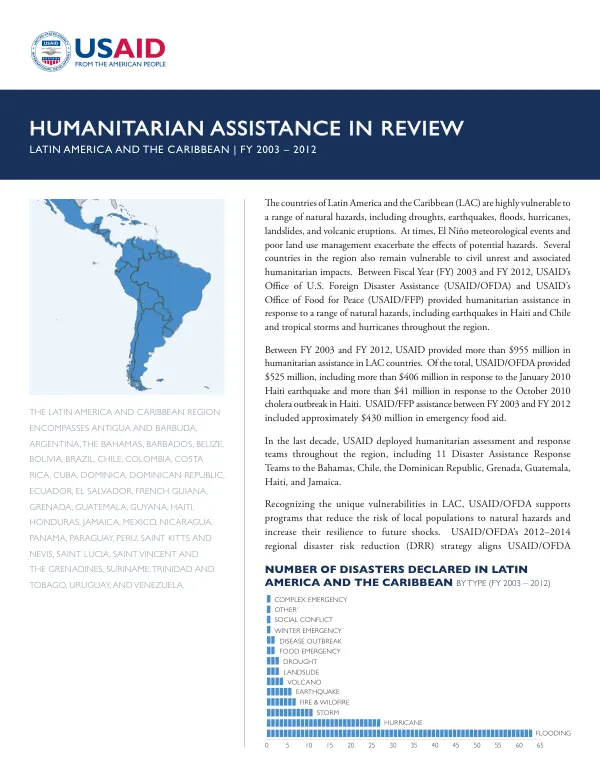
In Latin America and the Caribbean, countries experience a multitude of natural hazards, including earthquakes, hurricanes, floods, tsunamis, landslides, volcanoes, and drought.
2011 · 11 pages
Sign in to readA free account is required to download.
Abstract
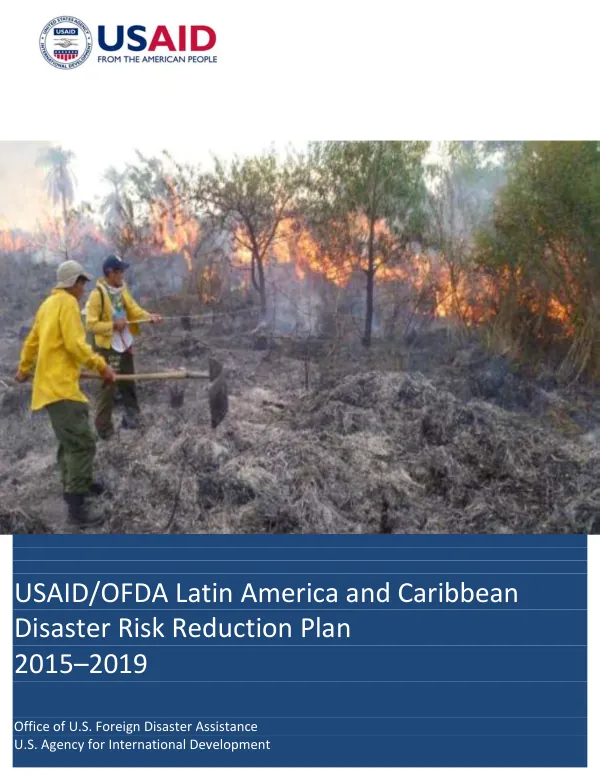
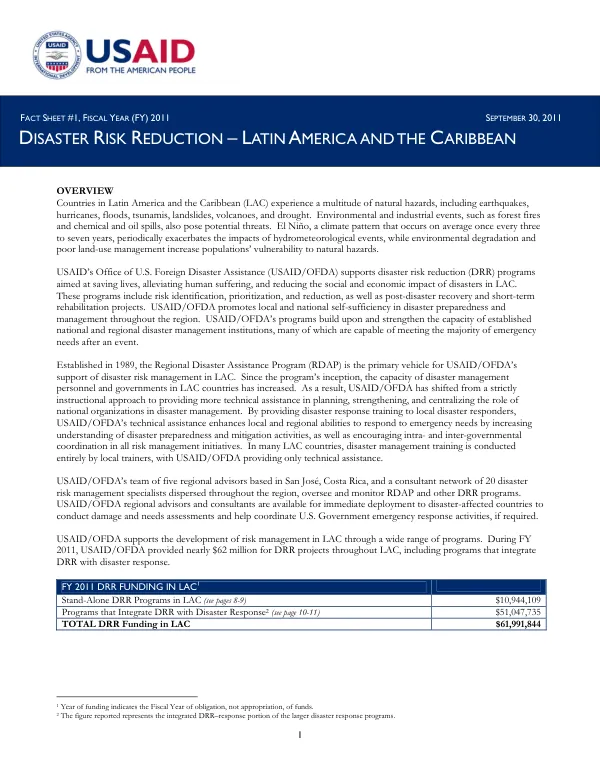
Environmental and industrial events, such as forest fires and chemical and oil spills, also pose potential threats. El Niño, a climate pattern that occurs on average once every three to seven years, periodically exacerbates the impacts of hydrometeorological events, while environmental degradation and poor land-use management increase populations' vulnerability to natural hazards. USAID's Office of U.S. Foreign Disaster Assistance (USAID/OFDA) supports disaster risk reduction (DRR) programs aimed at saving lives, alleviating human suffering, and reducing the social and economic impact of disasters in Latin America and the Caribbean. These programs include risk identification, prioritization, and reduction, as well as post-disaster recovery and short-term rehabilitation projects. USAID/OFDA promotes local and national self-sufficiency in disaster preparedness and management throughout the region. The Regional Disaster Assistance Program (RDAP) is the primary vehicle for USAID/OFDA's support of disaster risk management in Latin America and the Caribbean. Established in 1989, the program has increased the capacity of disaster management personnel and governments in the region. As a result, USAID/OFDA has shifted from a strictly instructional approach to providing more technical assistance in planning, strengthening, and centralizing the role of national organizations in disaster management. By providing disaster response training to local disaster responders, USAID/OFDA's technical assistance enhances local and regional abilities to respond to emergency needs. In FY 2011, USAID/OFDA provided nearly $62 million for DRR projects throughout Latin America and the Caribbean, including programs that integrate DRR with disaster response. Stand-alone DRR programs in the region received $10,944,109, while programs that integrate DRR with disaster response received $51,047,735. The total DRR funding in the region was $61,991,844. USAID/OFDA's team of five regional advisors based in San José, Costa Rica, and a consultant network of 20 disaster risk management specialists dispersed throughout the region, oversee and monitor RDAP and other DRR programs.