KIMETRICA LLC
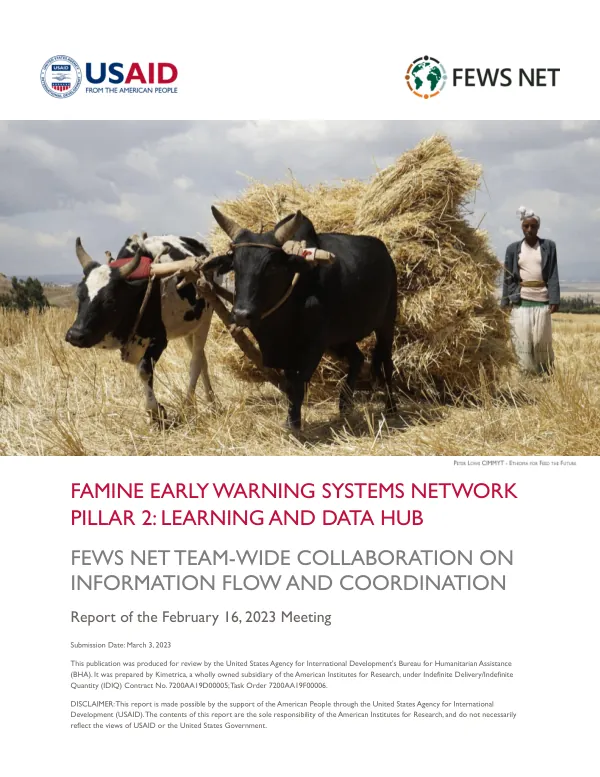
January 2023 Monthly Collaboration Meeting Report
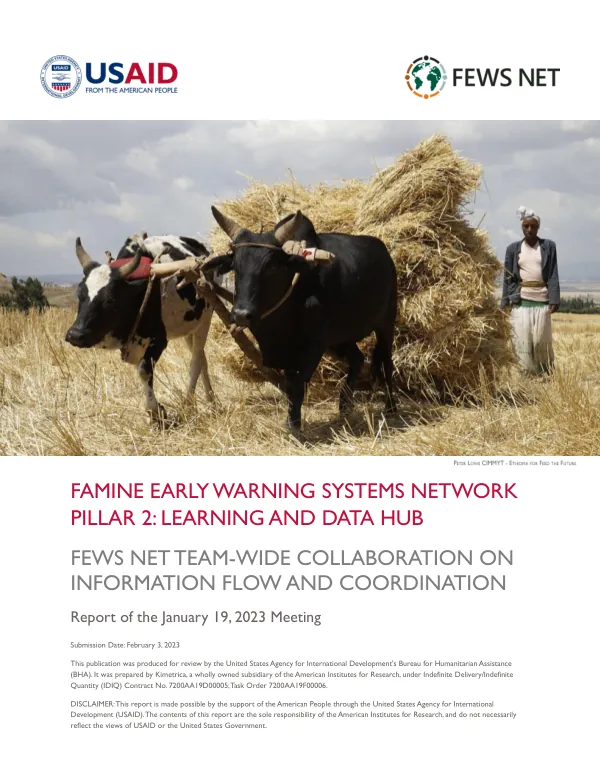
The Famine Early Warning Systems Network (FEWS NET) January 2023 Collaboration Meeting was held virtually on Thursday, January 19, from 1:30-3:00 pm Eastern Standard Time.
2023 · 26 pages
Sign in to readA free account is required to download.
Abstract
The meeting opened by welcoming participants who represented the U.S. Agency for International Development (USAID); the Learning and Data Hub (the Hub); the Early Warning team; the Science team; the Science team; the University of California, Santa Barbara Climate Hazards Center (CHC); and the National Oceanic and Atmospheric Administration (NOAA). The Hub team provided updates on collaboration activities, including finalizing standard visualizations for the refreshed FEWS NET Data Explorer (FDE) and collaborating with the Early Warning team on Kobo ODK documentation for South Sudan. The Hub also attended Early Warning team trainings on the FDE and produced new training content for the FEWS NET Learning Platform (FLP). The Science team welcomed a new team member who will focus on Central Africa coverage and a new Climate Hazards Center (CHC) rain gauge station project. The Science team collaborated with the Hub to promote FEWS NET's presence at the American Geophysical Union (AGU) meeting and co-authored a poster for the event. The Early Warning team has been working closely with the Science team and USAID managers in discussions with the Bureau for Humanitarian Assistance (BHA) El Salvador to clarify differences between FEWS NET science work and SERVIR. The Early Warning team has also been collaborating with the Hub on report-specific trainings and working on the transition of Seasonal Monitors to the Science team. FEWS NET's new task order, Pillar 3, was introduced, focusing on the dynamics of food, nutrition, and livelihood security. Pillar 3 will develop Household Economy Analysis (HEA) baselines for Zimbabwe, Northeast Nigeria, Guatemala, and Democratic Republic of the Congo. The selection of countries was based on the age of existing baseline construction, severity of food insecurity, and the potential to employ traditional and non-traditional approaches. The Science team presented on enhanced flood monitoring mechanisms, which had two objectives: to generate an assessment of current conditions and forecasts out to 1-2 weeks for weekly hazard briefings and to generate forecasts out to 3-4 months for monthly forecast assumptions. The team used flat tiles and special resolutions from NOAA's Visiting Scientist Program to generate flooding risk polygons. Flooding risk polygons were generated using flat tiles and special resolutions from NOAA's Visiting Scientist Program. Flooding conditions started to recede and inundated areas showed signs of shrinking by October. The team noted that flooding could be recorded in virtually every country from Senegal to Ethiopia by September 26. The Science team also presented on the transition of Seasonal Monitors to the Science team, which will involve developing new training content for the FEWS NET Learning Platform (FLP). The team will work closely with the Hub to produce new training content and provide training to Early Warning team members. The Science team has been working closely with the Hub to devise updated guidelines for FEWS NET's website content, including the use of certain images with human subjects. The team has also been collaborating with the Hub to produce new training content for the FEWS NET Learning Platform (FLP). The Science team has been working closely with the Early Warning team to develop new training content for the FEWS NET Learning Platform (FLP). The team has also been collaborating with the Hub to produce new training content and provide training to Early Warning team members. The Science team has been working closely with the Early Warning team to develop new training content for the FEWS NET Learning Platform (FLP). The team has also been collaborating with the