USAID
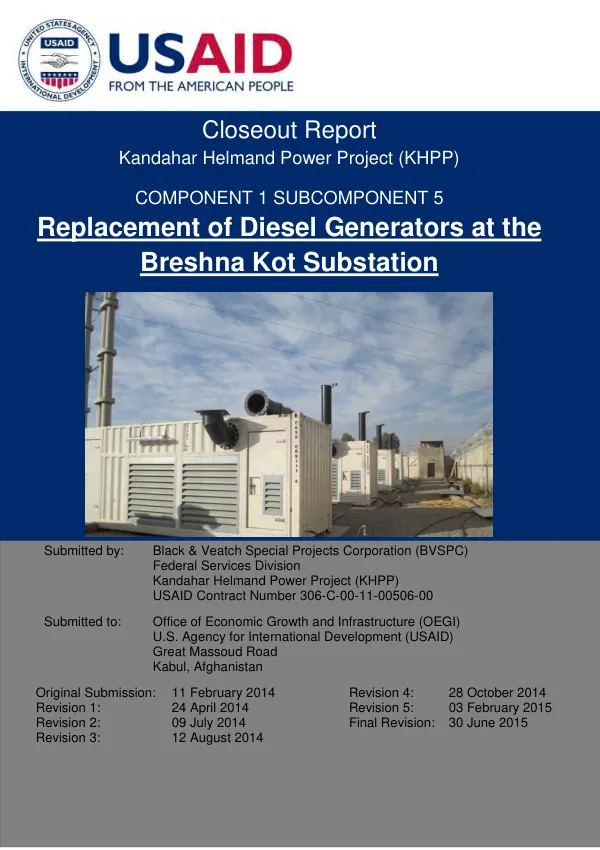
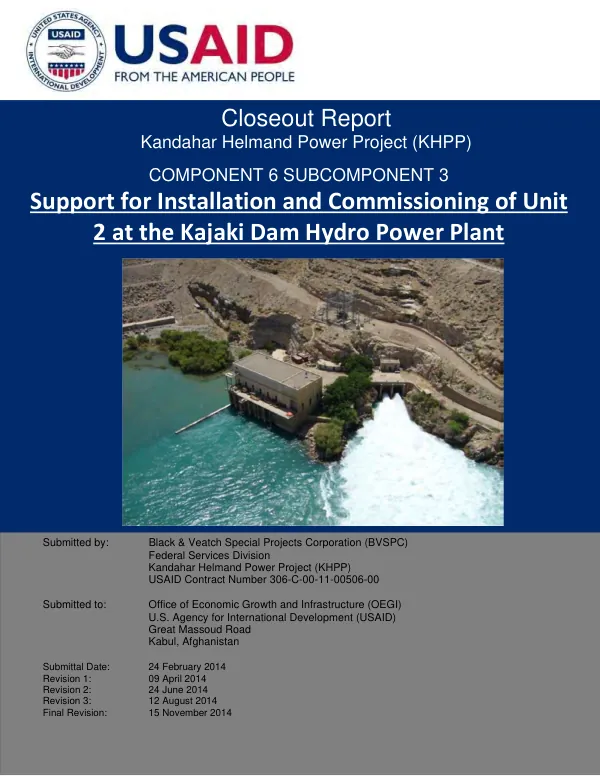
Kandahar Helmand Power Project (KHPP) Closeout Report
The Kandahar Helmand Power Project (KHPP) is a USAID-funded initiative aimed at improving the power supply in southern Afghanistan.
2014 · 46 pages
Sign in to readA free account is required to download.
Abstract
The project's scope of work includes the installation and commissioning of Unit 2 at the Kajaki Dam Hydro Power Plant, which is a critical component of the KHPP. The project's objectives are to increase the power generation capacity of the Kajaki Dam and to improve the reliability of the power supply in the region. The Kajaki Dam Hydro Power Plant has a long history, dating back to the 1950s. The plant was originally designed to generate 14.5 megawatts of power, but it has been plagued by technical issues and maintenance problems over the years. In 2011, the USAID contracted Black & Veatch Special Projects Corporation (BVSPC) to provide support for the installation and commissioning of Unit 2 at the Kajaki Dam. The contract, known as Subcomponent 6.3, was valued at $98,100,000. The project's execution was managed by BVSPC's Federal Services Division, which was responsible for overseeing the work and ensuring that it was completed on time and within budget. The project's organizational structure consisted of a project manager, a deputy project manager, and several technical specialists. The project team worked closely with the USAID's Office of Economic Growth and Infrastructure (OEGI) to ensure that the project's objectives were met. The project's physical completion was marked by the successful installation and commissioning of Unit 2 at the Kajaki Dam. The unit was commissioned on schedule, and it has been operating at full capacity since its completion. The project's sustainability was ensured through the development of a comprehensive maintenance plan, which includes regular inspections and repairs to ensure that the unit remains operational. The project's safety program was designed to minimize the risk of accidents and injuries to personnel working on the project. The program included regular safety training and drills, as well as the implementation of safety protocols and procedures. The project's quality control program was also implemented to ensure that the work was completed to the required standards. The project's environmental control program was designed to minimize the impact of the project on the environment. The program included the implementation of environmental protocols and procedures, as well as regular monitoring and reporting of environmental conditions. The project's statement of patents, royalties, or classified materials was also prepared, as required by the USAID contract. The project's value engineering changes were implemented to optimize the project's cost and schedule. The changes included the use of local labor and materials, as well as the implementation of energy-efficient technologies. The project's enhancing practices, or lessons learned, were documented and shared with the USAID and other stakeholders. The project's warranty was provided by the contractor, BVSPC, and it covered a period of one year from the date of completion. The warranty included the provision of maintenance and repair services, as well as the replacement of defective materials and equipment. The project's outstanding issues were identified and addressed through the development of a comprehensive closeout plan. The project's impact assessment was conducted to evaluate the project's effectiveness in achieving its objectives. The assessment included the collection of data on the project's outcomes and the analysis of the data to determine the project's impact. The assessment concluded that the project was successful in achieving its objectives and that it had a positive impact on the power supply in southern Afghanistan.