USAID FAMINE EARLY WARNING SYSTEMS NETWORK
Kenya Food Security Brief
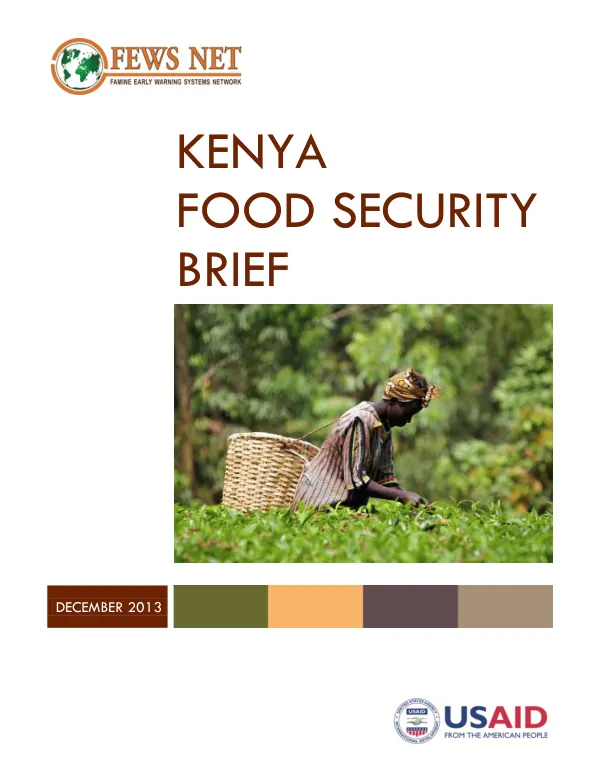
Kenya's agricultural sector is a key component of the country's economic development, providing about 25 percent of Gross Domestic Product (GDP) and directly and indirectly supporting more than 75 percent of the population.
2013 · 52 pages
Sign in to readA free account is required to download.
Abstract
The sector is a primary source of food and income for most households, despite the fact that only about 20 percent of the total land area is arable. Agriculture provides about 80 percent of the food and income for the 70 percent of the population living in rural areas. Kenya has a structural production deficit of several staples, including maize, and imports are an important source of food at the national level. Cereal imports have increased steadily in recent years, driven primarily by population growth and urbanization. Despite recent increases in maize yields, agricultural development continues to be hindered by numerous challenges, including vulnerability to weather-related shocks, limited access to inputs by some farmers, pests and disease, and lack of credit. The impact of climate change will pose a significant challenge to agricultural productivity, as the frequency of drought is expected to increase both in intensity and extent. About 40 percent of the country's population lives below the national poverty line, and most of the poor lack adequate access to basic services, including education, water and sanitation, and healthcare. Acute and chronic food insecurity is highest among households in the arid and semi-arid lands (ASALs), which cover 80 percent of the country's land area but are home to only 25 percent of the population. Poverty, low education levels, lack of economic development, and limited access to basic social services are characteristic of most parts of the ASALs. Households have low resilience to shocks as a result of repeated exposure to drought and other climate-related hazards and continued depletion of assets. Increasingly, agriculture is less viable as a means of earning a livelihood in some marginal areas due to diminishing land holdings, declining land productivity, and limited access to inputs and markets. Kenya's population is expected to nearly double in the next two decades, further straining food and income resources. The population has more than tripled over the past 30 years, greatly increasing pressure on food supplies, natural resources, basic services, infrastructure, and employment opportunities. Urbanization is another key feature of Kenya's food security situation, with rural populations typically having been at the forefront of food security concerns but urban dwellers representing an increasingly important share of the food insecure and malnourished. The agricultural sector is closely tied to domestic agricultural production, and the impact of poverty on access to food and basic services, population dynamics, shifting climate patterns, and changing demographics all play a significant role in Kenya's food security situation. The country's food security is closely tied to the four pillars of food security: availability, access, utilization, and stability. Availability refers to the physical existence of food, access refers to a household's ability to obtain foods for a nutritious diet, utilization refers to how well individuals utilize the food they access, and stability underpins the other three pillars and captures the level of uncertainty or vulnerability to future disruptions in food security. Kenya's food security situation is characterized by a complex combination of factors, including poverty, limited access to basic services, population growth, urbanization, and climate change. The country's agricultural sector is a key component of the economy, but it faces numerous challenges, including vulnerability to weather-related shocks, limited access to inputs, pests and disease, and lack of credit. The impact of climate change will pose a significant challenge to agricultural productivity, and the country's population is expected to nearly double in the next two decades, further straining food and income resources.