USAID DEC
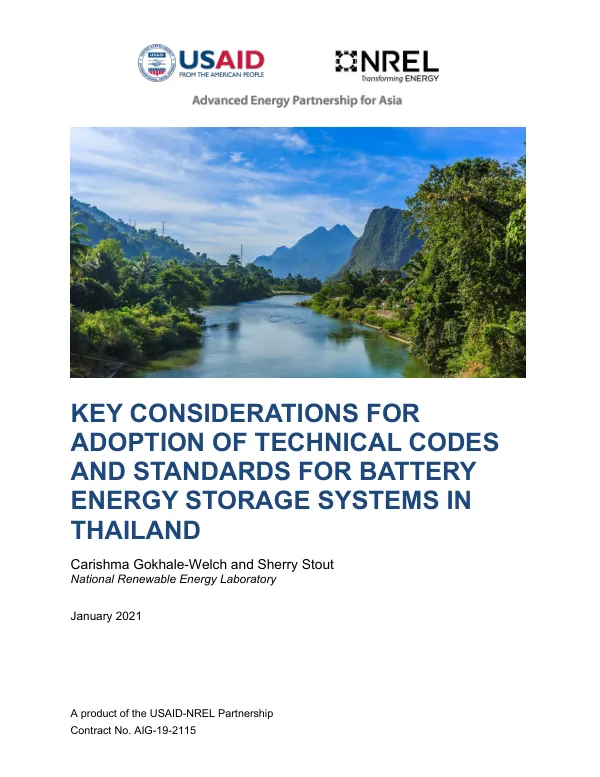
Key Considerations for Adoption of Technical Codes and Standards for Battery Energy Storage Systems in Thailand
Sign inU.S. NATIONAL RENEWABLE ENERGY LABORATORY
Key Considerations for Adoption of Technical Codes and Standards for Battery Energy Storage Systems in Thailand
The adoption of technical codes and standards for battery energy storage systems (BESS) in Thailand is a critical consideration for the country's energy sector.
2021 · 23 pages
Sign in to readA free account is required to download.
Abstract
BESS technology presents numerous opportunities for increasing contributions of variable renewable energy technologies, providing ancillary services, enabling energy access to remote areas, and increasing resilience during grid power outages. However, the use of BESS requires codes and standards similar to those for other inverter-based technologies, as well as special safety considerations in specific contexts. Several countries in Asia, including Australia, New York, and California, have developed advanced storage markets and practices that can serve as a model for Thailand. These jurisdictions have established codes and standards for the safe and reliable deployment of BESS, including guidelines for installation, operation, and maintenance. For instance, Australia has developed a comprehensive set of guidelines for the safe operation of BESS, while New York has established a framework for the interconnection of BESS to the grid. In Thailand, the adoption of technical codes and standards for BESS is crucial for ensuring public safety, maintaining a reliable grid, and meeting national, regional, and local energy goals. The Thailand Office of Energy Regulatory Commission (OERC) plays a key role in developing and implementing these codes and standards. A robust BESS market can support the increased adoption of variable renewable energy generation technologies to meet Thailand's energy portfolio goals. Key considerations for the adoption of technical codes and standards for BESS in Thailand include energy storage system components, safety, procurement, interconnection, ancillary services, and relevant interconnection standards and codes. The development of technical codes and standards should be coupled with well-defined regulatory objectives, market incentives, permitting procedures, and technical review processes to provide regulatory certainty and reduce barriers to investment. The National Renewable Energy Laboratory (NREL) has prepared this report with support from the U.S. Agency for International Development (USAID) Regional Development Mission for Asia, and in collaboration with USAID Clean Power Asia. The report presents global best practices on codes, standards, and interconnection procedures developed to support the safe and reliable deployment of BESS. Several relevant case studies highlight current efforts to ensure safe operation of BESS and showcase potential pathways for adoption of relevant codes and standards. The report emphasizes the importance of developing and prioritizing regulatory objectives and aligning them with larger policy goals to set the market context for the deployment of BESS. Regulators and operators must consider how BESS resources are going to be utilized before designing specifications and requirements for the development of new BESS systems. The report also highlights the need for specific procedures and safety measures during the installation, commissioning, and operation of BESS systems due to their inherent characteristic of being always energized. The adoption of technical codes and standards for BESS in Thailand has the potential to provide regulatory certainty, reduce barriers to investment, and support the increased adoption of variable renewable energy generation technologies. The report provides a comprehensive overview of international best practices on codes and standards developed to support the safe and reliable deployment of BESS, with a focus on lithium-ion batteries.
Related documents