USAID DEC
Khokhoba CaRe Fund Initiative – Partners in Success
The Catchment Resilience Fund (CaRe Fund) concept was developed in response to the widely recognised extent and impacts of catchment degradation in Lesotho.
2018 · 2 pages
Sign in to readA free account is required to download.
Abstract
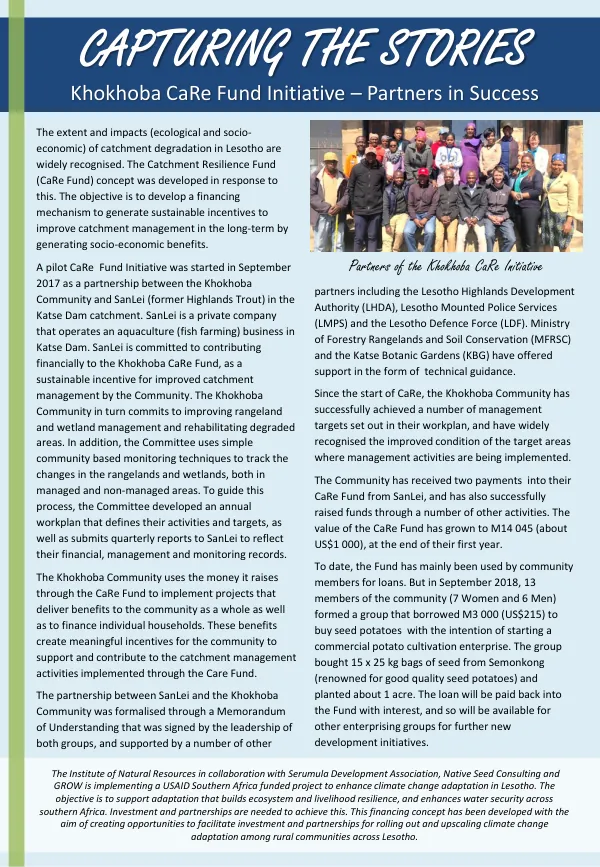
The objective of the CaRe Fund is to develop a financing mechanism to generate sustainable incentives to improve catchment management in the long-term by generating socio-economic benefits. A pilot CaRe Fund Initiative was started in September 2017 as a partnership between the Khokhoba Community and SanLei in the Katse Dam catchment. SanLei, a private company operating an aquaculture business in Katse Dam, committed to contributing financially to the Khokhoba CaRe Fund as a sustainable incentive for improved catchment management by the Community. In return, the Khokhoba Community committed to improving rangeland and wetland management and rehabilitating degraded areas. The Khokhoba Community uses simple community-based monitoring techniques to track changes in the rangelands and wetlands, both in managed and non-managed areas. To guide this process, the Committee developed an annual workplan that defines their activities and targets, as well as submits quarterly reports to SanLei to reflect their financial, management, and monitoring records. The Khokhoba Community uses the money it raises through the CaRe Fund to implement projects that deliver benefits to the community as a whole as well as to finance individual households. Since the start of CaRe, the Khokhoba Community has successfully achieved a number of management targets set out in their workplan, and have widely recognised the improved condition of the target areas where management activities are being implemented. The Community has received two payments into their CaRe Fund from SanLei, and has also successfully raised funds through a number of other activities. The value of the CaRe Fund has grown to M14,045 (about US$1,000) at the end of their first year. The partnership between SanLei and the Khokhoba Community has been formalised through a Memorandum of Understanding that was signed by the leadership of both groups, and supported by a number of other partners including the Lesotho Highlands Development Authority (LHDA), Lesotho Mounted Police Services (LMPS), and the Lesotho Defence Force (LDF). The Ministry of Forestry Rangelands and Soil Conservation (MFRSC) and the Katse Botanic Gardens (KBG) have offered support in the form of technical guidance.