THE MOUNTAIN INSTITUTE
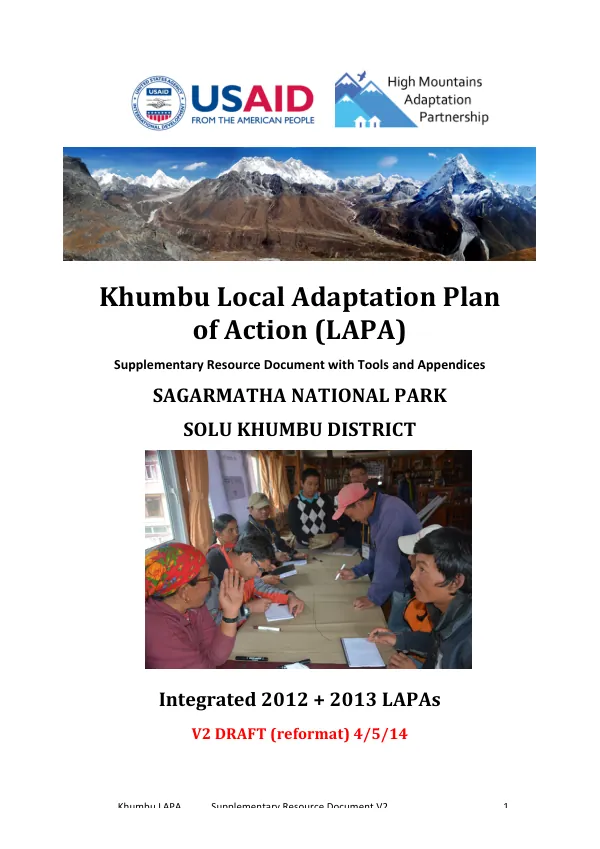
Khumbu Local Adaptation Plan of Action (LAPA) Supplementary Resource Document V2
The Government of Nepal initiated climate adaptation planning and implementation with the National Adaptation Programme of Action of 2010.
125 pages
Sign in to readA free account is required to download.
Abstract
Recognizing the enormous variability within Nepal and its various communities, Nepal was the first country in the world to pilot a formal Local Adaptation Plan of Action (LAPA) process that recognized this social and environmental complexity, as well as the wide range of climate change impacts that the country experiences. The standard GON LAPA framework was designed to consist of seven steps for integrating climate change resilience into local-to-national planning processes. These steps include sensitization/climate change awareness building, climate vulnerability and adaptation assessment, prioritization of adaptation options, developing a local adaptation plan for action, integrating the local adaptation plan for action into planning processes, implementing the local adaptation plan for action, and assessing progress of the local adaptation plan for action. The Khumbu LAPA was developed by The Mountain Institute's (TMI) Nepal Programs, supported by and in partnership with TMI's High Mountains Adaptation Partnership (HiMAP) program. As per the standard GON framework, it is based on the seven steps mentioned previously. However, one significant difference is that a focus on development and development needs was incorporated into step 1, sensitization, so that the final LAPA would in theory address both climate change as well as developmental priorities and action projects. The Khumbu LAPA contains descriptions of the key methods, processes, findings, results, and materials used in a series of community consultations and District-level meetings held between September 2012 and December 2013. It is meant to serve as a supplementary resource document to the much more condensed Khumbu summary LAPA. Participants included representatives from local communities, the Ministry of Forests and Soil Conservation, Sagarmatha National Park, SNP Buffer Zone Council, women's groups, eco-club members, teachers, Dalit (traditionally untouchable ethnic groups), NGOs, former Village Development Committees (VDC) officials, political party representatives, security forces, and porters. Eleven different LAPA tools were used throughout the course of the LAPA program, including timeline analyses, social and physical hazard mapping, climate change impact ranking, stakeholder impacts analyses, and adaptation project prioritization. Six priority climate-induced hazards were identified and ranked in order of importance, including glacial lake outburst floods (GLOFs), landslides, heavy snowfall, windstorms, forest fires, and floods. Participants determined that a total of 1,284 households would likely be affected by GLOFs and 927 households by landslides. A five-year implementation plan was developed, and prospective donors for each activity were identified. The Sagarmatha National Park and Buffer Zone, Buffer Zone Council, and VDCs were identified as the most promising organizations for mainstreaming priority LAPA adaptation initiatives into existing and future developmental budgets. A series of meetings with each of these and other organizations commenced in January 2014. The Khumbu LAPA was developed through a series of community consultations and District-level meetings held between September 2012 and December 2013. The consultations involved representatives from local communities, the Ministry of Forests and Soil Conservation, Sagarmatha National Park, SNP Buffer Zone Council, women's groups, eco-club members, teachers, Dalit (traditionally untouchable ethnic groups), NGOs, former Village Development Committees (VDC) officials, political party representatives, security forces, and porters. The consultations aimed to identify priority climate-induced hazards, assess vulnerabilities, and suggest adaptation actions. The participants identified six priority climate-induced hazards, including glacial lake outburst floods (GLOFs), landslides, heavy snowfall, windstorms, forest fires, and floods. They also determined that a total of 1,284 households would likely be affected by GLOFs and 927 households by landslides. The consultations also aimed to develop a five-year implementation plan, which was developed in collaboration with prospective donors for each activity. The plan identified the Sagarmatha National Park and Buffer Zone, Buffer Zone Council, and VDCs as the most promising organizations for mainstreaming priority LAPA adaptation initiatives into existing and future developmental budgets.
Related documents