USAID DEC
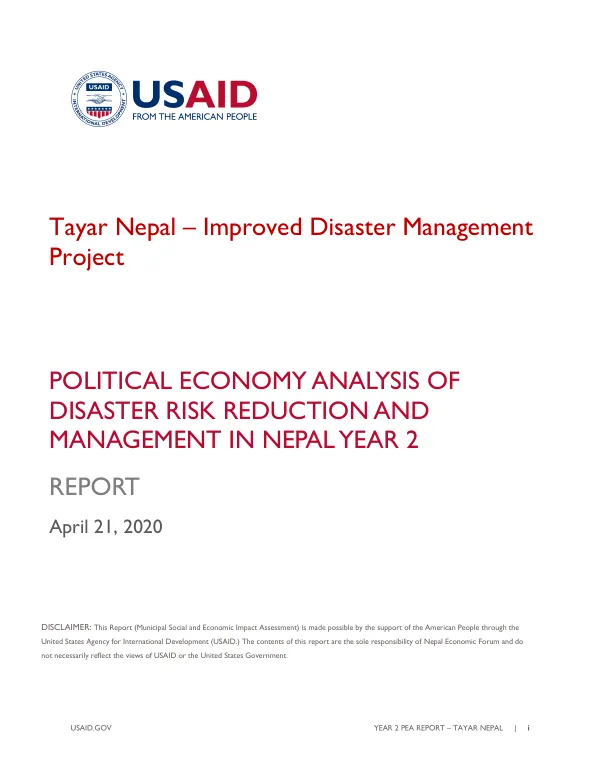
Year 2 PEA Report – Tayar Nepal: Political Economy Analysis of Disaster Risk Reduction and Management in Nepal
Sign inDAI GLOBAL, LLC
Year 2 PEA Report – Tayar Nepal: Political Economy Analysis of Disaster Risk Reduction and Management in Nepal
The Tayar Nepal – Improved Disaster Risk Reduction and Management Project is a USAID-funded initiative aimed at strengthening the capacity of Nepal's national, provincial, and municipal institutions responsible for disaster risk reduction, preparedness, and response.
2021 · 85 pages
Sign in to readA free account is required to download.
Abstract
The project focuses on building the capacity of disaster risk reduction and management (DRRM) institutions, including the newly created National Disaster Risk Reduction Management Agency (NDRRMA), at the national level. Locally, the project supports eight urban municipalities to develop risk-sensitive land use plans and implement technical assistance packages to improve disaster resilience. The project's scope of work involves informing Tayar Nepal's adaptive management, guiding national-level engagement, and targeting interventions and resources to advance disaster risk reduction and management (DRRM) in Nepal. A comprehensive political economy analysis (PEA) was conducted in 2020 to inform the project's activities, and this report builds on the findings of the PEA year 1, carried out in 2020. The major objective of this assignment is to update the findings of PEA year 1 activities to achieve the following objectives. The project's methodology involves a qualitative data collection method, including both primary and secondary data collection. Desk review of key policy, project, and legislative documents was part of secondary data collection. For primary qualitative data collection, the PEA team consulted with numerous key DRRM stakeholders at federal, provincial, district, and local levels (eight selected municipalities) and various sectors during key informant interviews (KIIs) and focus groups conducted in Tayar Nepal's eight partner municipalities. The changing context of the Year 2 PEA is characterized by the COVID-19 outbreak, which has disrupted the country's disaster risk reduction and management (DRRM) governance. The essence of federalization has not truly materialized, and the execution power of DRRM still lies with the Ministry of Home Affairs (MoHA) and Chief District Officers (CDOs). The COVID-19 disruptions have also led to the revival of DRRM governance, with a focus on building the capacity of local institutions. The rules of the game in Nepal's DRRM system are shaped by formal and informal institutions. Formal institutions include the National Disaster Risk Reduction Management Agency (NDRRMA), the Ministry of Home Affairs (MoHA), and the Chief District Officers (CDOs). Informal institutions, on the other hand, include social norms, power dynamics, and cultural practices that influence the behavior of key actors in the DRRM system. The social diversity and gender equality and social inclusion (GESI) sensitivity are still not on the priority list of the DRRM system in Nepal. The municipal DRRM capacities are also a concern, with many municipalities lacking the necessary resources and expertise to develop and implement effective DRRM plans. The identification of champions is crucial for the success of the DRRM system in Nepal. Champions are individuals or groups that can influence the behavior of others and promote the adoption of DRRM practices. The key actors in the DRRM system in Nepal include the National Disaster Risk Reduction Management Agency (NDRRMA), the Ministry of Home Affairs (MoHA), the Chief District Officers (CDOs), and the local governments. The roles of the Chief District Officers (CDOs) have been strengthened during the COVID-19 pandemic, with a focus on building the capacity of local institutions. However, the cluster system has not been activated, and the worst forest fire ever has occurred in the country. The Tayar Nepal project has identified several "early wins" in its eight partner municipalities, including the development of risk-sensitive land use plans and the implementation of technical assistance packages to improve disaster resilience. The summary of the assessment and recommendations is as follows: the COVID-19 pandemic has disrupted the country's DRRM governance, and the essence of federalization has not truly materialized. The social diversity and GESI sensitivity are still not on the priority list of the DRRM system in Nepal. The municipal DRRM capacities are a concern, and the identification of champions is crucial for the success of the DRRM system in Nepal. The key actors in the DRRM system in Nepal include the National Disaster Risk Reduction Management Agency (NDRRMA), the Ministry of Home Affairs (MoHA), the Chief District Officers (CDOs), and the local governments. The Tayar Nepal project has identified several "early wins" in its eight partner municipalities, including the development of risk-sensitive land use plans and the implementation of technical assistance packages to improve disaster resilience. The recommendations for the Tayar Nepal project include the following: the project should continue to build the capacity of local institutions, including the Chief District Officers (CDOs) and the local governments. The project should also focus on promoting the adoption of DRRM practices, including the development of risk-sensitive land use plans and the implementation of technical assistance packages to improve disaster resilience. The project should also identify and support champions in the DRRM system in Nepal, including individuals or groups that can influence the
Related documents