WWF
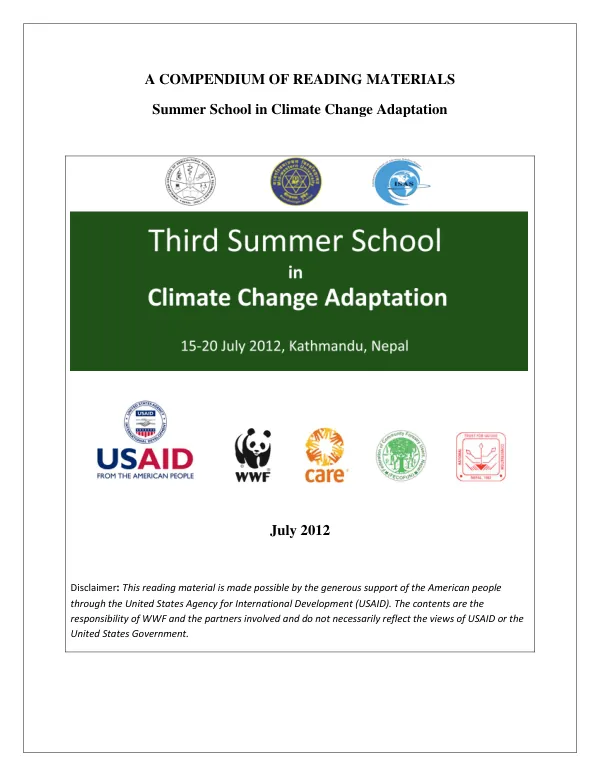
Third Summer School on Climate Change Adaptation
Climate Change is a global phenomenon characterized by changes in temperature and weather conditions on Earth.
2012 · 129 pages
Sign in to readA free account is required to download.
Abstract
These changes are caused by natural phenomena, such as the Earth's and Sun's interactions, but human-induced changes, particularly the large emission of Carbon Dioxide and other Green House Gases (GHGs), are attributed as the major cause of such changes. The concentration of Carbon Dioxide, a major GHG, has increased from 280 parts per million (ppm) before the industrial revolution to 397 ppm now. Scientists have identified cycles of global warming in the Earth's history and how nature has taken care of such changes. However, the current rate of global warming is alarming, with the average surface temperature of the Earth increasing by 0.8°C (1.4°F) since the 1900s, with most of this increase occurring after 1980. It is estimated that this may increase by another 1.1 to 2.9°C (2 to 5.2°F) over the 21st century. The threat of rising sea levels, changes in precipitation, and receding glaciers and snow lines are just a few examples of the impacts of climate change. In the Maldives, the threat of rising sea levels is feared to wipe out the entire islands from the world map. In South Asia, changes in precipitation are disturbing cultivation patterns. In Nepal's Himalayas, the threat of receding glaciers and snow lines is depleting water resources for drinking and irrigation, which could decrease quality of life and agriculture yields. To minimize the large-scale emission and deposit of GHGs in the atmosphere and prevent irreparable losses, there is a call for action. The establishment of the Inter-governmental Panel on Climate Change (IPCC) in 1988 by the UN and the endorsement of the United Nations Framework Convention on Climate Change (UNFCCC) in 1992 are major events in addressing climate change. The Kyoto Protocol, enforced in 2005, put legally binding limits for emission of GHGs for developed countries. The conference of parties (COP) is held annually to assess progress towards goals set for reducing adverse effects of climate change. The impacts of climate change can be analyzed in three broad categories: impacts on natural resources and environment, impacts on human health, and impacts on economic and social systems. Impacts on natural resources and environment include melting of ice in the arctic region, shrinking glaciers, rising sea levels, and changes in precipitation patterns. These changes can have devastating effects on ecosystems, biodiversity, and human settlements. In the context of Nepal, climate change is affecting the country's natural resources, including water resources, forests, and biodiversity. The receding glaciers and snow lines in the Himalayas are depleting water resources for drinking and irrigation, which could decrease quality of life and agriculture yields. Climate change is also affecting the country's agriculture, with changes in precipitation patterns and temperature affecting crop yields and food security. The Summer School in Climate Change Adaptation aims to enhance understanding on climate science, vulnerabilities, and socio-economic impacts of climate change and possibilities for adaptation with empowerment of people. The program incorporates articles and presentations from experts on climate change from government, academic, civil society, and international areas. The program focuses on climate change scenarios, climate change science, impact and adaptation strategies, climate change mitigation initiatives, environmental and socio-economic vulnerability, climate change impact from agriculture, food security, and livelihood perspectives, and climate change adaptation from gender and social inclusion perspectives. The program includes presentations from experts such as Mr. Suresh Pradhan, Academic Director, ISAS, Prof. Dr. Dinesh Bhuju, Academician and Consultant, Er. Adarsha Pokhrel, Experts/Consultant, Mr. Resham Dangi, REDD Forestry and Climate Change Cell, Prof. Narendra Raj Khanal, Academic Consultant, Prof. Khem Raj Dahal, Expert/Researcher, Dr. Bishwo Raj Joshi, Public Health Consultant, Ms. Meena Kunwar, Gender Expert, Dr. Judy Oglethorpe, Chief of Party - Hariyo Ban, Dr. Sunil Kumar Regmi, Coordinator, Hariyo Ban Program, Dr. Narayan Prasad Chaulagain, Dr. Swoyambhu Man Amatya, Expert, and Dr. Devendra Gauchan, Scientist and Expert. The program aims to provide a comprehensive understanding of climate change and its impacts on natural resources, human health, and economic and social systems. The program also aims to provide insights into climate change adaptation strategies and possibilities for adaptation with empowerment of people. The program is designed to enhance the understanding and skills of development professionals, researchers, and promising candidates for future professionals in the field of climate change.