USAID DEC
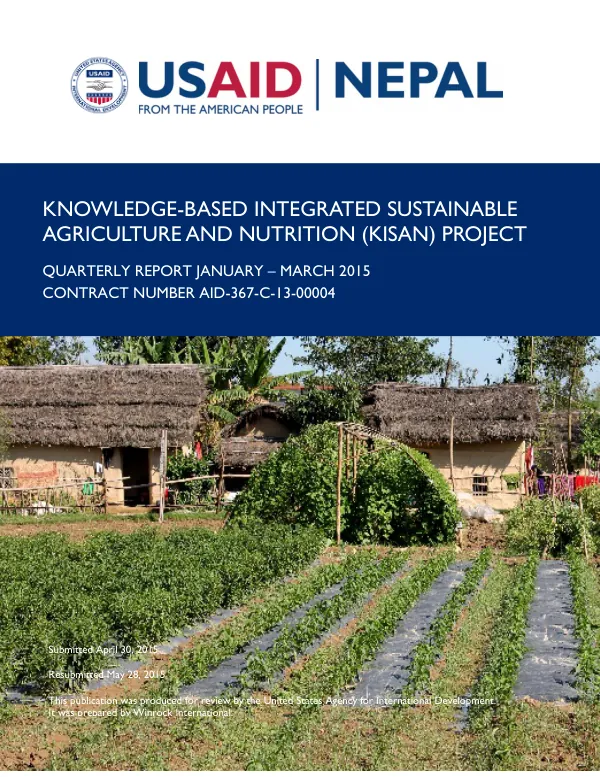
KNOWLEDGE-BASED INTEGRATED SUSTAINABLE AGRICULTURE AND NUTRITION (KISAN) PROJECT QUARTERLY REPORT JANUARY – MARCH 2015
Sign inWINROCK INTERNATIONAL FOUNDATION
KNOWLEDGE-BASED INTEGRATED SUSTAINABLE AGRICULTURE AND NUTRITION (KISAN) PROJECT QUARTERLY REPORT JANUARY – MARCH 2015
The Knowledge-based Integrated Sustainable Agriculture and Nutrition (KISAN) Project in Nepal began in 2013 with funding from the Feed the Future (FTF) Initiative.
2015 · 55 pages
Sign in to readA free account is required to download.
Abstract
The project's overall goal is to sustainably reduce poverty and hunger in Nepal by achieving inclusive growth in the agriculture sector and increasing farm family incomes. KISAN targets 20 districts in Nepal's West, Mid-West, and Far-West regions, which comprise the FTF Zone of Influence. Implementation of the project's Year 3 (Y3) Workplan began in July 2014 and continued through September 2015. This quarter's report covers the period between January 1 and March 31, 2015. The KISAN team worked closely with USAID to align all key project management documents with USAID/Nepal and the Bureau of Food Security's vision for KISAN. This included revising the Contract Scope of Work (SOW), Budget, M&E Plan, and Year 3 Annual Workplan. KISAN's overarching objective remains increasing smallholder farm incomes. The primary shift is a sharper focus on building capacities within the private sector to deliver quality agriculture inputs and services. KISAN is using a $1.2 million grant fund to help offset the costs and risks of private sector partners interested in expanding their offerings and customer base in the FTF target regions. Greater emphasis will be placed on assessing and addressing needs related to access to irrigation and finance. During this quarter, KISAN provided training to 50,077 farmers through commercial agribusinesses, Marketing Planning Committees, Government of Nepal extension agents, and local service providers. The project is now building the capacity of a total of 82,027 farmers, of which 6,137 are new farmers this quarter. KISAN has worked with farmers to produce 588 MT of rice seed and 222 MT of maize seed. The project brought together producer farmers and traders in production pockets for lentil crops and seed, resulting in a strong level of trust between seed and grains purchasers and producer farmers. KISAN also installed 69 new irrigation systems for farmer groups on a cost-share basis and rehabilitated 17 others. To ensure sustainability, 923 farmers were trained in irrigation management and maintenance. A total of 119 irrigation schemes have been installed to date, and KISAN is on target to reach 275 total installed irrigation schemes by end September. The project strengthened 1,123 savings and credit groups with 22,858 members and rolled out an innovative vendor finance product with eight agrovets, seed dealers, and machinery vendors.
Related documents