USAID DEC
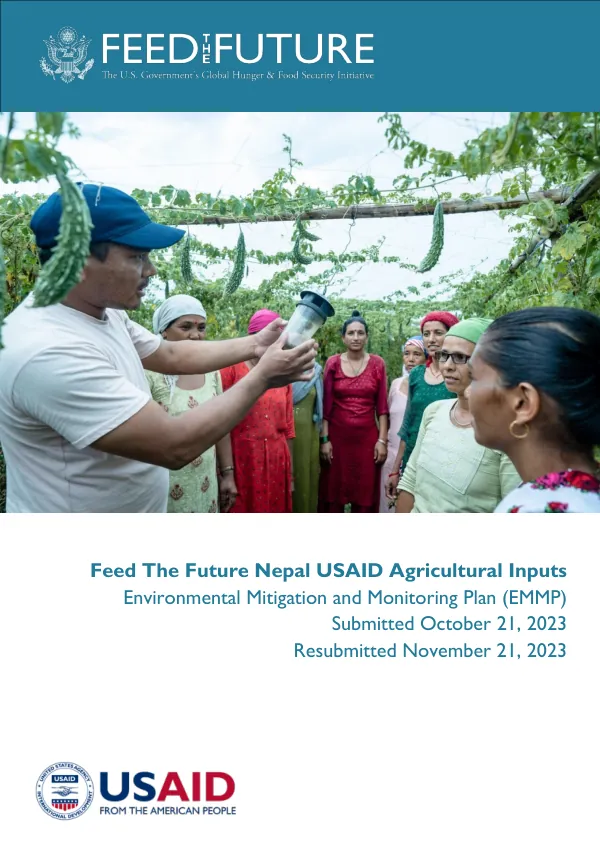
Feed The Future Nepal USAID Agricultural Inputs Environmental Mitigation and Monitoring Plan (EMMP)
Sign inMARKET SHARE ASSOCIATES
Feed The Future Nepal USAID Agricultural Inputs Environmental Mitigation and Monitoring Plan (EMMP)
The Feed the Future Nepal USAID Agricultural Inputs project aims to increase the accessibility, availability, and use of agricultural inputs and technology to improve Nepal's agricultural productivity.
2023 · 46 pages
Sign in to readA free account is required to download.
Abstract
The project will focus on market zones, working through Government of Nepal's (GON's) federal, provincial, and municipal agencies, and 200 partner firms and cooperatives to provide tailored, bundled packages of complementary information, input supplies, and access to finance for improved productivity and livelihoods of 200,000 farmers. The project will collaborate with private sector firms, farmers, and cooperatives, and GON agencies to achieve four interlinked objectives: improving the demand- and supply-responsive and financially viable seed system, enhancing soil fertility management and fertilizer distribution, improving climate adaptive and sustainable irrigation management, and increasing agricultural mechanization. The project will operate in select rural municipalities, municipalities, sub-metropolitan, and metropolitan areas of 16 proposed districts in five provinces – Sudurpaschim, Karnali, Lumbini, Bagmati, and Madesh. The project will continue to coordinate with diverse development stakeholders, and federal, provincial, and local governments to support sustainable, competitive, and inclusive market systems. As per the contract's Section F.5, Winrock International has prepared this Environmental Mitigation and Monitoring Plan (EMMP) for submission to USAID within 30 days after submitting USAID Agricultural Inputs' first year work plan, effective from June 15, 2023, through September 30, 2024. The EMMP provides a basis for systematic implementation of IEE conditions and serves as a vehicle for translating the broad programmatic-level IEE conditions into specific, implementable, verifiable actions. The EMMP is organized into three main sections: a screening of proposed tasks of USAID Agricultural Inputs per criteria outlined in the IEE to identify which tasks are Categorical Exclusion under section 22 CFR 216.2(c)(2) (i) and (iii) and do not require further actions and which tasks are Negative Determination with Conditions (NDC) under section CFR 216.3(a)(2)(iii). This section will identify tasks that require further environmental assessment and mitigation measures. The project will also address climate risks and suggested mitigation measures identified in the IEE. The EMMP will provide a framework for monitoring and reporting on environmental impacts and climate risks, ensuring that the project is implemented in a sustainable and environmentally responsible manner. The EMMP will be implemented in collaboration with diverse stakeholders, including government agencies, private sector firms, farmers, and cooperatives. The project will continue to coordinate with development stakeholders and federal, provincial, and local governments to support sustainable, competitive, and inclusive market systems. The project's objectives are aligned with the Government of Nepal's agricultural development priorities, and the EMMP will provide a basis for systematic implementation of IEE conditions and serve as a vehicle for translating the broad programmatic-level IEE conditions into specific, implementable, verifiable actions. The EMMP will ensure that the project is implemented in a sustainable and environmentally responsible manner, contributing to improved resilience, competitiveness, and inclusion in the agriculture sector.
Related documents