UNFPA
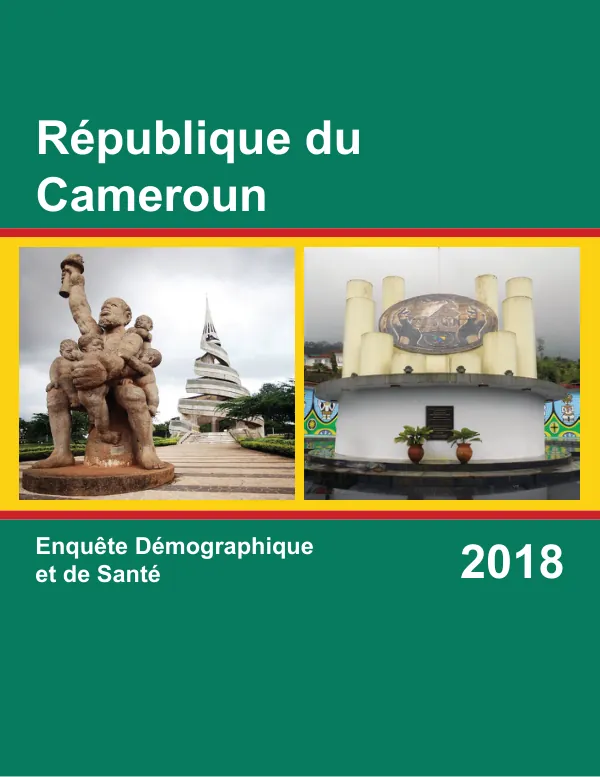
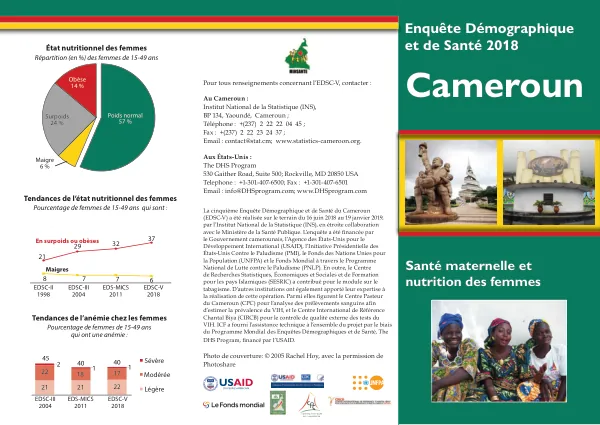
La cinquième Enquête Démographique et de Santé du Cameroun (EDSC-V)
The fifth Demographic and Health Survey of Cameroon (EDSC-V) was conducted from June 16, 2018, to January 19, 2019, by the National Institute of Statistics (INS) in close collaboration with the Ministry of Public Health.
2018 · 2 pages
Sign in to readA free account is required to download.
Abstract
The survey was funded by the Cameroonian government, the United States Agency for International Development (USAID), the President's Malaria Initiative (PMI), the United Nations Population Fund (UNFPA), and the Global Fund through the National Malaria Control Program (PNLP). The Centre for Research, Statistics, Economic, and Social Studies and Training for Islamic Countries (SESRIC) contributed to the module on tobacco use. Other institutions also provided expertise for the survey, including the Centre Pasteur du Cameroun (CPC) for the analysis of blood samples to estimate the prevalence of HIV, and the Chantal Biya International Reference Centre (CIRCB) for external quality control of HIV tests. ICF provided technical assistance to the entire project through the Global Program for Demographic and Health Surveys, The DHS Program, funded by USAID. The EDSC-V provides information on maternal health and women's nutrition. During the 2018 survey, more than 13,000 women aged 15-49 were interviewed. The survey found that 71% of recent births were protected against neonatal tetanus. Two out of three births occurred with the assistance of a trained healthcare provider. Due to security concerns, data from the South-West region are not representative of the entire region but reflect the situation in urban areas. The survey also examined prenatal care components. Among women who received prenatal care, the percentage who underwent certain examinations was as follows: measurement of height (86%), weight measurement (98%), blood pressure verification (92%), urine collection (97%), and blood collection (98%). Trends in prenatal care showed that the percentage of women who received four or more prenatal visits increased from 49% in 2004 to 62% in 2018. The percentage of women who received prenatal care from a trained healthcare provider increased from 33% in 2004 to 87% in 2018. The survey also found that 67% of births occurred in a healthcare facility, with the highest rates in the West (96%), Littoral (95%), Douala (98%), and Yaoundé (93%) regions. The percentage of births assisted by a healthcare provider increased from 37% in 1991 to 85% in 2018. The percentage of births that occurred at home decreased from 37% in 1991 to 33% in 2018. The survey also examined postnatal care. The percentage of women who received a postnatal examination within two days of birth increased with increasing levels of education. The postnatal examination rate was highest among women with secondary education (87%) and lowest among women with no education (33%). The maternal mortality ratio decreased from 782 per 100,000 births in 2011 to 467 per 100,000 births in 2018.