USAID DEC
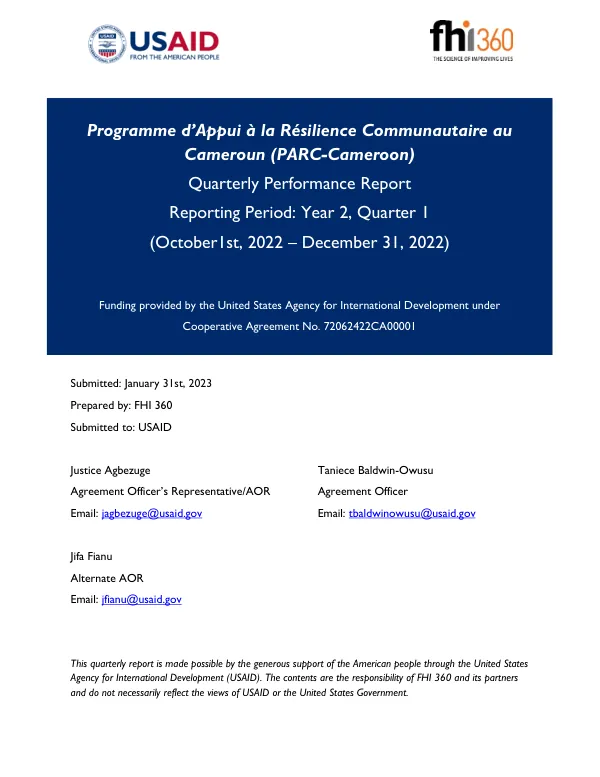
Quarterly Performance Report: Programme d’Appui à la Résilience Communautaire au Cameroun (PARC-Cameroon)
Sign inFHI 360
Quarterly Performance Report: Programme d’Appui à la Résilience Communautaire au Cameroun (PARC-Cameroon)
Programme d'Appui à la Résilience Communautaire au Cameroun (PARC-Cameroon) The PARC-Cameroon program aimed to strengthen the resilience of communities in Cameroon through institutional capacity development and community-based initiatives.
2023 · 48 pages
Sign in to readA free account is required to download.
Abstract
The program was funded by USAID under Cooperative Agreement No. 72062422. Implementation context The program operated in a challenging security environment, with Gender-Based Violence (GBV) being a significant concern. Food security and education were also major issues, with limited access to basic services in rural areas. Summary of activities and achievements The program focused on institutional capacity development with strategic partners, including training, networking, and networking initiatives. Women's organizations were empowered to address girls' education and development through analysis and advocacy. Community-based organizations (CSOs) were engaged in inclusive community analysis and response to development challenges. Progress in advancing women, peace, and security priorities Training was provided to PARC-Cameroon staff on safeguarding, with a focus on preventing and responding to GBV. The program also supported the development of a GBV strategy and action plan. Security, purchasing, and logistics The program maintained a high level of security awareness, with regular training and drills for staff. First aid and fire safety training were also provided to FHI 360 staff. Purchasing and logistics were managed through a centralized system, with regular monitoring and reporting. Monitoring, evaluation, and learning The program used a data management system to track progress and identify areas for improvement. Training was provided to partner CSOs on the MEL system, and community youth mapping was conducted to better understand the needs of target communities. Collaboration and coordination The program maintained strong relationships with USAID-Cameroon and other stakeholders, including the GBV Cluster. A coordination meeting was held with sector actors to discuss program activities and challenges. Lessons learned The program identified several lessons, including the importance of community engagement and the need for more effective monitoring and evaluation systems. Challenges The program faced several challenges, including security concerns, limited access to basic services, and the need for more effective monitoring and evaluation systems. Annexes The annexes include a tracking table for performance indicators, a summary of the program in English and French, and a visualization of the implementation areas.