USAID DEC
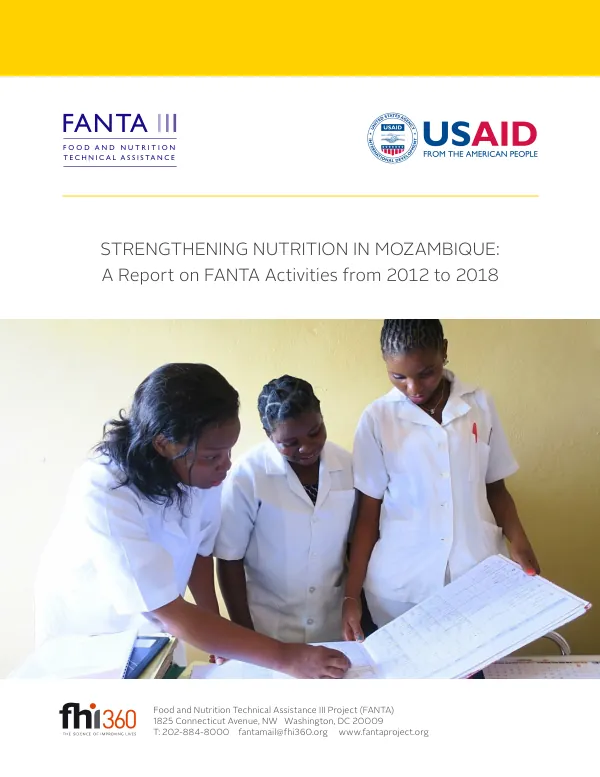
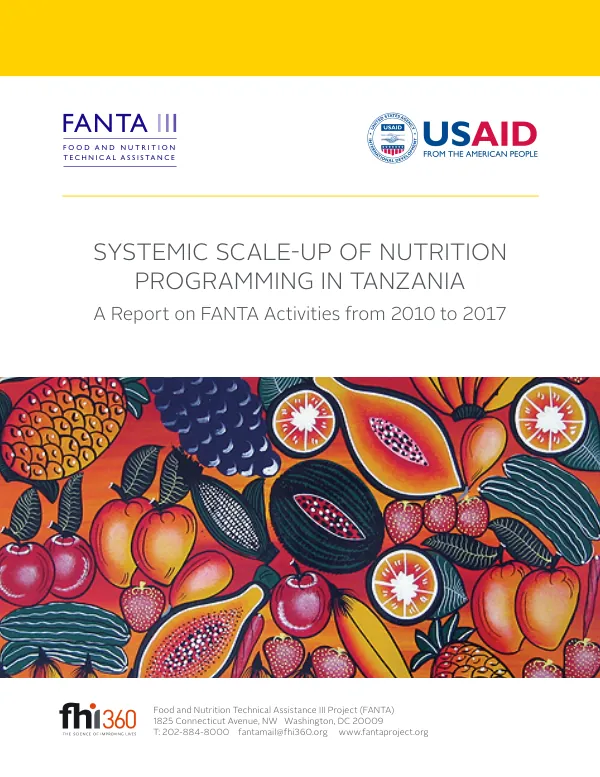
Systemic Scale-Up of Nutrition Programming in Tanzania: A Report on FANTA Activities from 2010 to 2017
Sign inELIZABETH GLASER PEDIATRIC AIDS FOUNDATION
Systemic Scale-Up of Nutrition Programming in Tanzania: A Report on FANTA Activities from 2010 to 2017
Undernutrition in Tanzania remains unacceptably high, with one in three children under 5 years (34 percent) being stunted and 14 percent being underweight, according to the Tanzania Demographic and Health and Malaria Indicator Survey 2015–16: Key Findings.
2017 · 20 pages
Sign in to readA free account is required to download.
Abstract
The population growth in Tanzania has led to an increase in the absolute numbers of undernourished people. The country also suffers from the double burden of undernutrition and overnutrition, with the incidence of diet-related non-communicable diseases increasing rapidly. Approximately half of children under 5 (58 percent) and women of reproductive age (45 percent) suffer from anemia. The Government of Tanzania (GOT) has expanded its political commitment to addressing nutrition, recognizing the value of investing in nutrition for national development and economic productivity. The GOT revised the National Nutrition Strategy 2011/12–2015/16, formed a High-Level Steering Committee on Nutrition, updated the national Food and Nutrition Policy, and developed a national Multi-Sectoral Nutrition Action Plan (MNAP) and Common Results Framework to translate policy into action and results. Nutrition Steering Committees have been formed in Local Government Authorities (LGAs) to facilitate multi-sectoral coordination and the engagement of key stakeholders. FANTA supported government-led efforts through the Tanzania Food and Nutrition Centre (TFNC) to build capacity to integrate nutrition assessment, counseling, and support (NACS) into health facility and community services. This support resulted in the systematic scale-up of NACS, capacity building of health managers, healthcare providers, and community workers, national guidelines on nutrition care and support for people with HIV, and training and reference materials for facility- and community-based service providers. With leveraged support from implementing partners, NACS services have been integrated into health facilities and community services in 22 of mainland Tanzania's 26 regions. The NACS approach aims to improve the nutritional status of individuals and populations by integrating nutrition into policies, routine health service delivery, and community and other programs. FANTA supported the operationalization and institutionalization of NACS in health facility and community service delivery, with leveraged support from implementing partners. The USAID Multi-Sectoral Nutrition Strategy 2014–2025 highlights the effectiveness of NACS in increasing access to nutrition services and strengthening health systems. From 2010 to 2017, FANTA/Tanzania worked with TFNC and LGAs in a government-led effort to operationalize and institutionalize NACS. FANTA supported the development of national guidelines on nutrition care and support for people with HIV, and training and reference materials for facility- and community-based service providers. The organization also collaborated with Tanzanian filmmakers to produce a nutrition feature film to model dietary diversity and optimal infant feeding and WASH practices and to increase utilization of health services to reduce stunting. This report summarizes FANTA's achievements and results in Tanzania over the past 8 years, showcasing multi-stakeholder collaboration, highlighting challenges and how they were addressed, and providing recommendations for future programming. The NACS training package for facility-based providers was first introduced in 2011, and the rollout of NACS training and supportive supervision with implementing partners began in 2012. In 2014, Tanzania PROFILES was supported, and NACS training and supportive supervision were implemented in 30 Partnership for HIV-Free Survival sites. The Food and Nutrition Policy and Implementation Strategy were revised in 2015, and the second edition of NACS training and reference materials was developed in 2016. The Roadmap for the MNAP 2016/17–2020/21, costed Multisectoral Nutrition Governance and Nutrition-Sensitive Interventions action plans, and the final community NACS training package were also developed in 2016. The Ngoma ya Roho feature film on nutrition and stunting was launched in 2017.
Related documents