USAID
La Clausura y Restauración del Botadero de Santa Barbara
The closure and restoration of the Botadero de Santa Barbara began in 2009 with the support of USAID through the PROLAGO project.
2011 · 2 pages
Sign in to readA free account is required to download.
Abstract
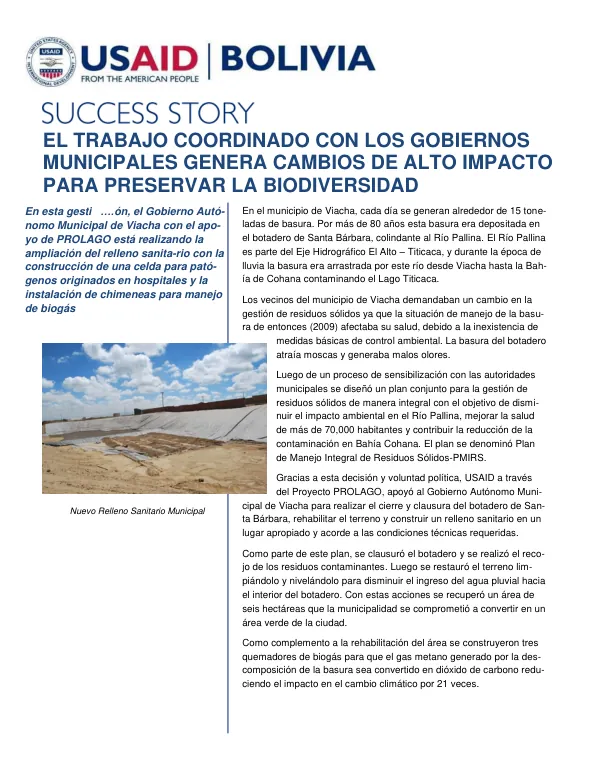
The area had become a major source of pollution, with residents dumping their trash in the river and its margins. The situation had worsened over the years, with the population growing and a lack of proper waste management systems. By the 2007-2008 period, some residents had even started raising pigs on the waste, posing a significant health risk. The high levels of contamination in the area had a severe impact on the local population, particularly children, who suffered from diarrhea and other waterborne diseases. The pollution also affected the Río Pallina, causing a significant increase in organic waste in the river and its tributaries, which in turn contaminated the waters that feed the Bahía de Cohana and Lake Titicaca. In response to the situation, the Government Municipal Autónomo of Viacha, with the technical and financial support of USAID, initiated actions to close the area. The project involved the formation and stabilization of solid waste in the botadero, the construction of biogas capture systems, drainage channels, and a pool for capturing and storing leachates. The area was also made impermeable to prevent further contamination. By May 2009, a total area of 30,000 square meters had been cleaned up, with a total investment of Bs. 385,000. In addition, PROLAGO supported the construction of a municipal sanitary landfill to prevent the improper disposal of solid waste. The landfill included the impermeabilization of a leachate pool and the construction of a biogas capture system. As of September 2011, the area had been successfully restored, with the waste properly stabilized and awaiting conversion into a green area. The surrounding conditions had also improved, with the disappearance of bad odors and mosquitoes, and the loss of the stigma associated with living near a landfill. This had led to the reappearance of new homes and the practice of agriculture in some areas. The restoration of the area had also contributed positively to the reduction of water pollution in the Bahía de Cohana (Lake Titicaca) region, improving the local biodiversity and environmental health.