CHEMONICS
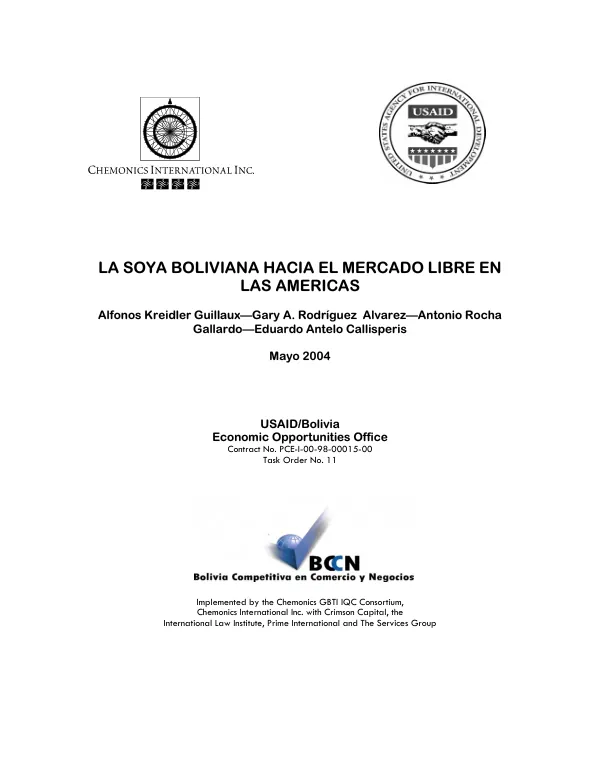
LA SOYA BOLIVIANA HACIA EL MERCADO LIBRE EN LAS AMERICAS
The Bolivian Soybean Industry Towards the Free Trade in the Americas began in 2004 with the implementation of a project by the Chemonics GBTI IQC Consortium, led by Chemonics International Inc.
206 pages
Sign in to readA free account is required to download.
Abstract
with Crimson Capital, the International Law Institute, Prime International, and The Services Group. The project was funded by USAID/Bolivia's Economic Opportunities Office under Contract No. PCE-I-00-98-00015-00 and Task Order No. 11. The project's main objective was to improve the competitiveness of the Bolivian soybean industry and increase its participation in the regional market. To achieve this goal, the project focused on three key areas: improving the quality of soybeans, increasing the efficiency of the production process, and enhancing the industry's institutional capacity. In terms of quality improvement, the project implemented a certification program for soybean producers, which aimed to ensure that the soybeans met the required standards for export. The project also provided training to producers on best practices for soybean production, including the use of improved seeds and fertilizers. To increase the efficiency of the production process, the project implemented a system for tracking and monitoring the production and transportation of soybeans. This system allowed for better management of the supply chain and reduced the risk of losses due to spoilage or theft. In terms of institutional capacity building, the project provided training to industry associations and government agencies on issues related to soybean production and trade. The project also supported the development of a soybean industry association, which aimed to promote the interests of the industry and facilitate communication between producers, processors, and exporters. The project also focused on improving the infrastructure for soybean production and trade. This included the construction of storage facilities, roads, and other infrastructure necessary for the efficient transportation of soybeans. The project's geographic focus was on the eastern region of Bolivia, where the majority of the country's soybean production takes place. The project worked with local producers, processors, and exporters to improve the competitiveness of the industry and increase its participation in the regional market. The project's timeframes were from 2004 to 2007, with a total duration of three years. The project's recommendations included the continued implementation of the certification program for soybean producers, the expansion of the tracking and monitoring system for soybean production and transportation, and the continued support for the development of the soybean industry association. The project's findings and conclusions highlighted the importance of improving the quality of soybeans, increasing the efficiency of the production process, and enhancing the industry's institutional capacity. The project's recommendations were based on the analysis of data collected during the project's implementation and were aimed at improving the competitiveness of the Bolivian soybean industry and increasing its participation in the regional market. The project's methodology included the collection of data on soybean production and trade, the analysis of market trends and consumer preferences, and the identification of opportunities for improvement in the production and trade of soybeans. The project's conclusions were based on the analysis of the data collected and the recommendations were aimed at improving the competitiveness of the Bolivian soybean industry.
Related documents