USAID DEC
La última jornada del LIC: Cierre de la primera fase y selección de prototipos
The Local Innovation Community (LIC) concluded its first phase in November with a closing ceremony.
2020 · 2 pages
Sign in to readA free account is required to download.
Abstract
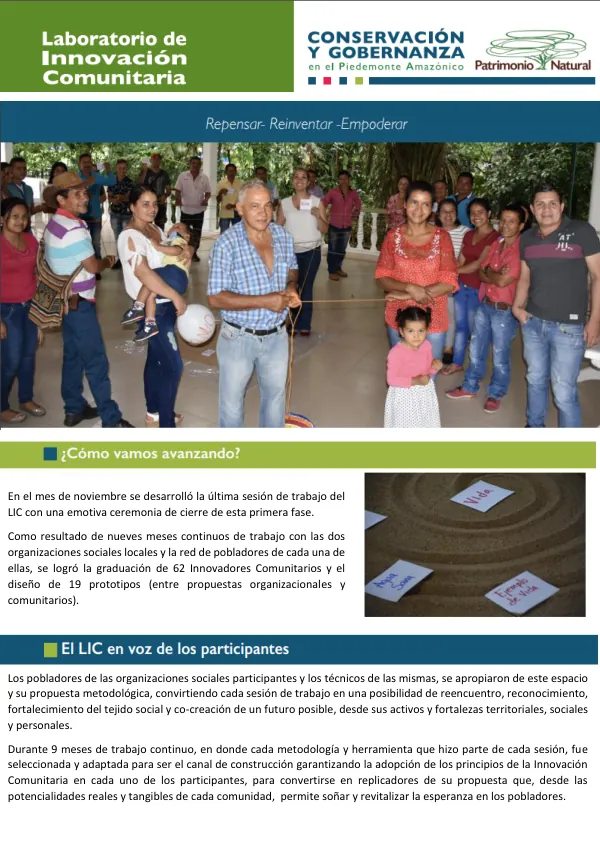
After nine months of continuous work with two local social organizations and their respective networks, 62 Community Innovators were graduated and 19 prototypes were designed, including organizational and community proposals. The participants, including local residents and technical staff, adopted the LIC space and methodology, transforming each working session into a reunion, recognition, and strengthening of social bonds, as well as co-creation of a possible future based on their territorial, social, and personal assets. The LIC's learn-by-doing approach is based on three guiding methodologies: the Theory U (Scharmer, 2007), Asset-Based Development, and Change Theory. By generating significant learning spaces that combine the community and its territory, the goal is to achieve significant learning that originates a scaled process of new opportunities through innovation and new mental models. The current prototyping phase allows for the guided combination of doing, feeling, and knowing, resulting in the concretization of ideas and proposals into a better reality for all. The evaluation and final selection of initiatives to be funded and implemented in 2019 will begin. This final session was an opportunity to close a challenging process that enabled the construction of 19 prototypes, accompanied by experts from the Conservation and Governance Program. These prototypes will be subject to a selection process in December, using a multicriteria matrix to evaluate the selected criteria and ensure a documented and supported selection. The evaluation criteria were presented and voted on by the attending community members, making them part of the selection phase. The results will be presented by the Conservation and Governance Program coordination in December, marking the beginning of the funding and implementation phase. The new version of the LIC focuses on the Soil and Water Conservation District of Caquetá, serving as the main axis for activities and proposals in this learning space and generation of lessons learned. The 19 initiatives proposed by the organizations and their residents have a community-oriented focus, with clear social, economic, and environmental aspects guided by conservation and care principles for water sources, forests, and trails inhabited by the new community innovators. The implementation of selected prototypes will strengthen the LIC's training process (with the triad of Being-Organization-Territory) and the launch of its learn-by-doing strategy, aiming to consolidate the capacity installed in the territory. For 2019, significant advances, developments, and achievements are expected for the LIC, and it is hoped that these will become a reality for each person who made this a reality.
Related documents