USAID DEC
La voz del Gera: lecciones aprendidas para impulsar un mecanismo de retribución por servicios ecosistémicos
Sign inUSAID
La voz del Gera: lecciones aprendidas para impulsar un mecanismo de retribución por servicios ecosistémicos
However, this document focuses on a different project, "Impulsando Mecanismo de Retribución por Servicios Ecosistémicos en la cuenca del Gera, Distrito de Jepelacio, Moyobamba, San Martín," which aimed to implement a mechanism of retribution for ecosystem services in the Gera River basin.
2014 · 19 pages
Sign in to readA free account is required to download.
Abstract
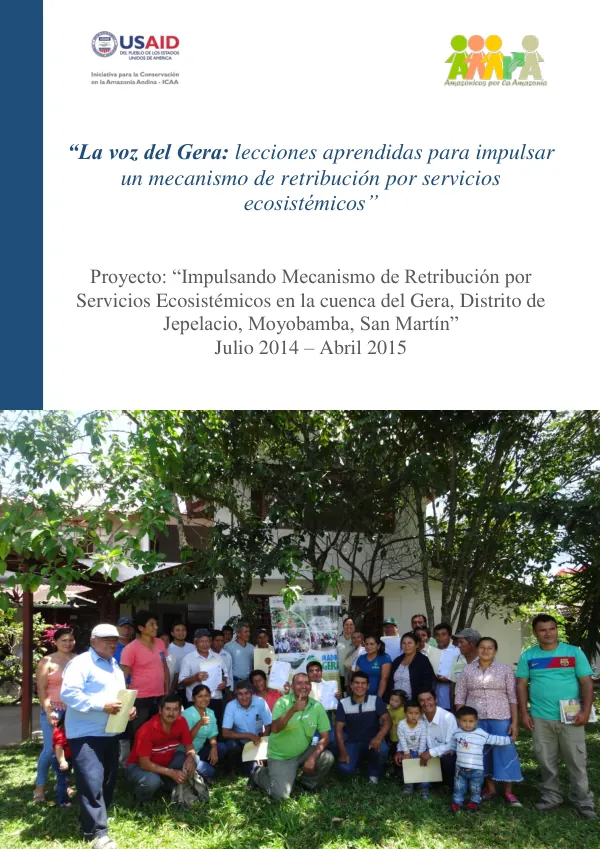
The project was located in the Amazonian Andean region of Peru, specifically in the district of Jepelacio, province of Moyobamba, region of San Martín. By 2010, 62.23% of the Gera River basin lacked forest cover due to inadequate management of productive activities by local residents. This led to problems such as water contamination, soil instability, increased sedimentation, and river flow instability, as well as elevated deforestation indices. The project's context and area of knowledge highlight the importance of conserving ecosystem services, such as water regulation, sediment reduction, aquifer recharge, scenic beauty, and hydrological performance. The project aimed to reduce deforestation rates and promote sustainable land use practices in the Gera River basin. The project's objectives were to sensitize the population and strengthen capacities, implement the mechanism of retribution for ecosystem services, and systematize the experience and lessons learned. The project was implemented from July 2014 to April 2015 and involved a range of activities, including a campaign of sensitization, workshops on conservation, biodiversity, and ecosystem services, and the incorporation of good agricultural practices. The project's methodology involved participatory information collection and analysis, including interviews with participating actors, field visits, observation, and bibliographic review. The project's results and lessons learned are presented in the document, which aims to provide a useful tool for those working on the recovery and conservation of ecosystem services. The project's lessons learned highlight the importance of research as a source of information for implementing strategies, capacity building as a source of empowerment for the population, the role of women as a motor of growth and social inclusion, and the importance of forming a diverse management committee headed by the population. The project also emphasizes the need for a communication strategy as a tool for sensitization, the importance of implementing incentives as a strategy for signing conservation agreements, and the need for an integral approach to the intervention within the basin. The project's success factors were the commitment and trust of the population, the idea of a campaign of sensitization that changed the technical name of the project to a more accessible name, the involvement of local organizations such as the rural patrols, key actors such as the local government, the water authority, Electro Oriente, the Solidarity Foundation, and the Regional Environmental Authority, and the personal factor, people committed, identified, who know and dominate the subject, and who feel passion and love for what they do. The project was supported by the Initiative for Conservation in the Amazonian Andean Region II (ICAA), a regional program of the United States Agency for International Development (USAID) with local and international partners in Bolivia, Colombia, Ecuador, and Peru. The project's themes of retribution for ecosystem services are directly connected to ICAA's central objective of conserving the Amazonian biome through the reduction of deforestation rates and biodiversity loss, contributing to the effective functioning of natural resource governance and the improvement of the quality of life of Amazonian peoples.
Related documents