CREATIVE ASSOCIATES INTERNATIONAL INC.
In-Depth Implementation Assessment (Option Period 2)
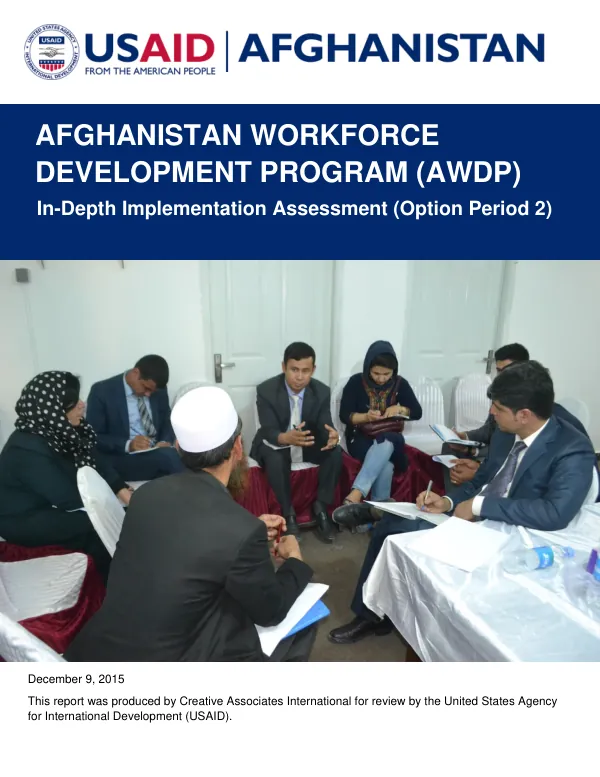
The Afghanistan Workforce Development Program (AWDP) began a qualitative assessment in the first quarter of Option Period 2 (OP-2) to evaluate the implementation of the AWDP model.
2015 · 16 pages
Sign in to readA free account is required to download.
Abstract
This assessment involved face-to-face interviews with private sector entity (PSE) employers who had benefited from AWDP's trainings, placements, and promotions. The interviews were conducted over a two-week period in May 2015, and the results were used to inform the program and improve its implementation. The AWDP model is designed to be adaptable and Afghan-led, allowing for changes based on the needs expressed by the Afghan private sector. The model consists of four pillars: demand assessment, curricula development or adaptation, competency-based training design and delivery, and employment-related services. The training providers funded through the AWDP program are provided technical support to better meet the needs of the private sector while meeting the obligations of their grant agreements. The assessment revealed that the AWDP model was effective in meeting the needs of the private sector, with PSE employers expressing satisfaction with the quality and effectiveness of the training. The focus groups and interviews also highlighted the importance of employment-related services, which were seen as essential in preparing employees for the professional work environment. The AWDP introduced the Master Training of Trainers (MToT) workshops in April 2015, which had a positive impact on PSE focus group feedback in May and June 2015. The successful MToT workshops continued through August 2015, and additional focus groups and roundtable meetings were held in the third quarter of OP-2 to further develop the AWDP model. The assessment methodology used by AWDP included private sector interviews and focus groups, as well as meetings with AWDP grantees. The interviews and focus groups were conducted in person and face-to-face, and the results were used to inform the program and improve its implementation. The assessment was also conducted as a form of qualitative research, which was organized into themes to further inform the program down the line. The AWDP model has been successful in meeting the needs of the private sector, with PSE employers expressing satisfaction with the quality and effectiveness of the training. The model has also been effective in preparing employees for the professional work environment, with employment-related services being seen as essential. The AWDP has continued to develop and refine the model, with additional focus groups and roundtable meetings held in the third quarter of OP-2 to further improve its implementation. The AWDP has also recognized the importance of addressing the concerns of marginalized groups, including women-owned PSEs and civil society. The AWDP has held focus groups with these groups to gather feedback and recommendations, and has used this information to inform the program and improve its implementation. Overall, the AWDP has been successful in meeting the needs of the private sector and preparing employees for the professional work environment. The model has been effective in adapting to the needs of the private sector, and has continued to develop and refine its implementation. The AWDP has also recognized the importance of addressing the concerns of marginalized groups, and has used this information to inform the program and improve its implementation.