GOVERNMENT OF COLOMBIA
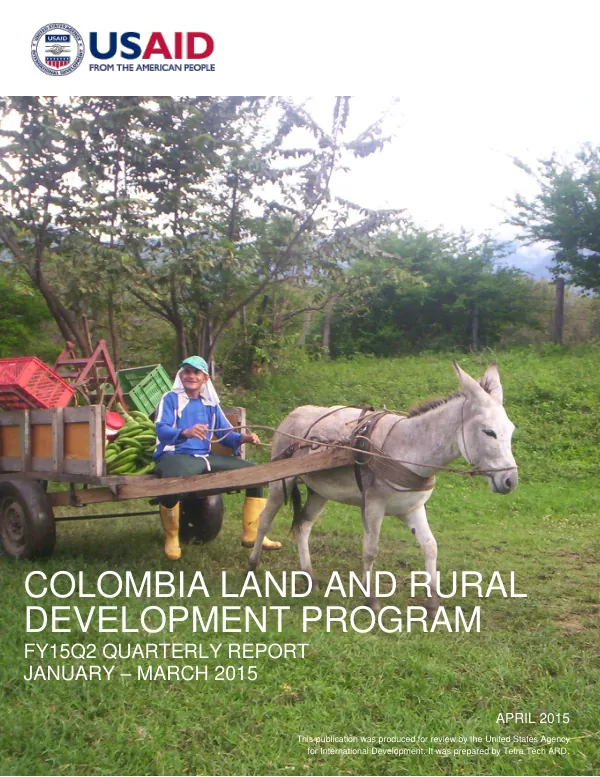
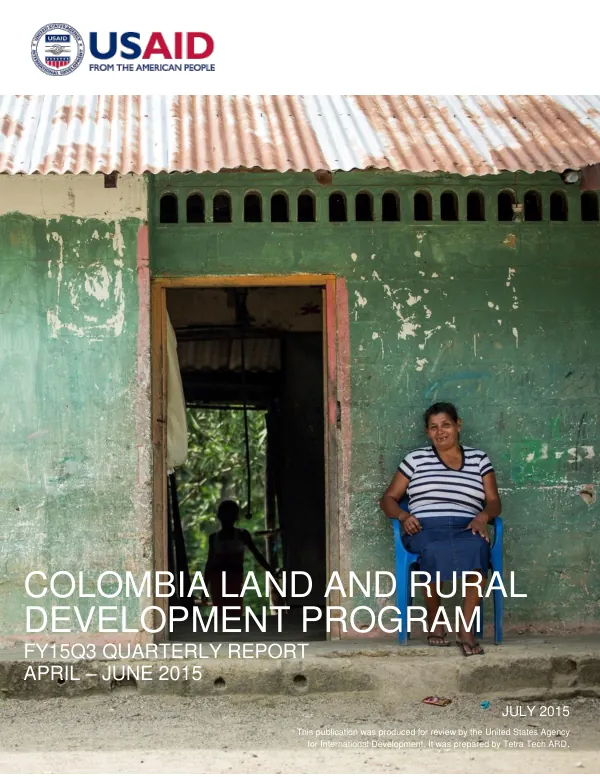
Land and Rural Development Program: FY15Q3 Quarterly Report (April 2015–June 2015)
The Land and Rural Development Program (LRDP) in Colombia aims to build capacity and bridge the gap between government institutions addressing land-related issues.
2015 · 45 pages
Sign in to readA free account is required to download.
Abstract
LRDP interventions facilitate the government's ability to sustainably address these challenges. This quarter, LRDP provided technical inputs to the newly approved National Development Plan (NDP), a four-year government plan and budget that establishes guidelines for growth and improvement in the country. The NDP outlines the steps to meet these goals, including the establishment of the Land Authority, a new entity charged with streamlining land formalization procedures, and the Rural Development Fund. The Land Authority and the fund are critical for promoting legal security, well-being, and economic development for citizens in rural areas. LRDP will support the government in seizing the opportunity to take advantage of the president's extraordinary powers to fulfill these mandates by December 9, 2015. LRDP also supported the identification of 22,821 land parcel registration files for possible inclusion in the Land Fund, representing nearly half of the government's overall inventory goal of 47,000. The Land Fund is recognized as vital to sustainable peace and prosperity in Colombia and is referenced in point one of the peace talks. Additionally, LRDP supported a large-scale analysis of 107,945 baldíos (public lands) contained in two government land databases. The findings showed that 51,015 of these still require formal registration, and LRDP is helping the Colombian Institute for Rural Development (INCODER) develop methodologies to ensure these lands are registered, giving campesinos legal land security. The Program is also supporting the development of new legislation that will allow formalization to occur on a massive scale and facilitate transformational land reform in Colombia. Local and international experts collaborated with LRDP to complete a policy note that provides recommendations for legislative design. The policy note analyzes current judicial and administrative processes, highlights the critical need for gender considerations, identifies methods for ensuring the sustainability of the formalization process, and outlines the role that the new institutional framework must play. In a cross-cutting activity, LRDP made progress in the development of the Land Node, a web-based platform that will facilitate the sharing of key information across eight key government entities. Through technical assistance, the Landowner Search System and Ethnic Module of the Land Node are now fully operational. The Landowner Search System allows entities to quickly search land ownership data by entering a person's cédula, or national ID number, reducing the time it takes to access this information from one hour to four minutes. The Ethnic Module is the country's first-ever electronic platform to provide systematized information on indigenous and Afro-Colombian variables, reducing the processing time for registering and analyzing ethnic restitution cases by 55%. Sustainable rural development in Colombia's hardest-to-reach areas is essential for lasting peace and prosperity. LRDP helped create a new regional civil society network, the Network for the Modernization of Rural-Sector Institutions, which draws on the technical knowledge emanating from each region. The network contains over 400 members from academia, trade unions, businesses, community organizations, and small farmers from ten regions, bridging the gap between regional citizens and the national-level government, ensuring that rural development policies created at the national level accurately represent the needs and interests of the communities. LRDP's efforts aim to promote legal security, well-being, and economic development for citizens in rural areas, facilitate transformational land reform, and support sustainable rural development in Colombia's hardest-to-reach areas. The Program's interventions are critical for lasting peace and prosperity in Colombia.