GOVERNMENT OF COLOMBIA
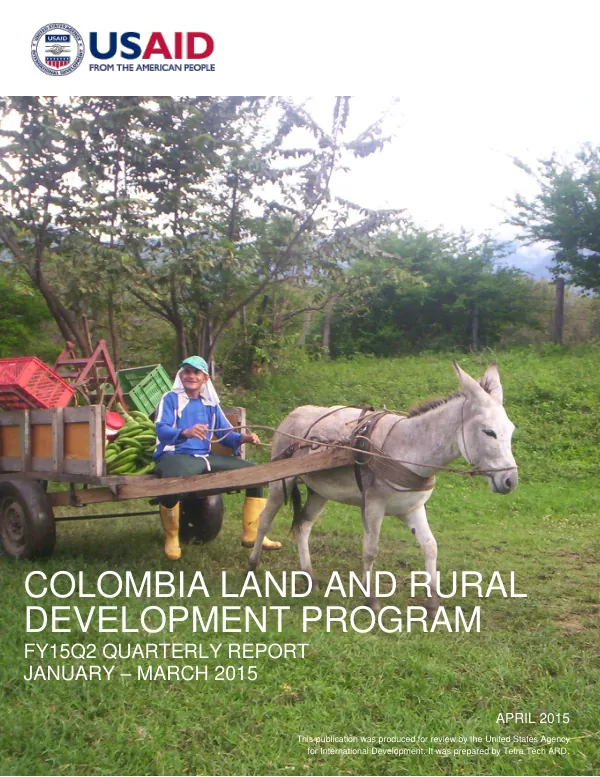
Land and Rural Development Program: FY15Q2 Quarterly Report (Jan. 2015–Mar. 2015)
The Land and Rural Development Program (LRDP) is working effectively with Government of Colombia (GOC) entities at the national and regional levels to address challenging and complex issues that have plagued the country and fueled conflict for years.
2015 · 41 pages
Sign in to readA free account is required to download.
Abstract
The program's relationship with the Land Restitution Unit (LRU) is thriving, primarily due to efforts to initiate joint committee meetings between the LRU, USAID, and LRDP. This has proven to be an effective planning and coordination platform. Technical assistance provided to the LRU has helped address the serious challenges revolving around secondary occupants. The Victims Law does not provide guidelines for addressing cases where families are currently occupying land restituted to victims. The LRU estimates that there are 4,538 secondary occupants, which is one of six key indicators being tracked throughout the life of the Program. Improved access to quality, digital data is essential for making the land restitution, land titling, and registration process quicker. During the reporting period, the Agustin Codazzi Geographic Institute (IGAC) digitalized more than 624,000 property records, giving Colombia's national cadastral authority real-time access to land data for 995 of Colombia's 1,100 municipalities. The Ministry of Agriculture and Rural Development (MARD), a major Program counterpart, continued to be in flux with frequent personnel changes. Despite this, the Program has continued to support MARD's efforts, including the development of projects that were approved for financing, representing an estimated value of US$3.3 million. These projects will benefit a host of families in Montes de María and Southern Tolima. For example, the municipality of Los Palmitos (Sucre) increased its agricultural funding by approximately 650% between 2014 and 2015. Another important achievement was the analysis of 3,148 identification files belonging to land parcels that could potentially feed into the Land Fund, as part of the support to the Superintendent of Notary and Registry (SNR) in responding to Sentence T-488 of the Constitutional Court. This result represents an important advance in another one of the Program's key indicators. Program staff played an instrumental role in facilitating the inclusion of key elements in the GOC's National Development Plan (NDP). The NDP defines the strategy to allocate government resources through 2018 to priority initiatives. The Program's support to the National Planning Department's Rural Mission initiative is a critical endeavor. Rural Mission aims to modernize rural Colombia through an improved institutional framework that will facilitate and quicken the delivery of public goods and services throughout the country. The Program has also taken several actions to improve operations and communicate its story more effectively, including revising the Activity Monitoring and Evaluation Plan (AMEP) in close coordination with USAID. The new AMEP includes 21 indicators, of which six are considered "key indicators."
Related documents