USAID DEC
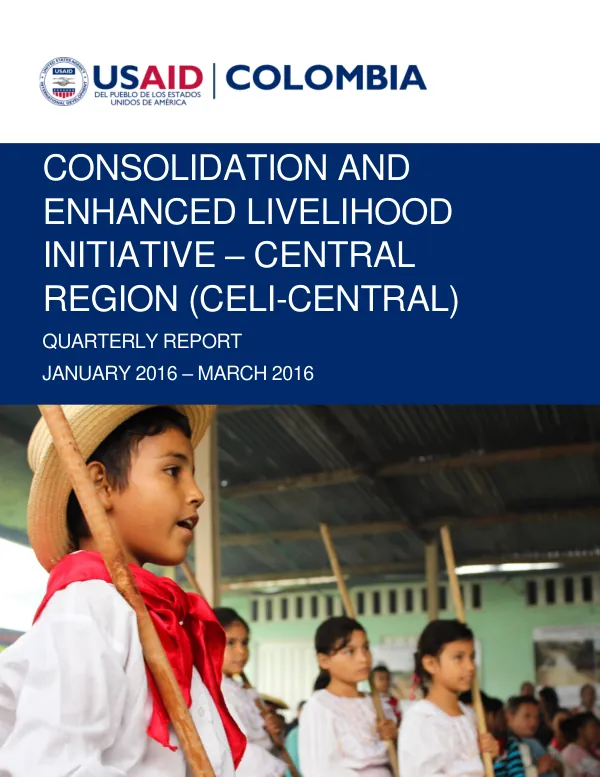
Consolidation and Enhanced Livelihood Initiative – Central Region (CELI-Central) Quarterly Report – January 2016-March 2016
Sign inGOVERNMENT OF COLOMBIA
Consolidation and Enhanced Livelihood Initiative – Central Region (CELI-Central) Quarterly Report – January 2016-March 2016
The Consolidation and Enhanced Livelihood Initiative – Central Region (CELI-Central) is a program aimed at empowering smallholder producer associations and expanding private sector investment in rural communities.
2016 · 47 pages
Sign in to readA free account is required to download.
Abstract
The program has invested a total of $8.6 million and leveraged $38.4 million from public and private sources. During the period of January to March 2016, CELI-Central began drawing its original four integrated activities to a close and designed a series of complementary integrated activities for implementation during the last year of operation. A further investment of $23.4 million was approved this quarter, with CELI-Central committing $9.2 million. These contributions will support strong organizational structures, the participative creation of business plans with a strategic vision for development, improved planning and marketing capacities, and training to foster a generational shift. The program's focus has increasingly been on empowering and mobilizing smallholder producer associations, and expanding private sector investment in rural communities to create economic opportunities for community stakeholders within the context of licit markets and the rule of law. CELI-Central has made significant progress in its efforts to create economic opportunities for community stakeholders. The program has accelerated the creation of two tailor-made Public-Private Partnerships (PPPs) with an investment of $1.2 million from USAID, and the participation of organizations in the rubber- and coffee-producing sectors in Caquetá, Cauca, and southern Tolima. A key outcome of these partnerships was the launch of the first ever international Colombian rubber trading company in February 2016. The program has also made significant progress in its efforts to empower smallholder producer associations. CELI-Central has provided training and capacity-building support to these associations, enabling them to develop business plans and improve their planning and marketing capacities. The program has also worked to create a favorable business environment for these associations, by promoting the rule of law and licit markets. In Caquetá, CELI-Central has worked with the local government and private sector organizations to develop a comprehensive plan for the rubber-producing sector. The plan aims to increase productivity and competitiveness in the sector, and to create economic opportunities for smallholder producers. In Cauca, the program has worked with local organizations to develop a plan for the coffee-producing sector, which aims to improve the quality and productivity of coffee production, and to create economic opportunities for smallholder producers. In southern Tolima, CELI-Central has worked with local organizations to develop a plan for the coffee-producing sector, which aims to improve the quality and productivity of coffee production, and to create economic opportunities for smallholder producers. The program has also worked to promote the rule of law and licit markets in these regions, by supporting the development of local institutions and promoting good governance practices. Overall, CELI-Central has made significant progress in its efforts to empower smallholder producer associations and expand private sector investment in rural communities. The program's focus on creating economic opportunities for community stakeholders within the context of licit markets and the rule of law has been a key factor in its success.
Related documents