EXETER ASSOCIATES, INC.
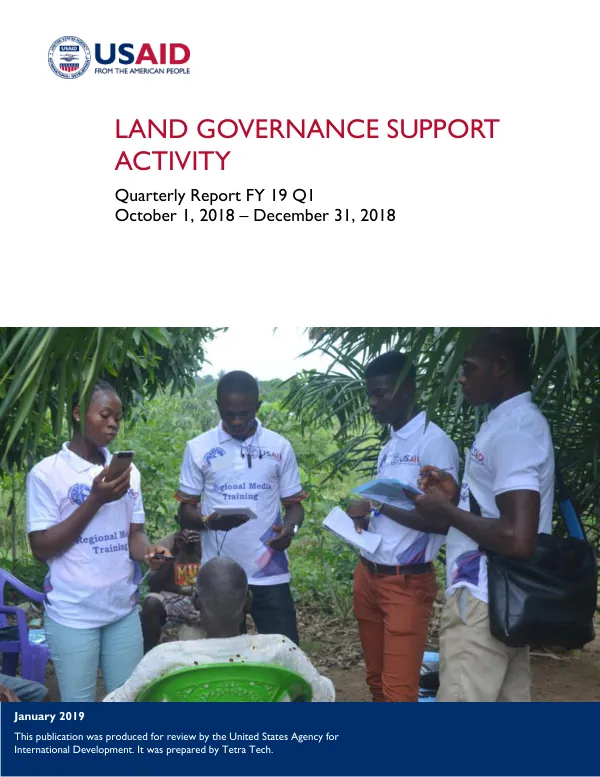
Land Governance Support Activity Quarterly Report FY17, Q3
The Liberia Land Governance Support Activity (LGSA) is a project implemented by Tetra Tech under the Strengthening Tenure and Resource Rights (StARR) Indefinite Delivery/Indefinite Quantity Contract.
2017 · 43 pages
Sign in to readA free account is required to download.
Abstract
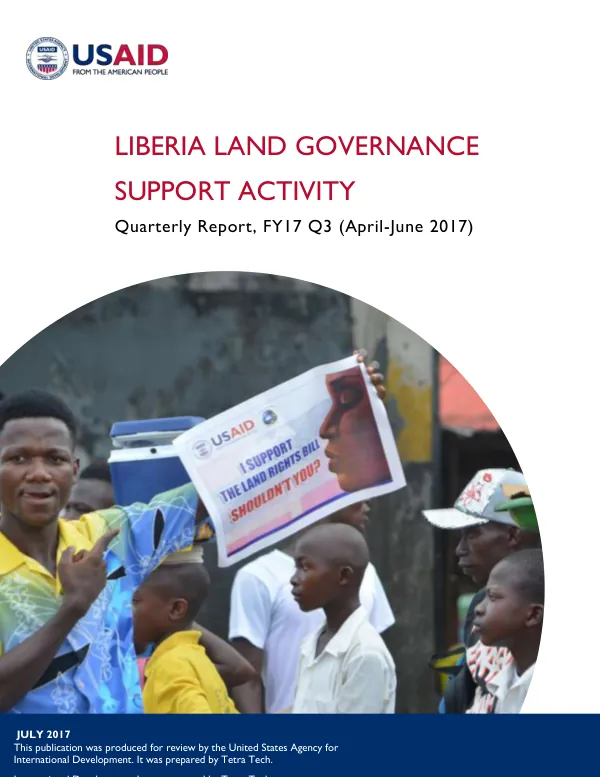
The project aims to establish more effective land governance systems, ready to implement comprehensive reforms to ensure equitable access to land and security of tenure, facilitate inclusive sustained growth and development, ensure peace and security, and provide sustainable management of the environment. The Year 2 project work plan continues to support USAID's engagement in the sector. The Liberia Land Authority (LLA) passed the Legislature and was signed into law by the President in October 2016. In the last quarter, a third commissioner was appointed and confirmed on the LLA, allowing the LLA to advance its implementation. LGSA provided technical support to the LLA in developing a logo, structure, and staffing plan, as well as a five-year work plan and budget, legal and regulatory reform, and a conceptual design for a Regional Land Governance Office (RLGO). Support for the passage of the Land Rights Act (LRA) continued this quarter, with LGSA providing editorial support for language in the LRA and facilitating a public hearing on May 22, 2017. The LRA has been published in the newspaper, and more consultations are planned for Quarter 4. LGSA partners, including SDI and Parley, and the Government of Liberia (GOL), continue to work on improving procedures for customary land rights and public outreach based on existing processes and research findings. The project has made significant progress in implementing its work plan, with key activities including the operationalization of the LLA, transition committee establishment, and decentralization of the LLA. The project has also conducted action research and developed a methodology for implementing the Land Rights Law. Additionally, the project has strengthened civil society, private sector, and citizen engagement in land governance, including public information campaigns, gender-responsive activities, and grants management, as well as the establishment of public-private partnerships. The project has also made progress in monitoring, evaluation, and learning, including contingency planning for potential challenges such as the Land Rights Act not being passed before the election and customary land recognition being more time and resource intensive than anticipated. The project has also identified success stories, including the establishment of the Liberia Land Authority and the development of a logo, structure, and staffing plan. The project has a collaborative team, including Tetra Tech, Landesa, Namati, CDP Associates, Sustainable Development Institute (SDI), and Parley, providing technical and organizational support to the GOL, civil society, and communities in the land rights reform process. The project is funded by USAID/Liberia and has a total budget of $10 million.