MICHIGAN STATE UNIVERSITY FOUNDATION
Land Policy and Food Prices: Evidence from a Land Consolidation Program in Rwanda
The Crop Intensification Program (CIP) in Rwanda began in 2007 with the goal of improving agricultural productivity and food security.
2021 · 11 pages
Sign in to readA free account is required to download.
Abstract
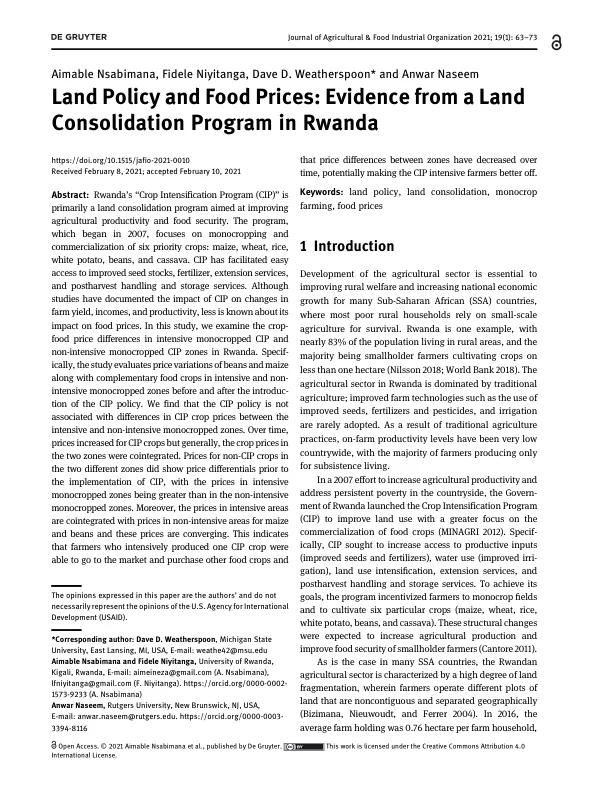
The program focused on the commercialization of six priority crops: maize, wheat, rice, white potato, beans, and cassava. CIP provided farmers with access to improved seed stocks, fertilizer, extension services, and postharvest handling and storage services. The program incentivized farmers to monocrop fields and cultivate the six priority crops, with the expectation of increasing agricultural production and improving food security. Land fragmentation is a significant obstacle to agricultural development in Rwanda, with farmers operating multiple noncontiguous plots of land. To counter this issue, land use consolidation was introduced in 2008 under CIP, allowing farmers in the same farming areas to cultivate one selected crop while retaining ownership of their original smallholder lands. As a result of the CIP policy, the cultivation of CIP crops increased significantly, with the cultivated area under the CIP policy reaching 254,000 hectares over the first three years. The productivity of priority crops increased considerably after the introduction of the CIP and land use consolidation. Wheat and maize production increased six-fold, cassava and white potato production tripled, and rice and beans production increased by 30%. The impact of CIP policy on the welfare of smallholder farmers has become an important topic of discussion and research. Previous studies have primarily focused on the impact of CIP on farm production and consumption, while little is known about the impact CIP has had on farmers from the market perspective. This study investigates the crop-food price differences in intensive and non-intensive monocropping zones in Rwanda. Specifically, the study evaluates price variations of the most commonly produced and consumed food staples – beans and maize – in intensive and non-intensive CIP zones. The findings of the study contribute to the literature by revealing the role land use consolidation policy plays in addressing food price volatility. The study also sheds light on the success of land use consolidation in enhancing small-scale farmers' welfare. The agricultural sector in Rwanda is dominated by traditional agriculture, with improved farm technologies such as the use of improved seeds, fertilizers, and pesticides rarely adopted. As a result, on-farm productivity levels have been very low countrywide, with the majority of farmers producing only for subsistence living. The Rwandan agricultural sector is characterized by a high degree of land fragmentation, with farmers operating different plots of land that are noncontiguous and separated geographically. In 2016, the average farm holding was 0.76 hectare per farm household, typically divided over four to five plots located in different areas. The CIP policy has created complementary crop-food price variations by CIP zones, with farming under the CIP improving household welfare and reducing poverty. The study finds that the CIP policy is not associated with differences in CIP crop prices between intensive and non-intensive monocropped zones. Over time, prices increased for CIP crops, but generally, the crop prices in the two zones were cointegrated. Prices for non-CIP crops in the two different zones did show price differentials prior to the implementation of CIP, with the prices in intensive monocropped zones being greater than in the non-intensive monocropped zones.
Related documents