USAID DEC
The relationship between inequitable gender norms and provider attitudes and quality of care in maternal health services in Rwanda: a mixed methods study
Sign inWHO
The relationship between inequitable gender norms and provider attitudes and quality of care in maternal health services in Rwanda: a mixed methods study
Rwanda has made significant progress in improving reproductive, maternal, and newborn health (RMNH) care by investing in health workforce development, scaling up service provision, and increasing the demand for, accessibility, and quality of health services.
2021 · 15 pages
Sign in to readA free account is required to download.
Abstract
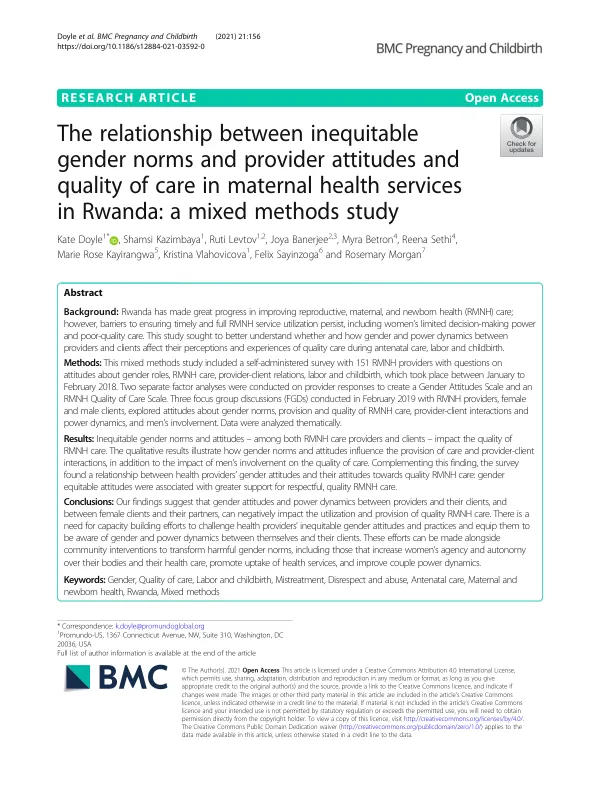
The maternal mortality ratio was more than halved between 2010 and 2015, falling from 476 per 100,000 live births to 210. By 2015, nearly all women attended at least one antenatal care (ANC) visit (99.0%) and gave birth in a health facility (90.7%). Despite these advances, challenges to ensuring timely and full RMNH service utilization remain. The 2014/15 Demographic and Health Survey (DHS) indicated that only 44% of women attended the recommended four ANC visits, and only 56% of women sought ANC before their fourth month of pregnancy. Women in the lowest socio-economic level and with the least amount of education were the least likely to deliver in a health facility. In addition, 55% of women reported that they did not have a postnatal check-up. The DHS noted that barriers to women's care seeking or to timely care were varied and multiple, but included cost, the distance to the health facility, and women's limited decision-making power. Recent research in Rwanda has found that women's dissatisfaction with and experiences of low-quality care during pregnancy were disincentives for attending the recommended number of ANC visits and were catalysts for seeking care at another health facility. The World Health Organization defines quality of care as the extent to which health care services provided to individuals and patient populations improve desired health outcomes. Quality of care includes ensuring individuals receive the same quality of care regardless of gender and that care takes into account individual preferences. Recent research has highlighted the important role that quality, respectful RMNH care has for women's care-seeking and positive birth experiences and outcomes. Studies in multiple settings have found that a lack of privacy, uncaring provider attitudes, physical abuse, and delays in receiving care led to dissatisfaction with the care women received, and were deterrents from giving birth in a health facility or seeking facility-based care for complications. Research has shown that health providers' attitudes about gender roles may influence their interactions with female and male clients at RMNH services, and ultimately impact the quality of care female clients receive. Studies examining the impact of men's participation at ANC or family planning services have found that men's presence may sometimes negatively impact providers' interactions with female clients. Health providers' beliefs about appropriate roles and behavior and prejudices towards certain client attributes, such as their socio-economic status, age, or education level, have also been found to influence the quality of care. This study sought to better understand whether and how gender and power dynamics between providers and clients affect their perceptions and experiences of quality care during antenatal care, labor, and childbirth. A mixed-methods study was conducted, including a self-administered survey with 151 RMNH providers and three focus group discussions with RMNH providers, female and male clients. The study found that inequitable gender norms and attitudes among both RMNH care providers and clients impact the quality of RMNH care. The qualitative results illustrate how gender norms and attitudes influence the provision of care and provider-client interactions, in addition to the impact of men's involvement on the quality of care. The survey found a relationship between health providers' gender attitudes and their attitudes towards quality RMNH care: gender-equitable attitudes were associated with greater support for respectful, quality RMNH care. The study's findings suggest that gender attitudes and power dynamics between providers and their clients, and between female clients and their partners, can negatively impact the utilization and provision of quality RMNH care. There is a need for capacity building efforts to challenge health providers' inequitable gender attitudes and practices and equip them to be aware of gender and power dynamics between themselves and their clients. These efforts can be made alongside community interventions to transform harmful gender norms, including those that increase women's agency and autonomy over their bodies and their healthcare, promote uptake of health services, and improve couple power dynamics.
Related documents