FHI 360
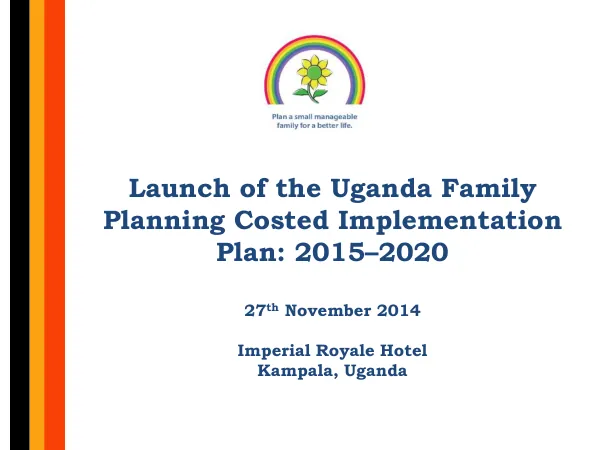
Launch of the Uganda Family Planning Costed Implementation Plan: 2015–2020
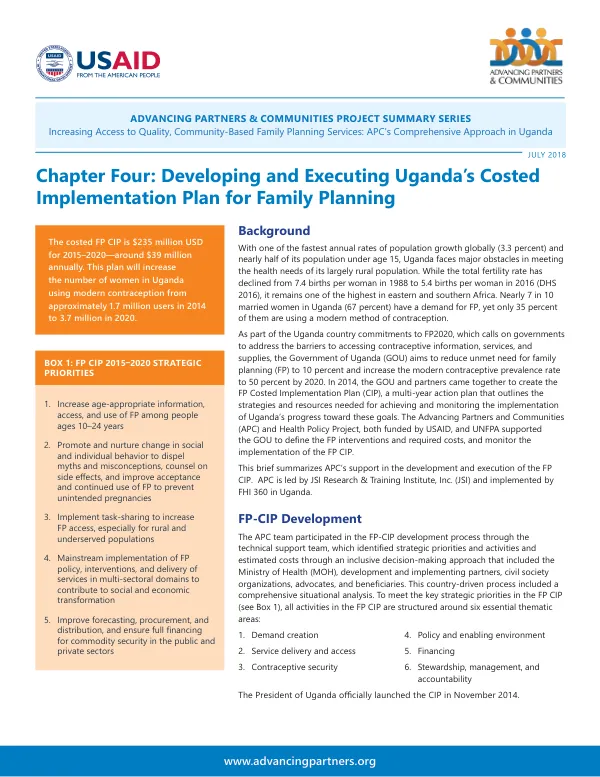
The Uganda Family Planning Costed Implementation Plan (FP-CIP) aims to reduce unmet need for family planning to 10% and increase modern contraceptive prevalence rate (mCPR) amongst married and women in union to 50% by 2020.
2014 · 37 pages
Sign in to readA free account is required to download.
Abstract
The plan is a multisectoral initiative, supported by the Ministry of Health (MoH) and various partners, including the United Nations Population Fund (UNFPA) and Futures Group/FHI 360. The FP-CIP development process involved a comprehensive situation analysis, stakeholder consultations, and prioritization and validation meetings. Key informants were engaged to provide insights, and cost estimates and impact estimates were generated. The plan was validated and launched on November 27, 2014, at the Imperial Royale Hotel in Kampala, Uganda. The launch was attended by high-ranking government officials, including the President of Uganda, who emphasized the importance of family planning for the health and welfare of families and the country as a whole. The FP-CIP has seven sections, including an introduction, goals, background, rationale, and implementation roadmap. The plan is designed to serve as a planning and management tool, a performance monitoring plan, a resource mobilization tool, and an advocacy tool. The global context for the FP-CIP includes commitments made at the FP2020 and London summit, while the regional context is characterized by efforts to improve family planning services in neighboring countries. The Uganda context is shaped by the country's Vision 2040, National Development Plan 2 (NDP2), and other national frameworks. The FP-CIP is grounded in the understanding that family planning services are one of the most cost-effective interventions to prevent maternal, infant, and child deaths. Uganda has a high total fertility rate, high unmet need for family planning, and high maternal mortality rate, which the FP-CIP aims to address. By lowering fertility and child mortality rates, Uganda will be better positioned to harness the demographic dividend for economic growth, as desired in the Vision 2040. The implementation roadmap for the FP-CIP includes a range of activities, including the development of a comprehensive family planning program, the strengthening of health systems, and the mobilization of resources to support family planning services. The plan also emphasizes the importance of advocacy and communication to promote family planning and address social and cultural barriers to access. Overall, the FP-CIP is a critical initiative that aims to improve family planning services in Uganda and contribute to the country's development goals.