USAID DEC
Chapter Four: Developing and Executing Uganda’s Costed Implementation Plan for Family Planning (July 2018)
Sign inFHI 360
Chapter Four: Developing and Executing Uganda’s Costed Implementation Plan for Family Planning (July 2018)
The Government of Uganda aims to reduce unmet need for family planning (FP) to 10 percent and increase the modern contraceptive prevalence rate to 50 percent by 2020.
2018 · 4 pages
Sign in to readA free account is required to download.
Abstract
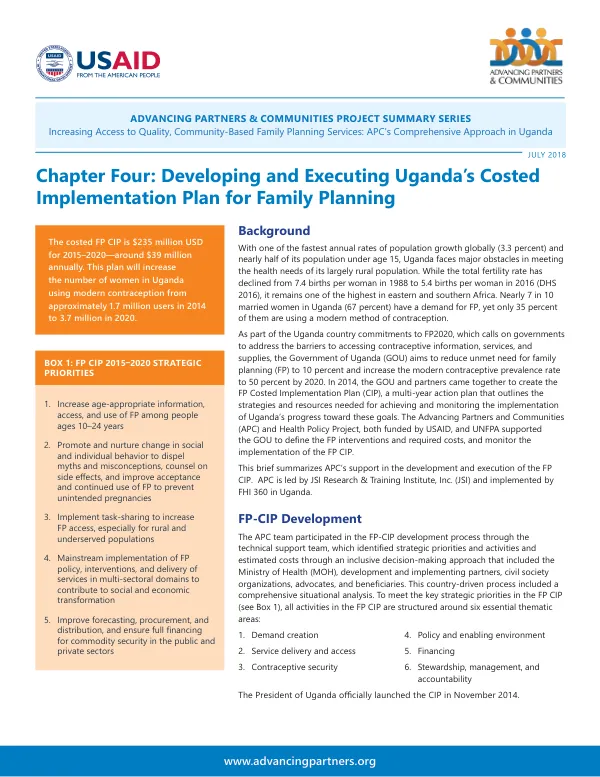
As part of the Uganda country commitments to FP2020, the Government of Uganda (GOU) has developed the FP Costed Implementation Plan (CIP), a multi-year action plan that outlines the strategies and resources needed for achieving and monitoring the implementation of Uganda's progress toward these goals. The FP-CIP development process involved an inclusive decision-making approach that included the Ministry of Health (MOH), development and implementing partners, civil society organizations, advocates, and beneficiaries. The plan is structured around six essential thematic areas: demand creation, service delivery and access, contraceptive security, policy and enabling environment, financing, and stewardship, management, and accountability. The President of Uganda officially launched the CIP in November 2014. The costed FP CIP is $235 million USD for 2015-2020, with an annual budget of $39 million. The plan aims to increase the number of women in Uganda using modern contraception from approximately 1.7 million users in 2014 to 3.7 million in 2020. The APC team, led by JSI Research & Training Institute, Inc. (JSI) and implemented by FHI 360 in Uganda, provided technical and operational support to the GOU in developing and executing the FP CIP. APC's support covered two key areas: district FP-CIP action planning and performance monitoring plan (PMP) development and implementation. The team worked with 10 districts to create FP-CIP action plans that specify how the districts will respond to national FP-CIP priorities and thematic areas. APC facilitated regional workshops that enabled multiple districts to discuss experiences and potential activities. The PMP ensures that the districts and GOU are actively monitoring FP-CIP execution activities and course-correcting as needed. The aims of the PMP are to track results and resource flows, engage stakeholders, support informed decision-making, encourage accountability, facilitate work plan adaptations, and measure output-level results against performance targets. APC helped the MOH host national stakeholder meetings in 2016 and 2017 to monitor FP-CIP performance using the PMP as a guide. Discussions focused on the FP-CIP progress reports, latest results on population-level indicators, sharing insights from budget tracking and advocacy, introducing new tools or resources, and sharing achievements and lessons learned. In partnership with the GOU, APC created a web-based performance monitoring database to actively monitor PMP implementation. The database can track resource expenditures, plan performance, and monitor financial commitments made by implementing partners and funders. Stakeholders submit results of their contributions to projects on a quarterly basis and annual costed work plans at the beginning of each fiscal year. The development and launch of the FP CIP in Uganda was considered successful in many ways, but further support to the MOH is needed to fully operationalize and realize the CIP goals. APC will continue to support national FP-CIP coordination and bi-annual review meetings. Resource mobilization for the FP CIP will form a core agenda of these reviews. APC has transferred the FP-CIP database, along with data analysis and reporting, to the MOH in collaboration with the USAID Strategic Information Technical Assistance project, but will continue to support and monitor its use.