USAID DEC
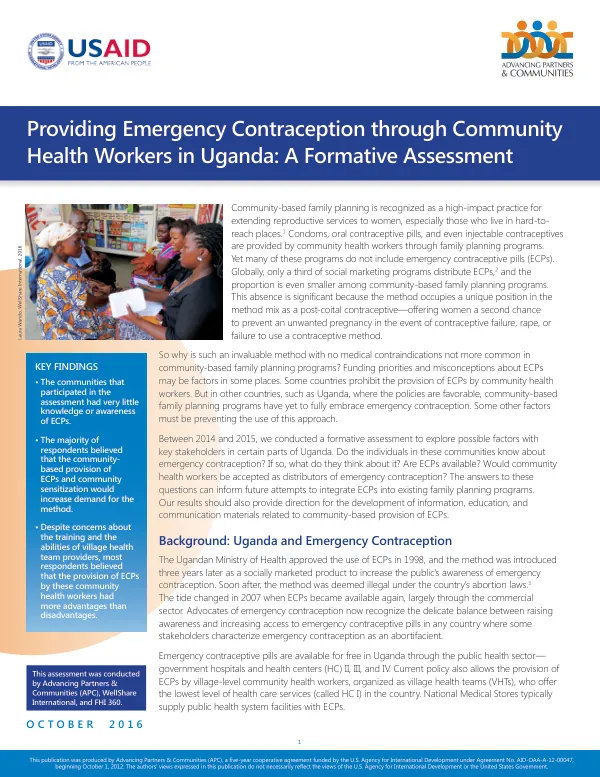
Providing Emergency Contraception through Community Health Workers in Uganda: A Formative Assessment
Sign inFHI 360
Providing Emergency Contraception through Community Health Workers in Uganda: A Formative Assessment
The Ugandan Ministry of Health approved the use of emergency contraceptive pills (ECPs) in 1998, and the method was introduced three years later as a socially marketed product to increase public awareness of emergency contraception.
2016 · 4 pages
Sign in to readA free account is required to download.
Abstract
However, the method was deemed illegal under the country's abortion laws soon after its introduction. The tide changed in 2007 when ECPs became available again, largely through the commercial sector. Advocates of emergency contraception now recognize the delicate balance between raising awareness and increasing access to emergency contraceptive pills in any country where some stakeholders characterize emergency contraception as an abortifacient. Emergency contraceptive pills are available for free in Uganda through the public health sector, including government hospitals and health centers (HC) II, III, and IV. Current policy also allows the provision of ECPs by village-level community health workers, organized as village health teams (VHTs), who offer the lowest level of health care services (called HC I) in the country. National Medical Stores typically supply public health system facilities with ECPs. Despite these policies, the provision of ECPs by VHTs has been limited, with only a small percentage of VHT providers currently providing the method. A formative assessment was conducted in 2014-2015 to explore possible factors with key stakeholders in certain parts of Uganda. The assessment aimed to determine whether individuals in these communities knew about emergency contraception, what they thought about it, and whether ECPs were available. The assessment also aimed to determine whether community health workers would be accepted as distributors of emergency contraception. The results of the assessment should inform future attempts to integrate ECPs into existing family planning programs and provide direction for the development of information, education, and communication materials related to community-based provision of ECPs. The assessment was conducted in four districts in Uganda, including Arua, Iganga, Kanungu, and Mubende. These districts were selected for convenience based on past and present programs in these areas by WellShare and FHI 360. The districts provided a geographically and socially diverse sample of Uganda. The assessment used quantitative and qualitative methods to collect data, including interviews with VHT providers, family planning clients, and key informants at the national and district levels. The assessment also held 16 focus group discussions with men and women from communities in the assessment area. The focus group discussions revealed very low levels of awareness of ECPs in the assessment communities. Once the communities were informed of this post-coital contraceptive method, opinions varied on whether it was an abortifacient, whether it would be accepted by men and religious leaders, and whether it would be a good method for VHTs to provide to community members. Although many women in the focus groups felt that men would not allow it, most FGD participants agreed that the demand for ECPs would increase if VHTs were allowed to provide the method. Key informants and VHT providers believed that provision by VHTs would increase demand for and awareness of the method. More than 85 percent of VHT providers said they felt comfortable with the task of providing ECPs to community members and that, in turn, most community members would accept VHT provision of ECPs.
Related documents